River fading before our eyes, say campaigners

 Owen Sennitt/BBC
Campaigners who say they have witnessed a protected river suffer decades of decline fear for its future as a summer drought takes hold.
Members of the Wensum Riverkin, a group campaigning to conserve Norfolk's River Wensum, say it is under increasing pressure from very low flows and pollution.
The waterway is one of only about 250 chalk rivers in the world - unique ecosystems often described as the UK's equivalent of the Amazon rainforest.
Meeting with the group along the upper reaches between Lenwade and Lyng, they highlighted how the river was struggling after one of the driest periods in 150 years.
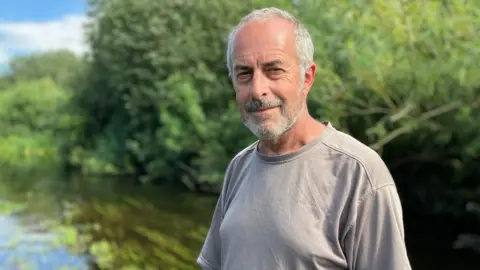
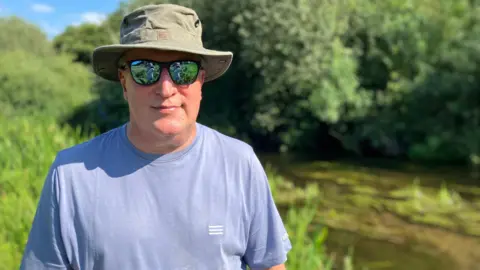
Tim Ellis, who has spent more than 40 years visiting its banks, said: "We think it's really sad that the river we've cherished for many years is just fading in front of our eyes really, it's a lovely river."
Hundreds of dead fish were found washed up along its riverbanks in Norwich on Saturday, which the Environment Agency put down partly to the heatwave.
A spokesperson explained that high temperatures created the conditions that "significantly" reduced dissolved oxygen levels in the water.
They also said heavy rainfall on Thursday had likely flushed in contamination from surface water drainage systems.
 Owen Sennitt/BBC
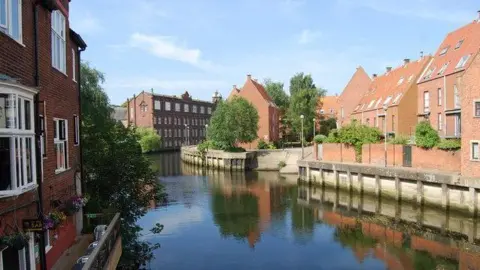
The River Wensum rises between the villages of Colkirk and Whissonsett and flows about 46 miles (75km) to Norwich.
It is designated both a Site of Special Scientific Interest and a Special Area of Conservation, but campaigners say efforts to improve its health have so far failed to reverse its decline.
 Owen Sennitt/BBC
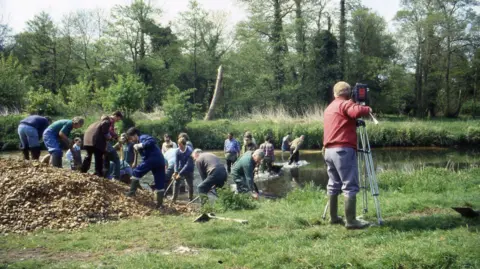
Chris Turnbull, a seasoned angler who moved to Norfolk in the 1980s for the fishing, said: "At that time, it was one of the finest fishing rivers in the country.
"Since then, it has declined pretty much in every way you could imagine.
"The Wensum used to be known for its roach. Back in the 60s, there was a match angler, Ivan Marks, who was once recorded as saying that if you run out of bait, it didn't matter because you could chop up your hat and use that as bait and catch just as many fish.
"That just sounds like an impossible story nowadays, because you could fish the River Wensum for days and days and days and not catch roach."
More from Norfolk:
 Chris Turnbull
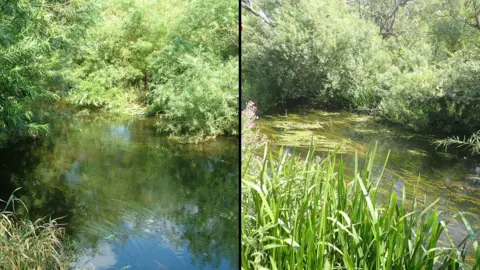
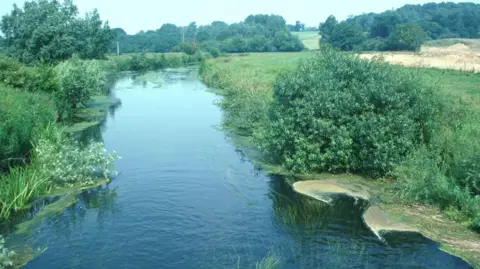
The stretch of river visited is known as a riffle, a shallow section where fish spawn in gravel on the river bed.
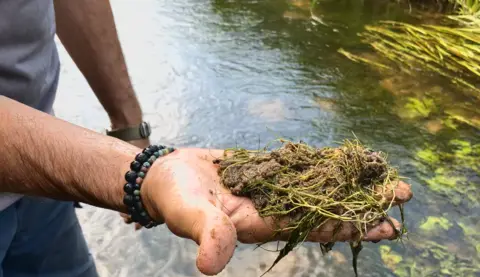
Ellis said it was becoming choked with silt and sediment washed into the water from farms and roads.
It is also suffering from an overgrowth of bur reed, which he said indicated elevated nitrate and phosphate levels linked to pollution.
"It's basically down to human activity one way or another," said the 64-year-old.
 Owen Sennitt/BBC
Drier, hotter summers are adding to the pressure.
During a recent heatwave, campaigner Jeremy Hadaway recorded the river's temperature at nearly 25C.
Chalk rivers would normally be about 10C.
"The higher temperatures obviously reduce the water levels more and more.
"It concentrates all the nutrients and makes the river condition even worse."
 Chris Turnbull
Temperatures have continued to soar this week and the region has been declared in drought.
The Environment Agency has also received reports of fish deaths on the River Yare at Cantley and has attempted to aerate sections of the River Bure near Aylsham and Great Massingham after reports of fish in distress.
Blue-green algal blooms have also been reported in parts of the region, raising concerns they could further reduce oxygen levels in rivers.
A spokesperson said East Anglia had experienced some of the driest five-month periods in 150 years, meaning "surface water river flows and levels are lower than normal for this time of year".
"Heatwaves and hot weather cause additional stress on water availability and the environment."
 N Chadwick/Geograph
As dry conditions persist, over-abstraction from groundwater sources and rivers is becoming an increasing concern.
The Environment Agency is enforcing licence conditions on 250 abstraction licence holders across the region.
A hosepipe ban has been in force for Anglian Water customers since mid-July, while Essex and Suffolk Water has also introduced restrictions.
A spokesperson for Anglian Water said it was "committed to reducing our abstraction levels to protect the environment – especially precious chalk streams such as the River Wensum – for several years".
The company does not abstract water from the upper reaches of the Wensum, but does so further downstream near Norwich, where flows are stronger and the river is considered less vulnerable.
An Environment Agency spokesperson added it was working with partners to restore chalk stream habitats and tackle pollution and sediment run-off.
Do you have a story suggestion for Norfolk? Contact us below.
Follow Norfolk news on BBC Sounds, Facebook, Instagram and X.