William champions regenerative farming during visit

 PA Media
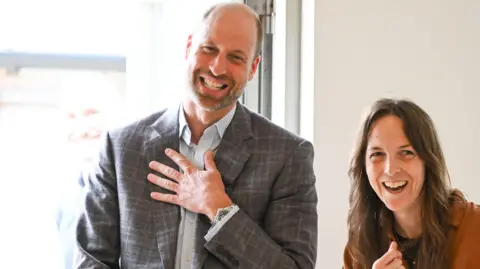
Regenerative farming and nature's role in supporting wellbeing were the themes of a visit the Prince of Wales made in the South West.
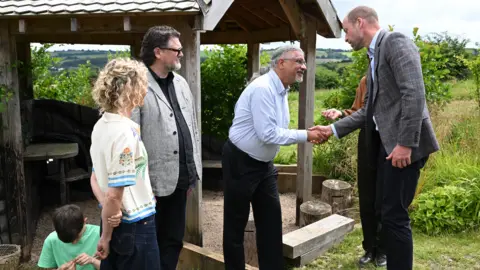
Prince William was at the Apricot Centre in Dartington, Devon, which uses organic and regenerative farming methods including agroforestry, permaculture and rotational grazing.
Since becoming Duke of Cornwall, the prince has set a goal of getting the Duchy of Cornwall estate to net zero by the end of 2032.
The centre was founded in 2015, building upon a disused dairy farm, with managing director Rachel Phillips saying it was now a "bish, bash, bosh farm" which the prince was "really interested" in.
Phillips said: "[He was] really interested in talking to the farmers about the systems that they put in place to ensure that we can grow nutritious food that is also good for nature, that isn't using sort of chemicals or anything on it as well, but also how we make that balance with finance as well and in terms of being farmers.
"He's also really interested in our new entrance schemes that we run for farmers that are wanting to train up in regenerative agricultural practises and also those that are in transition because we have 300 students that come through every year."
The Apricot Centre said it had achieved an annual turnover of £1.3m while also becoming carbon neutral and increasing biodiversity across the site by 400%.
Phillips said Prince William was "really generous and honest" with his feedback and he "really understood the things that we were talking about".
She said: "[He] really understood the issues that we were facing but also really celebrated the work that we were doing as well.
"I was really sort of surprised at how knowledgeable he was around those systems but also really understanding of the impact that could have if we could create more farms at a nature friendly farming and work in regenerative practises."
 PA Media
The Apricot Centre also supports farmers and land-based businesses with nature-based wellbeing therapies and training courses.
The centre said it supported the mental, emotional and social wellbeing of children, young people, families and farming communities.
Amir Qureshy, director of quality assurance at the centre, said nature was the best environment to support people in.
He said: "Most children, young people, families - they're used to clinical environments, it can be quite intimidating.
"This nature and environment, the connection with nature, we know from research that in terms of anxiety levels, cortisol levels - all of that comes down."
Qureshy added the prince "lived up to his reputation".
"He seemed natural in the environment and so from our perspective you know it's a wonderful connection to make, particularly in terms of his particular special interests," Qureshy said.
 PA Media
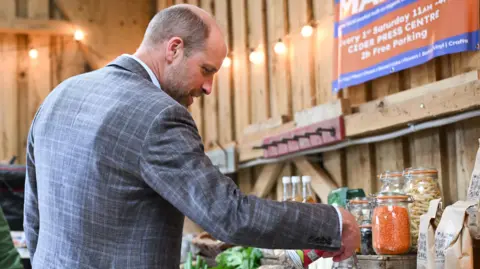
Wellbeing service manager Maxine Stevens said Prince William showed a particular interest the centre's work with farmers stepping down from a larger generation of farmers.
Stevens added farming could be quite isolating and its programmes were important to supporting those in the industry.
She said: "We're wanting to support our local community and all the people in this rural area and provide them with wellbeing because we know that suicide rates are really high in farming.
"There's huge isolation in farming and you think about all the families as well that impact so we are offering support to a wider network of farmers as well."
Follow BBC Devon on X, Facebook and Instagram. Send your story ideas to spotlight@bbc.co.uk.