Under-fire bus stop will not be moved, says report

 BBC
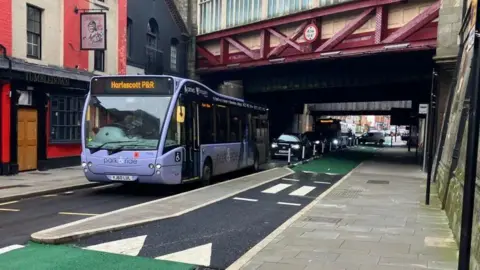
BBCA town's floating bus stop, which came under fire over safety concerns, will not be relocated, a report has said.
The stop was installed on Castle Foregate, Shrewsbury, in October as part of Shropshire Council's £3.8m gyratory project to create a new road system around the railway station.
But it has since been the subject of complaints after the BBC found the buffer zone between the main road and cycle lane did not meet government guidance as it was too narrow.
The council, which previously said it was "let down" by the contractor, confirmed it would be discussing the bus stop at a meeting later this week.
A report said while the stop could not be moved because it was "not viable", it added the current one could be modified to address concerns.
It said the authority was analysing the costs of changes as part of an action plan, which would be discussed when the economy and environment overview and scrutiny committee met on Thursday.
"Fundamental changes to the operation of the traffic lanes in front of the railway station may result in abortive costs for the design and construction to date," the report added.
"This would present a revenue burden to the council and work is under way to identify the extent of these costs."
'Lives at risk'
The BBC measured the buffer area between the road and cycle land at about 1.1m (3.6ft) wide in November.
Government guidance suggests it should be between 1.5m (4.9ft) and 2m (6.5ft), meaning it is nearly 40cm (15.7in) short of the minimum width.
Bus operator Arriva previously halted services at the stop after it carried out a safety review and said the safety of its passengers was a priority.
Disability campaigners and wheelchair users also criticised the project, claiming the island was dangerously small and not fit-for-purpose.
The chairman of Shropshire and Wrekin Fire Authority previously said lives and safety were at risk, because of the traffic issues caused by the gyratory.
It came after fire engines were forced to use the new cycle lane to avoid traffic jams in the area, a method which has since been approved by the council.
This news was gathered by the Local Democracy Reporting Service which covers councils and other public service organisations.
Follow BBC Shropshire on BBC Sounds, Facebook, X and Instagram.