'Separate in name and power': How America reinvented English

 BBC/ Emmanuel Lafont
From "deadline" to "lituation", from "prairie" to "amirite", America's linguistic independence has transformed the English language with a wealth of new words and phrases – shaping its own cultural identity in the process.
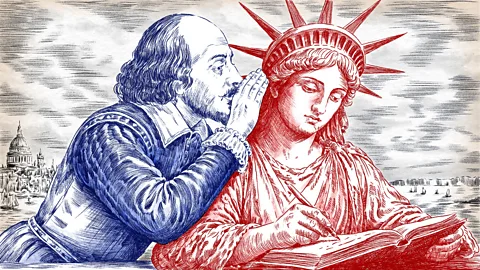
Did the founding of the United States of America demand a new way of speaking? President Thomas Jefferson certainly thought so. In August 1813, he wrote an impassioned letter to his friend John Waldo about the blossoming of new terms in fertile terrain of the 37-year-old United States of America.
"So great growing a population, spread over such an extent of country, with such a variety of climates, of productions, of arts, must enlarge their language, to make it answer its purpose of expressing all ideas, the new as well as the old," he claimed. "The new circumstances under which we are placed, call for new words, new phrases, and for the transfer of old words to new objects."
Let British English remain "stationary", Jefferson argued, while American English gained strength: "Its new character may separate it in name as well as in power, from the mother-tongue."
By this point, the British had long complained about American phrases "contaminating" the purity of the English language – even before Independence. In 1756, the writer Samuel Johnson defined the "American dialect" to mean "a tract [trace] of corruption to which every language widely diffused must always be exposed."
In the 21st Century, the UK and the US remain two countries divided by our common tongue – and on the 250th anniversary of American Independence, there is no better time to examine how American and British English evolved to sound so distinct. From the rise of "soccer" in place of "football" and "fall" in place of "autumn" to the spread of "cooties", the words spoken on either side of the Atlantic have been the product of social undercurrents alternately pushing the two countries apart and pulling them together again – forces that continue to shape our speech today.
The New World Order
The immediate process of colonisation would have quickly placed the settlers' language apart from the people they left behind. With a mix of populations from across the British Isles and Europe, most regional differences between individuals' initial accents and vocabulary would have been "levelled off", says Jack Grieve, a (Canadian) linguist from the University of Birmingham in the UK.
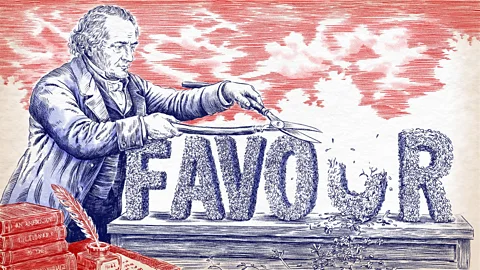
When those groups then spread out across the continent, each area would have started to develop their own ways of speaking, resulting in the distinct accents we hear across the continent today. And this natural drift was accompanied by concerted efforts to establish a new voice that was distinct from the King's English. The ringleader was the lexicographer Noah Webster. "A national language is a band of national union. Every engine should be employed to render the people of this country national," he wrote 1789. "As an independent nation, our honor [sic] requires us to have a system of our own, in language as well as government..." It was, he said, essential for their "political harmony".
The Webster Blue Back Speller
Learn more about the history of the Webster Blue Back Speller, and how a single object became a gateway to literacy and self-determination, on A History of the US in 100 Objects.
To do so, he established a series of grammars, spellers and dictionaries. Webster is responsible for omission of the u's in words such as hono[u]r and favo[u]r, the single l in words like "traveled", the conversion of "draught" to "draft", and the reversal of the r and the e in centre ("center").
"It was a long hard struggle for those spellings to change, but they eventually did bed down," says American-British linguist Lynne Murphy at the University of Sussex, UK.
'Tung' and 'lether'?
Not all Webster's suggestions would stand the test of time: he advocated for spelling tongue as "tung", and "leather" as lether, for instance – suggestions that were quickly abandoned by his successors.
Even so, the sales of his American Spelling Book eventually reached an estimated 100 million copies over the following century, comparable only to the bible.
 BBC/ Emmanuel Lafont
The new dictionaries included vast swathes of vocabulary that would have been unfamiliar to readers in London or Birmingham. Some were taken directly from the indigenous populations to describe the flora and fauna of the world around them. As Murphy notes in her book The Prodigal Tongue, "skunk", "raccoon", "chipmunk", "moose", "opossum", and "caribou" all come from Algonquian languages.
American English would also come to absorb words from the languages of other colonists, including "prairie", which means marshy meadows in French, and "cookie", a variation of the Dutch word for small cake.
Over time, some American coinages started to plant themselves in British soils. The US Civil War gave us the word "deadline", for instance, which originally meant, "a line that couldn't be crossed without the risk of being shot." (Don't tell my editor!)
Surprising Britishisms
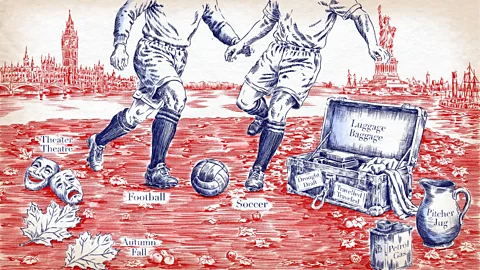
Often the early Americans simply settled on old Britishisms that had started to fall out of fashion in the old country. We may think that saying "fall" to mean "autumn" is a typically American feature, but it had been used this way in Britain since the 1500s. We can even see it in the poetry of the English poet John Dryden: "What crowds of patients the town doctor kills, Or how last fall he raised the weekly bills."
Murphy suspects that the term took off in the US due to the stunning displays of foliage in New England. "Autumn in Britain is relatively drab," she writes in The Prodigal Tongue. "The early English colonists lived in parts of America where leaf-falling is truly spectacular, with red and sugar maples, red oaks, and sassafras exploding into fiery oranges and reds."
Other British terms that would take on a distinctively American flavour include "bills" for banknotes, "soccer" for football, "mad" for angry, "cooties" for the lurgy, "smart" for clever, "pet" to mean stroke, and "sick" to describe a general state of illness rather than a stomach upset.
Sometimes, it's simply the connotations of the words, and their social value, that have changed. Using the accepted term in the UK can make you sound like a "hick" in the US, Murphy points out. "Saying jug instead of pitcher, for example."
Americans also revived some archaic grammatical structures, such as "gotten". (In Britain, the past participle of "get" is "got".)
The early speakers never lost touch with the Old World, of course. "Early British colonists in America tended to send their children home back to England for schooling," says Grieve – a fashion (for the wealthy, at least) that continued into the 19th Century. That's not to mention economic trade, and cultural ties in the books being read.
 BBC/ Emmanuel Lafont
The "special relationship", as it would come to be known, between the UK and US may have slowed the divergence of the two tongues, Murphy says.
"If the split in the language had happened 500 years before, then maybe we would be speaking different languages," says Murphy. "But we've got so much contact. Just the fact that the printing press existed when the split happened meant that people were always in touch with the English back in Britain."
The 'un-American dude'
The tensions between the lingering British influence, and the desire to establish a new national language, was evident in public discourse and satire. Ingrid Paulsen, a researcher at the University of Kiel in Germany, recently examined a huge corpus of 78 million newspaper articles spanning the 19th Century, for references to classic examples of Americanisation – such as the transition from "trousers" to "pants" and from "luggage" to "baggage". Her aim was to understand how such linguistic changes became imbued with American values and identity – a sociolinguistic process known as "enregisterment".
She found that jokes around the changing language often featured cartoons of the "dude" figure, for instance. The "dude" was an American-born man who failed to embrace his American identity, and instead, aspired to adopt British fashions and language. "He is this very unsuccessful Anglo-maniac who is not [acting like an] American at all," says Paulsen.
Those discussions often centred on his lower garments, and what he called them. "There's a lot about what trousers he wears, how tight his trousers can be, that he has to turn up the trousers so that they don't get wet," Paulsen says. "So trousers, as a term, becomes linked to the dude." The perceived elegance of the word has become an object of ridicule, whereas "pants" comes to be seen as the truly American term.
British humourists have often enjoyed making fun of the British/American linguistic dance. "We really have everything in common with America nowadays, except, of course, language," Oscar Wilde quipped in 1887.
A moveable feast
Evolution never stops – and online resources have made it far easier to study contemporary language change as it happens. In 2018, Grieve used huge sets of geocoded data from Twitter – collected in 2013 and 2014 – to identify which regions of the US are producing the greatest number of coinages. In order of importance, they were:
• The West Coast, which introduced such terms as "amirite" and "cosplay"
• The Deep South, which introduced "boolin" (relaxing) and "baeless" (single)
• The North East, which gave "lituation" (a very positive "lit" situation)
• Mid-Atlantic, which produced "shordy" (for someone small of stature)
• Gulf Coast, which produced "lordt" (an exclamation, like "Lord!")
He has found that the areas with the greatest linguistic innovation also have the highest density of African American populations. Given the pressures these communities face, "there may a bigger drive there to express social identity", he speculates.
We can see the same linguistic creativity in the use of the "double modal" – an unconventional grammatical structure that involves combining two modal verbs to express different shades of possibility and promise, such as "We might can go up there next Saturday" or "Once we get under way, it shouldn't oughta take us very long". Grieve's analyses of Twitter suggest the trend took off in African American communities in the Deep South, whereas previous theories argued that they were a relic of the language spoken by early Scottish and Irish settlers.
More like this:
Whether these inventive ways of speaking will spread across the whole population and onto the shores of the UK remains to be seen. Technology, after all, offers a far greater opportunity for the seeds of linguistic change to propagate and take root.
Today, Jefferson's prediction that "American" would eventually divorce its mother tongue seems extraordinarily unlikely. Instead, the proliferation of new words has only enriched the language we share. On both sides of the Atlantic, we can rejoice in both the words and phrases we hold common – and the many colourful variations that set us apart.
* David Robson is an award-winning science writer and author. His latest book, The Laws of Connection: 13 Social Strategies That Will Transform Your Life, was published by Canongate (UK) and Pegasus Books (USA & Canada) in June 2024. He is @davidarobson on Instagram and Threads and writes the 60-Second Psychology newsletter on Substack.
--
If you liked this story, sign up for The Essential List newsletter – a handpicked selection of features, videos and can't-miss news, delivered to your inbox twice a week.