Droughts are transforming the Turkish landscape with massive sinkholes

 Getty Images
The "breadbasket" of Turkey, Konya's valleys are filled with the farms needed to feed a growing nation. But the available groundwater is drying up and causing fields to collapse.
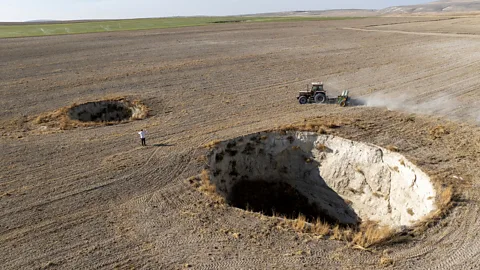
In a green field of freshly-watered ground, patrolled by four dogs with short legs and big barks, a stretch of thin razor wire twists in a circle. On the other side of the wire, the ground falls away. A chasm has opened in the middle of this field, deep enough that standing on the edge could make anyone treacherously dizzy.
Two years ago, the ground collapsed, adding one more to the large number of sinkholes in Konya, a province in central Turkey. Mehmet Akıf Işıklı gazes into this sinkhole on his neighbour's farm, a match for the one that opened up in the middle of his own field.
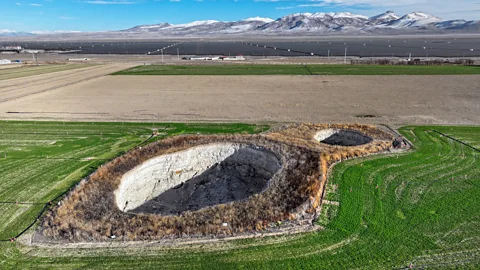
Işıklı's farm outside of Karapınar is a family business, and he's been farming since 1995. He grows alfalfa, corn, wheat and other contract crops, and he has the first company growing seed corn in Karapınar. Smack in the middle of his own field is another crater – a sinkhole that opened nearly 20 years ago and punctuates a lush field like an asteroid crater. "We were in our field when the villagers informed us [about the sinkhole]. When we arrived, the land had just begun to collapse, and there was water bubbling and boiling within it," Işıklı says.
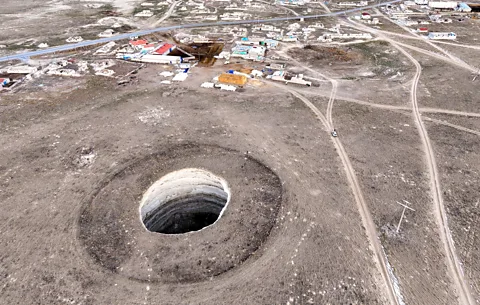
Konya is plagued by rapidly proliferating sinkholes. In central Anatolia, where the agricultural fields of corn and wheat and beets stretch out for miles and miles, the ground looks like it has been attacked by a cosmic hole punch, punctuated by a plague of craters. According to the Emergency Management Authority (AFAD), 684 of these massive abysses have opened in the Konya basin, with one of the largest stretching to 228m (752ft) in diameter and 171m (564ft) deep, marring the region often called the "breadbasket of Turkey". But they are not the result of bombs or meteors or anything from above. The problem is below the surface.
A perfect storm
Turkey has been seized by ongoing drought, with a United Nations report predicting that Turkey would become a water-poor country by 2030. This is exacerbating existing water scarcity problems throughout the country, making lakes dry up and agriculture falter. Konya's sinkhole problem is a perfect storm of geology, drought and intensive agriculture draining the groundwater.
 Getty Images
In order to compensate for the lack of water brought on by the drought, local farmers are illegally tapping into the groundwater. The natural disaster, combined with irresponsible agricultural practices that include siphoning away the groundwater for crops, has left a devastating mark on Konya, creating these new hazards that pockmark the land in all directions, and potentially harming Turkey's food security.
Konya is located in a closed basin, a rare geological quirk that means the rivers and underground water that feed it never reach the sea, instead pooling in a series of lakes. The groundwater is key to the entire water system of this agricultural region. The Konya Basin is full of salt lakes, freshwater lakes, marshlands and other biodiverse water spots, all sustained by groundwater that balances out the soft karst rock of the ground. But without the underground water, those structures quickly weaken.
"Water, underground rivers in this case, act as underground structures that hold the humidity and the stability, strength of these karstic areas," says Güven Eken, founder of Doğa Derneği, a an environmental agency based in Turkey. "The water capacity is decreasing there because of the wrong excess irrigation policies; these underground rivers have virtually dried out. So the water which once flowed underneath the Konya basin is no longer there. The whole system has dried out."
In the closed basin, farmers have relied for many years on underground wells, including a large number of illegally dug wells, to water their fields. This irresponsible siphoning of groundwater has been going on for many years. World Wildlife Fund (WWF) Türkiye did a study in 2014 in the Konya Basin on the water issues that were already plaguing the region, and found that of the 100,000 wells in the region at the time, 66,000 were illegal.
"Back in 2014, WWF Türkiye identified that there was 50% over-consumption of the water available. We call it water budget. You have water availability, and then you have the demand, then there was already an overconsumption issue, mainly because of the illegal wells," says Eren Atak, freshwater programme manager at WWF Türkiye.
The extraction of the groundwater might let the farmers water their fields for now, but without allowing time for the groundwater to replenish, they are borrowing from the future to succeed in the present – and causing the ground to collapse under their feet.
"Sinkholes right now are the final stage of the whole story. It is visible now, but it was visible way before, [just] not as sinkholes," says Atak.
An expanding problem
Sinkholes have been a feature of the Konya plain throughout history. "Sinkhole formations were formed thousands of years ago in the region. The plateau where the Kızören sinkhole is located is already known as the Obruk Plateau. "'Obruk' is a local Turkish expression for 'sinkhole'," says Fetullah Arık, head of the Geological Engineering Department at Konya Technical University. The area has experienced natural sinkholes over generations, with paleo-sinkholes from thousands of years ago formed due to the limestone caves and crevasses collapsing into themselves.
But the number of sinkholes has expanded rapidly in recent years. When the İnoba sinkhole was formed in 2008 right next to a village and the Yarımoğlu Sinkhole appeared close to the Konya-Adana highway in 2009, some began to realise the threat.
 Katie Nadwony
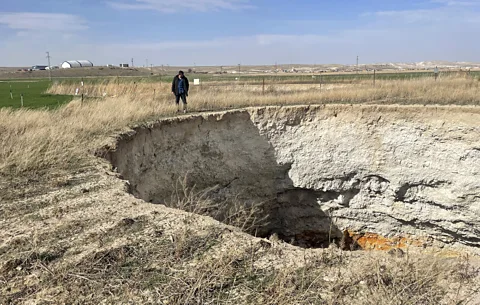
"The sinkholes are dangerous structures," says Arık. So far, they have not killed anyone, but there is always the threat that it could happen as the ground collapses, and that the way local farmers treat the sinkholes could exacerbate the problem. "Most of the time, [the farmers] try to close [the sinkhole] in panic… However, it is quite dangerous to fill it randomly without awareness. Because there is a cavity at the bottom that swallows the existing material, the collapse can be repeated and new hazards can be created," says Arık.
Back in the 1960s, Turkish authorities brought in agricultural policies for water allowances, establishing subsidies and recommending appropriate practices. However, those policies are outdated and haven't been adapted to reflect the current water issues facing Turkey and, specifically, the Konya Basin.
"Turkey requires a drastic political change immediately in these areas, which will both generate sufficient income to the agricultural community in the area and to the citizens of Konya Basin," says Eken. "It requires a very systematic agricultural basin-wide planning and implementation of it. Unfortunately, at this stage, we cannot see the signs of these.
"The symptoms are diverse, very different, but the solution is really simple: design a new agricultural strategy." (The Turkish authorities were contacted for a response, but declined to comment.)
Currently, water-thirsty crops such as sugar beets and maize, which are subsidised by the government, are grown throughout the Konya Basin. While these crops might be profitable, it is at the expense of the ecosystem where they are grown; there is not enough water to support expansive fields of water-thirsty crops in central Anatolia.
Incentivising crops that are better-suited to the climate and water budget of the Konya Basin, like grapes or native wheat varieties, would lead to a healthier ecosystem overall and slow the depletion of Konya's groundwater. Otherwise, the agricultural industry in the region could collapse as it dries out, and the consequences would reverberate throughout the country, authorities say.
Simmering issue
"It's very important for our food security…we as a country depend on fisheries, forestry, agriculture, so we need to sustain these resources. Livelihoods are dependent on that," says Atak. "I never blame the farmers. I never blame the local communities. I mean, they were born into a traditional system: fisheries, forestry, farming. And it is the government duty to plan, to inform, to guide, provide incentives and everything." (Turkish authorities declined to comment when contacted by the BBC.)
There are efforts to track the sinkholes, led by Arık and his team at Konya Technical University Sinkhole Research Center. "Currently, efforts are underway to create sinkhole sensitivity and hazard maps," says Arık. "The Obruk Susceptibility Map for Konya Province was made by a team including us. These maps are taken into account in zoning plans. In addition, in the zoning planning studies, special research is carried out for the sinkhole problem and measures are determined."
 Getty Images
But ultimately, unless the larger issue of water usage and agricultural practices are addressed, the problem will continue to grow. It's easy to blame the drought, but the drought has only brought a simmering issue into closer focus. "The conditions that we observe in the Konya basin, these sinkholes… this is a fully anthropogenic problem. We have created this problem. The climate crisis, yes, has accelerated the problem further, but it's not the underpinning cause," says Erek, referring to the drought throughout the region. "The sinkholes are really the tip of the iceberg."
More like this:
In Karapınar, the area most plagued by the sinkholes, Işıklı and his friend, another farmer named Caner Çorakçı, sit drinking tea and reflecting on the strange phenomenon of farming in a region where the ground might give out. There's a sinkhole in Çorakçı's field, and he tries to farm around it.
"We've gotten used to this situation, because this kind of mess is happening in all regions now. As a result, we're seeing that many parts of our fields are being affected and their surface area is sinking." He knows ultimately the government is responsible for dealing with the water issues that affect his farming and his field, and fears where the sinkhole will strike next. (Turkish authorities were contacted by the BBC, but did not respond.)
Çorakçı and Işıklı are most concerned about their pressing issues now: drought and the economy and farm yields and water availability. But if the problem isn't addressed, the future of the Konya Basin could be bleak.
"The risk is the whole basin is sinking. What's going to be in the future in 10 years' time? Twenty years' time? Will these people migrate elsewhere? Will agriculture be completely out of the agenda of Turkey in the Konya Basin?" says Atak from WWF. "[The farmers] are aware of what's going on. They are concerned. But in the end, this is their income. They depend on the harvest; for harvest, they have to dig these wells and get water. So I think it's an example of tragedy of the commons."
But the farmers hold onto their optimism in the face of the uncertain ground they stand on. "We are not happy with how things are going," says Çorakçı, but adds: "We believe that everything will get better, God willing."
--
For essential climate news and hopeful developments to your inbox, sign up to the Future Earth newsletter, while The Essential List delivers a handpicked selection of features and insights twice a week.