Power outages hit France as it records hottest day since measurements began

Reuters Three tourists with umbrellas walking in front of the Pyramid of the Louvre museumReuters
Tourists with umbrellas outside the Pyramid of the Louvre museum as it closes early due to the heatwave

France has recorded its hottest day since records began in 1947, its national weather agency says, breaking a record set on Tuesday as an early summer heatwave grips western Europe.

The national temperature indicator - an average of day and night temperatures across dozens of locations - hit 30C, up from 29.8C a day earlier.

More than half the country remains under a red heat alert with tens of thousands of homes in the west without power. The temperature in Paris and many other areas broke 40C on Wednesday.
It comes as a searing European heatwave continues to cause deaths and disruption, particularly in France, Spain and Italy.

Climate change is driving up temperatures around the world - but particularly in Europe. It is the fastest warming continent, heating up twice as fast as the global average, according to the Copernicus climate service.

This is causing increased summer heatwaves, greater pressure on Europe's water supply, and more intense wildfires.

The heatwave spread to other parts of western Europe on Wednesday, with an orange alert for dangerous weather in place for parts of the Netherlands.

A rare red heat alert is in place for parts of the UK, with June records breaking on Wednesday as the English county of Hampshire recorded 36.1C. Temperatures could hit 38C on Thursday, forecasters say.

Meanwhile, Météo-France recorded provisional maximum temperatures across the country that "remained relatively stable compared to the previous day".

Highs ranged from 39C to 42C across much of western France, with 43C recorded in the Poitou-Charentes-Val de Loire region, slightly lower than the 44.3C seen in Pissos on Tuesday.
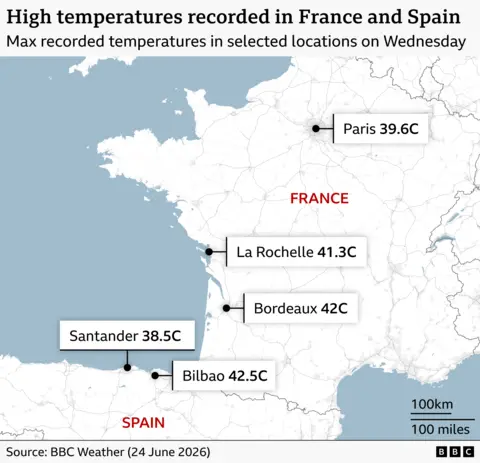
Overnight, minimum temperatures had exceeded 28C in the Vendée region and over 25C in Paris.

Map of France and northern Spain showing high temperatures recorded in selected cities on Wednesday 24 June 2026. Labels indicate Paris 39.6°C, La Rochelle 41.3°C, Bordeaux 42°C, Bilbao 42.5°C, and Santander 38.5°C. Source: BBC Weather.

Temperatures are expected to peak in the Netherlands and Belgium on Friday, while the temperature in Germany is expected to rise to 40C over the weekend.

The heatwave will also extend to eastern Europe over the next few days, with severe heat warnings issued for countries including Poland, Croatia and Hungary for later in the week.

So far, France, Spain and Italy have been hardest hit by the heatwave.

At least forty people have drowned in heatwave-related incidents in France since last Thursday, according to the prime minister.

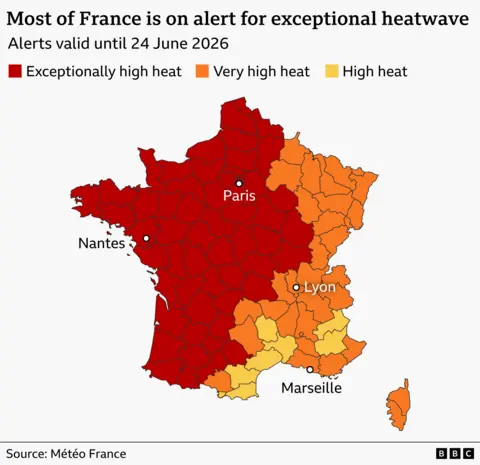
On Wednesday, red alerts in France were extended to include four more regions, Météo France said, bringing the total number to 58. Thirty-one more regions are under an orange alert.

Map of France showing heatwave alert levels valid until 24 June 2026. Most of the country, including Paris and Nantes, is shaded dark red for “exceptionally high heat.” Eastern regions around Lyon are orange for “very high heat,” while parts of the far south and Mediterranean coast near Marseille are yellow for “high heat.” A legend at the top explains the colour coding, and major cities are marked and labelled. Source: Météo France, BBC.

Some relief from the heat in France is expected from Friday, with temperatures forecast to gradually drop over the weekend. This change will come with thunderstorms, bringing a risk of flash flooding and large hail.

Speaking to French radio, labour minister Jean-Pierre Farandou said "we're in the process of finding out we've become a hot country" and warned society may need to adapt.

Authorities warn that the risk of forest fires is higher during such a prolonged and intense heatwave.

In the Maine-et-Loire region, more than 150 firefighters were deployed to fight a major fire on Tuesday in the Breignon forest in Saint-Macaire-du-Bois. It was brought under control overnight, authorities said, with no-one reported injured.

Sights in the French capital Paris have also been impacted by the hot weather.

The world's most visited museum, the Louvre, said it would close its doors earlier this week.

The Louvre said its historic building "remains fragile, external and is not sufficiently adapted to climate change", adding that the "build-up of heat is at its highest at the end of the day, and intensified by the volume of visitors".

The Eiffel Tower also closed earlier than usual on Tuesday and was to do so again on Wednesday.

Among those who died in heatwave-related drownings was a six-year-old child who had gone to an unsupervised beach with his parents in Bègles, Gironde on Tuesday evening.

A 17-year-old girl also drowned while swimming in a prohibited area of the Marne river in Champs-sur-Marne, on the outskirts of Paris.

Several drownings have also been reported in Germany, including that of a 26-year-old man who died after going into the Danube River near Regensburg in Bavaria on Tuesday evening.

Emergency services spent hours searching for the Syrian man, who could not swim, using a helicopter and boats. Attempts to resuscitate him after he was found some hours later were unsuccessful.

Temperatures were expected to reach 37C on Wednesday in Germany, and people are being warned not to underestimate the dangers of swimming.

There are also fears of drought in some regions. In Brandenburg, Hesse and North Rhine-Westphalia, authorities are urging people to use water sparingly, German newspaper Die Welt reports.

Barbecue bans have also been introduced in cities including Stuttgart and Freiburg in Baden-Württemberg, local media report.
While Spain has experienced baking heat over the last few days, temperatures were expected to start falling on the Iberian peninsula on Wednesday.

But red heat alerts remain in place for parts of northern Spain, with a maximum temperature of 42C possible in parts of the Basque country, forecaster Aemet said.

Spain's state meteorological agency said the country recorded its highest daily average temperatures in June since at least 1950, with Tuesday's average of 28.17C breaking the previous 2025 record of 28.01C.

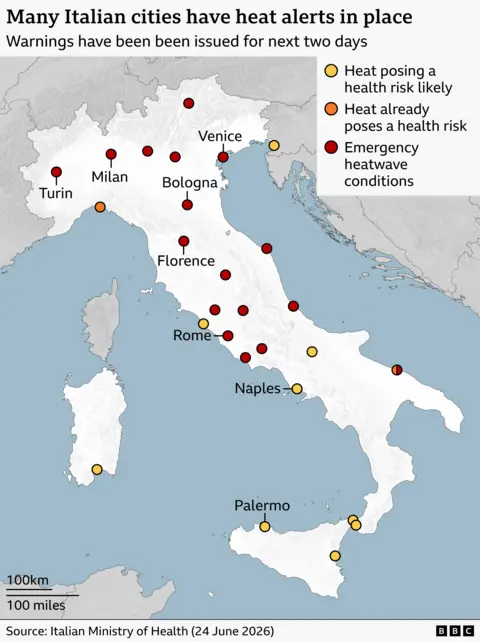
In Italy, meanwhile, 16 provincial capitals are now under red heat alerts, with Latina added to the list on Wednesday, while Bari will be added on Thursday, Italian news agency Ansa said.

Map of Italy showing city-level heat alerts for the next two days. Most of northern and central Italy - including Turin, Milan, Venice, Bologna and Florence - are marked in red, indicating emergency heatwave conditions. Additional red markers extend down much of the peninsula, showing widespread severe heat inland and along both coasts. A few coastal areas, including parts of the north-west and southern mainland, have orange markers for high heat risk. Southern regions and the islands—such as areas around Naples, Sicily and Sardinia including Palermo-mostly show yellow markers, indicating a lower but still likely health risk. The source is the Italian Ministry of Health (24 June 2026).

The Dutch weather service, the KNMI, has issued a Code Orange weather alert, which refers to a "high chance of dangerous weather" in southern and central areas of the Netherlands from Wednesday until at least Friday.

KNMI said maximum temperatures of 37C were expected, while Friday could see the mercury hit 39C.

In Belgium, most of the country is under an orange alert with highs of 37C expected over the next few days.

After meeting on Tuesday, Belgium's Risk Management Group said it was activating the "alert phase of the national ozone and heat plan" for only the second time. The first occasion was in August 2020, although no specific national measures have been announced, other than to raise awareness and call for extra care for the elderly and children.

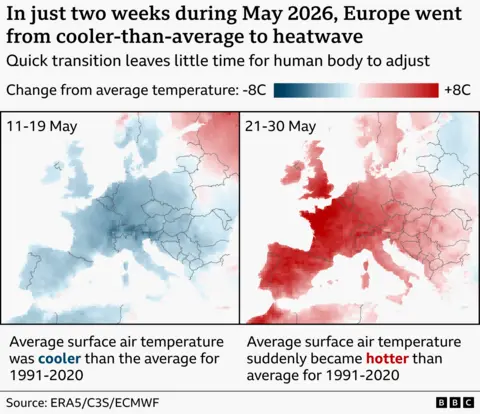
Maps of Europe showing how temperatures changed from average during May 2026. The left panel (11–19 May) is dominated by light to dark blue shading across most regions, indicating temperatures generally 2°C to 8°C below the 1991–2020 average, especially in western and central Europe. The right panel (21–30 May) switches to widespread light to dark red shading, showing temperatures 2°C to 8°C above average across much of the continent, with the strongest warmth in France, the UK, Spain and central Europe. A horizontal colour bar ranges from −8°C (dark blue) to +8°C (dark red). Captions below note that conditions shifted from cooler than average to hotter than average within two weeks, illustrating a rapid transition into heatwave conditions.