UK's first Mars landing honoured with 13 plaques

 ESA
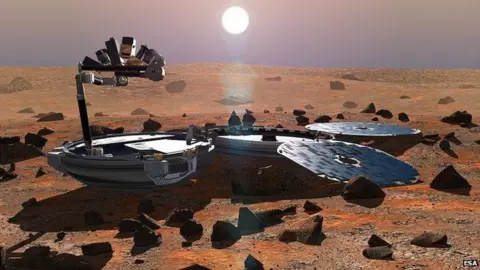
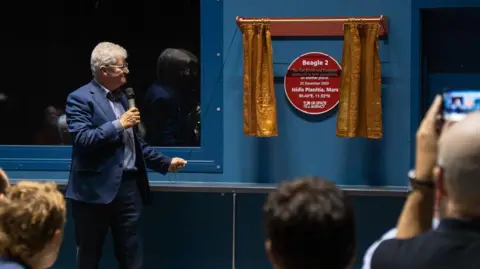
ESAThirteen plaques will be unveiled across the UK to celebrate Beagle 2, the first British and European spacecraft to successfully land on another planet.
The lander touched down on Mars on Christmas Day 2003, but, due to a communications error, it was considered lost until January 2015, when it was confirmed that it had actually landed successfully.
One plaque will be installed at the Open University in Milton Keynes, where Beagle 2 was conceived by Professor Colin Pillinger.
Others will appear at the National Space Centre in Leicester, the Science Museum in London, Jodrell Bank in Cheshire and Airbus in Stevenage, Hertfordshire.
 Department for Science, Innovation and Technology
Space minister Liz Lloyd said: "Beagle 2 captured the imagination of the nation, and it is one of the great stories of British science and engineering.
"I hope this initiative inspires a new generation to look up and ask what we might achieve next."
It was confirmed that the lander had been successful in its mission due to images captured by NASA's Mars Reconnaissance Orbiter.
Scientists believe a single solar panel failing to fully deploy blocked the communications antenna, leading to a loss of contact.
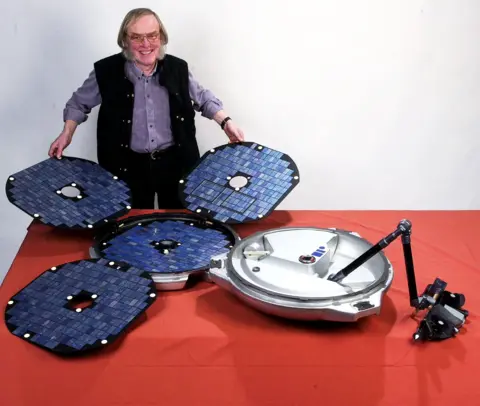
Pillinger died in 2014, months before it was revealed that the mission had been a success.
The project was a collaboration between The Open University and the University of Leicester.
Professor Mark Sims, mission manager at the University of Leicester at the time, said working on Beagle 2 was "one of the most extraordinary experiences of my life".
He added: "These plaques are a wonderful recognition of the thousands of hours of dedication from so many brilliant scientists, engineers and technicians in industry and academia across the UK who made the mission possible."
Do you have a story suggestion for Beds, Herts or Bucks? Contact us below.
Follow Beds, Herts and Bucks news on BBC Sounds, Facebook, Instagram and X.