The remarkable undisturbed remains of a Saxon saint

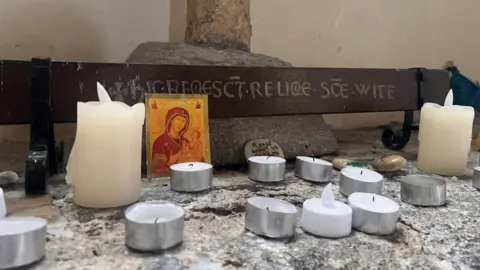 BBC
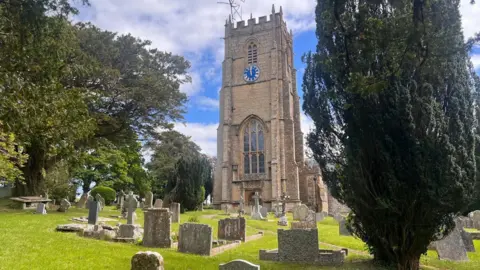
BBCFor more than 1,000 years, a rural church in a small Dorset village has been a site of pilgrimage, with people from all over the world seeking help and healing at its famous shrine.
The Church of St Candida and the Holy Cross in Whitchurch Canonicorum, near Lyme Regis, is the only parish church in England housing an intact medieval shrine containing a saint's remains undisturbed.
St Wite was a Saxon holy woman and healer and her sainthood was affirmed by King Alfred the Great. Her shrine is embedded in the north wall of the church.
BBC Solent's Steve Harris visited the church with the Reverend Virginia Luckett and Jan Graffius, curator at Stonyhurst College, to explore its remarkable spiritual heritage.
For Luckett, who cares for 12 churches in the Golden Cap Benefice on the Dorset coast, the Church of St Candida and the Holy Cross is surely her most remarkable.
"Colloquially around here, people call it 'The Cathedral, the Cathedral of the Vale"," she said.
"The church was built around her before the Norman Conquest [1066] and obviously she [St Wite] was a Saxon saint, so she's early medieval.
"Because her name is Wite, and it looks like 'white', they named it Candida, which is Latin for white.
According to Dorset legend, St Wite lived on the cliffs between Charmouth and Seatown and would light beacons at night to guide ships past the dangerous rocks below.
She is said to have lit a fire on the top of Golden Cap Hill to warn locals about an imminent Viking invasion. When she died in the subsequent battle, the church was built to house her remains.
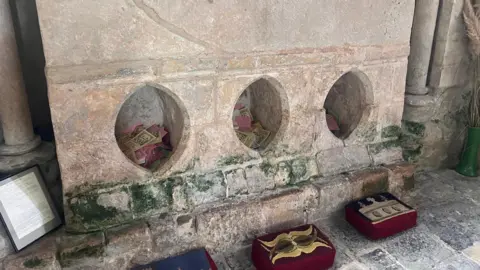
The relics of the county's patron saint are enclosed in a leaden casket, surrounded by marble.
Beneath it are three oval holes, containing scores of pink, yellow, green and white prayer cards.
"This is a prayer from a child who is praying for their grandma and their grandma's eyes, grandma's sight," said Luckett, inspecting one of the cards.
"Because we have so many people visiting, we've taken to printing a batch of different coloured cards so we know how old the cards are in the shrine - yellow is our current colour.
"Put your head, put anything else that is hurting in the holes. It's for physical bodily contact with the saint."
St Wite's shrine and relics survived the reformation of Henry VIII and the destructive campaigns of Cromwell.
"How on earth they were not destroyed is inexplicable," said Graffius. "It's very, very, very unusual for this to happen."
Graffius is an expert in relics at Stonyhurst College, a Jesuit school founded in the late 16th Century, and said there were "effectively 1,700 years of Catholic relics" in the school's chapel.
"We've got a piece of the True Cross [in the college collection] and we have 21 former pupils and teachers of our school who were executed for their faith, three of whom are now saints and 10 of whom have been beatified," she said.
But is there anything like St Wite's remains elsewhere in the UK?
"There are places such as St Winifred's Well in north Wales," said Graffius.
"That's not where relics were, that was a holy well, and that continued as a scene of pilgrimage all the way through the Reformation but there were no relics there, it was just simply this miraculous well.
"That's the only other comparable example I can think of.
"We returned a piece of the leg of St Thomas of Hereford to Hereford Cathedral about 20 years ago.
"But, as far as St Wite is concerned, I don't know of another example, and it's highly unusual."
The legend of St Wite still travels far to this day.
"There was a very notable day when I happened to be here and this family walked in and said, 'hello, we're from Iceland," Luckett recalled.
"I said 'that's great', and they said, 'actually, we're not from Iceland we're actually Vikings'.
"I said 'you know St Wite?'. They said, 'we know, that's why we've come because we wanted to come and say sorry'."