Wales breaks record for hottest day in June

 OutdoorMonkey / BBC Weather Watchers
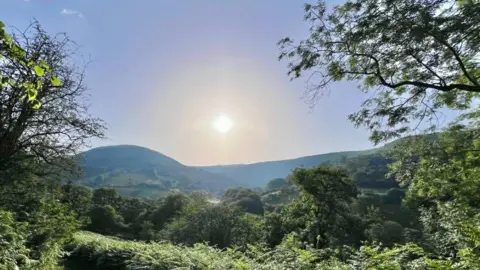
Wales has recorded its hottest June day on record and the highest temperature of the year so far, after a provisional high of 35.9C was recorded in Bute Park, Cardiff.
The new record surpasses the 33.7C recorded in Powys in 2000 but falls short of the all-time hottest day on record in Wales at 37.1C.
It comes after temperatures in Bute Park, Cardiff, hit 33.3C on Wednesday, and the capital went on to record the hottest overnight temperature in the UK at 23.5C.
Rail passengers have been advised to travel only if "absolutely necessary" on Thursday and Friday.
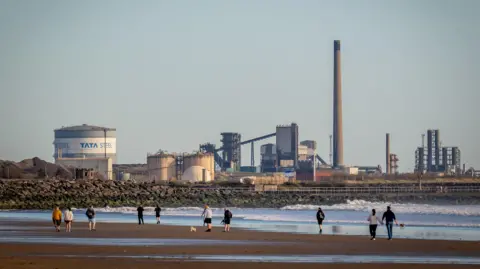
A 50-year-old man from Cilfrew, Neath Port Talbot, died after entering the sea at Aberavon Beach on Wednesday, South Wales Police said.
Emergency services were called at about 16:25 BST where the coastguard attempted to perform CPR until the air ambulance arrived.
Despite their best efforts, the man was pronounced dead at the scene. His next of kin have been informed.
Public Health Wales has urged people across Wales to stay safe and check on family, friends and neighbours.
It has reminded people to follow water safety advice including not swimming alone, avoiding jumping into open water, supervising children, choosing lifeguarded locations, avoiding alcohol, and follow "Float to Live" advice.
 Getty Images
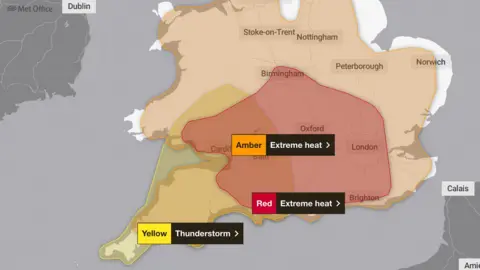
Temperatures are expected to hit 36C on Thursday, with the Met Office extending its current red extreme heat warning. It is now set to end at 23:59 on Thursday night.
A yellow thunderstorm warning is also in place for a large part of Wales between 18:00 on Thursday and 10:00 on Friday.
The thunderstorms may produce sudden, gusty winds of up to 60mph, with the chance of frequent lightning, hail and heavy rain.
What's happening with schools in Wales?
More than 840 schools across Wales are closed on Thursday as temperatures could soar as high as 36C in some places.
The number of school closures in west and mid Wales continues to rise with Carmarthenshire, Ceredigion and Powys reporting a higher number of school closures on Thursday.
Four schools in Pembrokeshire have shut, while Swansea, Cardiff and Rhondda Cynon Taf councils have also seen an increase.
Mathew Evans, head teacher of Ysgol Glantaf and Bro Edern in Cardiff, called it a "momentous decision" to close but said the weather had provided a unique challenge for Wales.
"They're small classrooms, windows of limited opening and when you add 30 pupils they overheat very, very quickly," he added.
He also highlighted the difficulties faced by kitchen staff who are working in "stifling" temperatures to feed the pupils.
Evans said it was "difficult" to look at long-term solutions to the problem without an "incredible" bill.
He added: "This weather creates a problem for the whole school. It's a problem for buildings like Bro Edern and Glantaf, which are 70s-build, concrete clad, and have very narrow corridors."
 Met Office
Due to increased reports of anti-social behaviour, a Section 35 dispersal order has been put in place in Langland Bay, Swansea.
Officers have the power to disperse crowds of people taking part in anti-social behaviour of any kind while the order is in place until 18:00 on Friday, 26 June.
Transport for Wales (TfW) has continued to impose restrictions on some lines on Thursday.
These include services from Chester to Wrexham, Aberystwyth to Shrewsbury, Machynlleth to Pwllheli, Cardiff Central to Ebbw Vale, Bridgend to Maesteg, and Cardiff to Penarth.
Due to a shortage of trains caused by extreme heat, fewer services than normal will run between Aberystwyth and Shrewsbury as well as between Machynlleth and Pwllheli.
The line is closed between Llandudno Junction and Blaenau Ffestiniog.
Network Rail has said trains will operate at reduced speeds and on amended timetables, meaning journeys are likely to take longer and there is a higher risk of disruption.
 Getty Images
Michaela James, senior researcher in children's health and wellbeing at Swansea University, said school closures were not a failure of teachers of children, but rather the "infrastructure of schools are just not equipped" to deal with the extreme temperatures.
She pointed out limited access to green space and strict uniform policies as just some of the issues she has identified as part of her research.
"What's really important to understand is the impact that this has on children's well-being," she said.
"I think this is a real opportunity here to listen to what teachers and young people are saying."
James recommended that evidence-based guidance "rooted in the lived realities of children" is put in place to provide support to both pupils and teachers.

Speaking to the BBC in Caernarfon, Gwynedd, Stephen Williams said he was a fan of the hot weather.
One of a handful of people to be found on the town's streets as the heatwave reached its peak on Thursday afternoon, Stephen said he loves "being in the heat".
"I don't like cold weather.
"As long as I keep hydrated. I make sure I take lots of little isotonic drinks," he said.
Emma Syska, from Llanberis, was also in Caernarfon as the sun beat down. She is less of a fan of the heat and has concerns about how the steep rise in summer temperatures reflects our changing climate.
"Well, it's not quite right, is it, really?" she said. "Because it's probably going to get hotter still. It's the thin end of the wedge. It will get worse."
A 'frightening and uncomfortable' experience
On Wednesday, a climate scientist said Wales was "absolutely not prepared" for the consequences of the extreme heat sweeping the country.
Mary Gagen from Swansea University called the red heat warning issued for Wednesday and Thursday "frightening".
Gagen said while we have always had heatwaves, it is nothing like the intensity and frequency we are seeing.
"Our infrastructure is absolutely not prepared for this," she said.
Welsh government's deputy minister for public and preventative health, Nerys Evans, called it a "heat emergency".
 Ruth Davies / BBC Weather Watchers
Referring to Wales' heatwave in May, Gagen said it was "really unusual to have two in a row".
"Actually, for me on a personal level, as I'm walking around, it feels like the first time in my life that I can physically feel climate change.
"And it's quite frightening, actually. It's an uncomfortable experience."
Mary said the country would experience "tropical nights" caused by a "heat dome" effect.
"Each one of those events, whilst, sure, it's a feature of a heatwave and we do get heatwaves in this country, each of them has a climate change element behind it that's making it more intense," she said.
"It's preparedness, it's having cool spaces in our cities. It's having buildings that can cope with the heat.
"And we are really learning in this heat event that we are absolutely not prepared. We're seeing school closures. If you are trying to manage ill people on a ward in our hospitals that doesn't have air conditioning, you're going to find this very uncomfortable.
"So, we really have a long way to go. Our infrastructure is absolutely not prepared for this."
In response the Welsh government said it was "committed to addressing the climate emergency".
"In line our manifesto and 100-day plan, we have begun work on a new Climate and Nature Plan which will set out the actions to realise our net zero 2040 ambition, and to ensure substantive nature recovery by 2050," the statement added.