London's driverless revolution: Awe, anxiety and the unknown
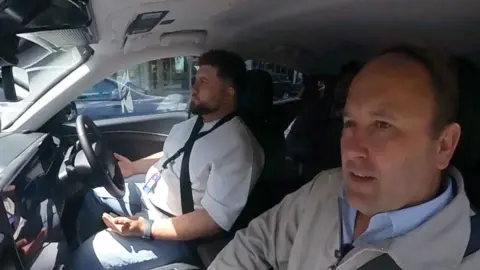
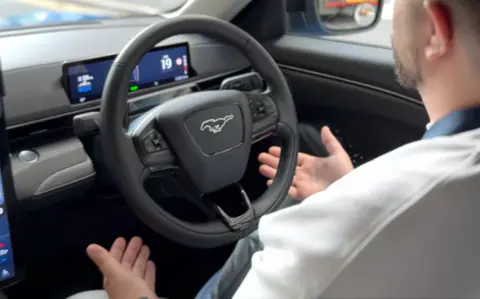
The driver has taken his hands off the wheel, and the car starts driving itself. I am suddenly dumbstruck and lost for words.
The car slows down at a zebra crossing and lets a pedestrian cross and then accelerates away.
My brain can't understand what is happening. It is a mixture of disbelief, amazement, slight concern and a sudden overwhelming feeling that things are going to change rapidly in the near future. It is a moment of incomprehension.
The driver Alan and Victor from Wayve treat the experience with the most extreme nonchalance I have ever come across, like they have done something simple and everyday like pour out a bowl of cornflakes.
And this isn't even the first time I've been in a driverless car.

Ten years ago I was in one on the A3 when it didn't recognise a road sweeper vehicle and accelerated into it. The human safety driver had to intervene. Back then, I wasn't exactly convinced the times were changing.
Another one that I tried that was being tested around The 02 Arena had battery problems and kept breaking down.
This time it feels different. Although how these cars would be introduced to the capital's streets isn't clear at the moment.
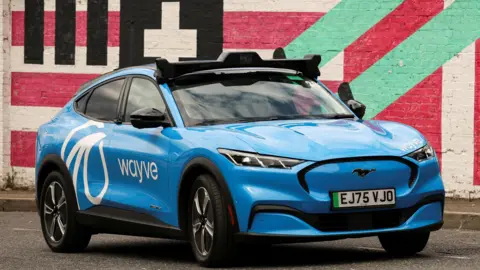
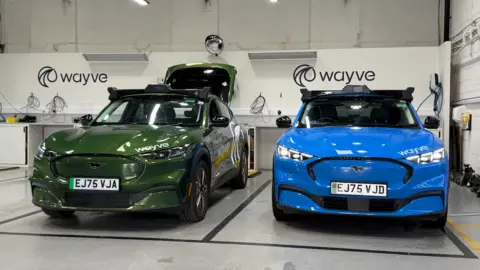
With a low profile, the company Wayve has been testing its autonomous vehicles (AVs) in London for ten years. They are different from the white cars covered in cameras operated by Waymo.
In basic terms, Waymo cars map the whole environment and then use GPS and radar and cameras to drive within it. Wayve uses AI to learn the behaviour of other road users. It then picks the best route from the data it has learnt over 10 years. It doesn't have to map the routes.
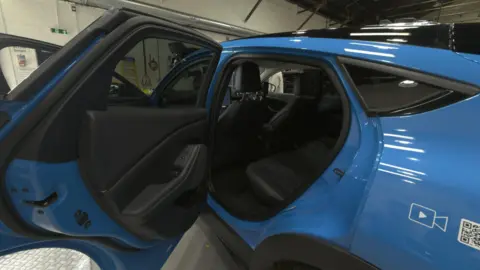
It looks like quite a simple roof rack that attaches to a modern car and uses radar and cameras. It then controls the car by using the central computer system of the existing vehicle.
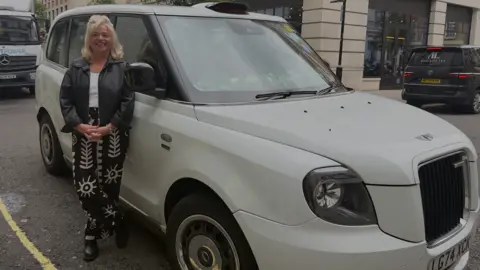
Karen Teale, a black-cab driver and a tour guide, has seen the driverless cars on the roads of London.
"I mean they are funny. We do watch them a lot," she says. "They're going down the tunnels the wrong way, so we do laugh."
Teale adds: "They're not wheelchair accessible; what if someone in the back had a heart attack? I can get five people in and they can say to me, 'We need three different stops' and in my head I can work it out which one goes first. They're not allowed in the bus lanes as they're not a taxi.
"It will never, ever replace the black cab. You cannot replace that with a robot. No way. Who's got sparkle like us eh? Nobody! These robocars are not something the black cabs are worried about. It's minicab drivers that are going to be worried."
 Reuters
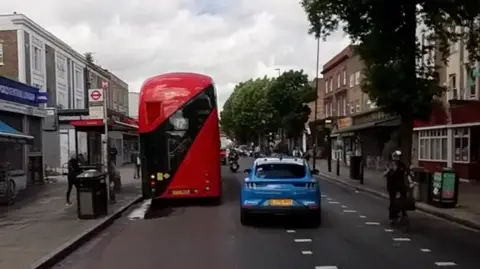
What is surprising on the test drive is the level of complexity the AI-driven car can handle. At one point, a bus pulls in and cyclists and vans are coming in the opposite direction. The car doesn't hesitate and overtakes the bus and leaves enough room for the bike.
With pedestrians dithering beside a zebra crossing, but not actually on it, the car is decisive and accelerates over the crossing. It corners like a professional driver. It feels smooth and secure and you soon forget there isn't a human behind the wheel.
Victor Charoonsophonsak from Wayve says London's streets are complex: "It is the density with cyclists all around us and pedestrians crossing.
"The unique thing is, as an American, is the willingness of pedestrians to jaywalk and cross and our vehicle handles those situations safely and is able to anticipate and manage those things.
"It learns pretty quick, there aren't many objects or issues we can't recognise. We have trained on so many diverse training scenarios though millions and millions of minutes of driving footage.
"I think the special thing with our approach is we ingest and learn just like any human driver through observation and we feed our world foundation model with all these examples of what human driving looks like, how to interact with surrounding traffic and pedestrians, and we learn from it quickly."
Wayve, which is in partnership with the minicab app company Uber, says it wants to carry passengers "within months" but to operate AVs in London, companies will require permission from Transport for London (TfL).
With a safety driver on board, the car must comply with the TfL Private Hire Vehicle (PHV) standards such as driver, operator and vehicle licences.
The companies will also be able to apply for a permit through the government's Automated Passenger Services (APS) scheme for driverless operation.
Then TfL also would have to give consent and make a judgement about whether the service is safe, appropriate and fits in with London's transport system.
A TfL spokesperson said: "Safety is our top priority and any new passenger-carrying service would need the appropriate regulatory approvals. We are actively engaging with government to help shape any future services."
They added: "Legislation must set a high benchmark and consider the impact on all road users, and in London the roll out of AVs must support achieving the aims of the mayor's Transport Strategy.
"This includes the management of congestion and alignment with Vision Zero, supporting the goal of eliminating all deaths and serious injuries from collisions on London's streets by 2041."
It's not yet clear if TfL will give companies using safety drivers on board and automation permission to operate with just PHV compliance.
I'm told Uber wants to use that route and apply for a PHV licence to carry passengers with automation, but that isn't confirmed by the company and it would be contentious.
Can a car with a safety driver but being driven by AI be a licensed minicab and carry passengers using the regulation as it stands?
TfL says: "Where a vehicle retains a driver who is responsible for the driving task, government guidance makes clear that existing routes such as Private Hire Vehicle licensing remain open to be used. TfL is responsible for taxi and PHV licensing in London. Any proposed modifications to a licensed vehicle, or one proposed to be licensed, would need to be submitted to Transport for London for approval.
"As with any licensing decision, TfL will prioritise safety and will need to be assured that any vehicle modifications present no additional risk to the travelling public."
Discussions are ongoing.
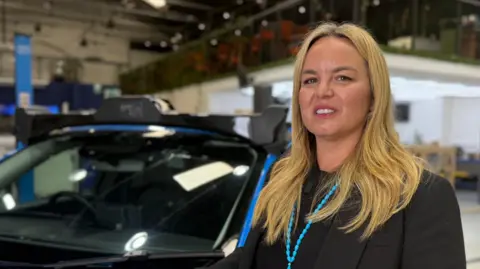
Speaking to me from Tokyo, Kaity Fischer from Wayve said: "Our intention is to engage early and often to get regulators into the vehicles to get them to understand the technology and what it involves. How it can be used safely, how they can create a structure to deploy autonomy safely and legally."
I ask her if she thinks TfL will sign it off.
"Absolutely, we have every confidence," she says. "Again, the UK has been a world leader in supporting not only AI but autonomy on roads.
"A great example of this was the UK was actually the very first country globally to establish a country-wide federal level framework to deploy autonomous vehicles. This has really made them a leader in this space.
"We view autonomous vehicles as a gradual rollout; we think this is something that complements current infrastructure and all forms of transportation. We are deploying on the Uber network; we are one piece in a broader transportation ecosystem. It will certainly be a gradual process.
"We view this a complement not a replacement."
I point out they don't actually need drivers.
"We don't need drivers for our fully developed technology; our initial rollout will be a supervised system so we will have vehicle operators behind the wheel monitoring the system," Fischer told me.
"This is part of how we work with local authorities to ensure that we take a step-by-step approach and ensure safety before we remove the drivers. This is part of the gradual approach and also part of we are one form of transport amongst many."
'We've had no clarity'
Minicab unions though are very concerned and want the trials stopped.
"TfL cannot just abandon London's drivers, shrug its shoulders and say, 'It's nothing to do with us' as massive global corporations fundamentally reshape the taxi and private-hire industry," says the App Drivers & Couriers Union (ADCU) general secretary Cristina-Georgiana Ioanitescu.
"Our members need urgent answers from TfL about the use of human safety drivers during the trial phase. Will these safety drivers be required to hold a valid TfL Private Hire Vehicle licence?
"Who will be held liable if there is a technical issue or an accident? The human driver, or the operating company?
"We've had no clarity at all on any of these issues and, until we do, TfL must halt the trial to prevent a dangerous circumvention of London's licensing standards."
The ADCU also says AVs will increase congestion, while it thinks the energy-intensive data centres required to run AV undermine London's zero-carbon emission goals.
Ioanitescu adds: "The information blackout from TfL must stop now. We are demanding that TfL steps up, demands answers and protects London's drivers before a single commercial AV hits the road."
So should minicab drivers be worried? Annie Duvnjak is from Uber, which is partnering with Wayve.
Uber has just opened a list of interest so users can register to be one of the first to get a driverless minicab.
"The beauty of the business is it continues to grow, and as it continues to grow there is demand for both," Duvnjak says.
"For drivers and for AVs we really think that will continue to come together.
"There are going to be certain routes that AVs can't take, or some who want to take a driver; we do think that kind of hybrid network of riders, drivers and AVs all coming together is what the future looks like. We are really leaning into that in the cities we are operating in."
The Mayor of London, Sir Sadiq Khan, also has concerns.
He told the BBC: "I'm not somebody who is either evangelical about AI or an alarmist. I'm realistic.
"I am concerned about potential impacts on jobs in London with AI. I do know lots of London families are supported by the main breadwinner being a minicab driver or a taxi driver. So we've got to make sure the regulation is right when it comes to automotive vehicles.
"There are big concerns in relation to congestion, in relation to accessibility, in relation to air quality, but also in relation to jobs. So we've got to work with the sector. We're going to work with the government to make sure AI works for London."
"So we know a couple of major companies are piloting automated vehicles in London. We're talking to the government to make sure we get the regulation right. I'm keen to make sure we don't inadvertently have job losses in London.
"That's one of the reasons we've set up an AI taskforce led by Baroness Martha Lane Fox, but also we're going to invest in training as well. It's really important to get this right."
Driverless cars are advancing rapidly and quickly. London's roads could be on the cusp of a huge change.
The authorities are again wrestling with how they approach and how they regulate this new technology.
London is Europe's first real test case for fully autonomous urban transport.
At the moment, driverless cars in London bring excitement, scepticism and unanswered questions.
Listen to the best of BBC Radio London on Sounds and follow BBC London on Facebook, X and Instagram. Send your story ideas to hello.bbclondon@bbc.co.uk