Inflation unexpectedly steady as food price rises slow

 Getty Images
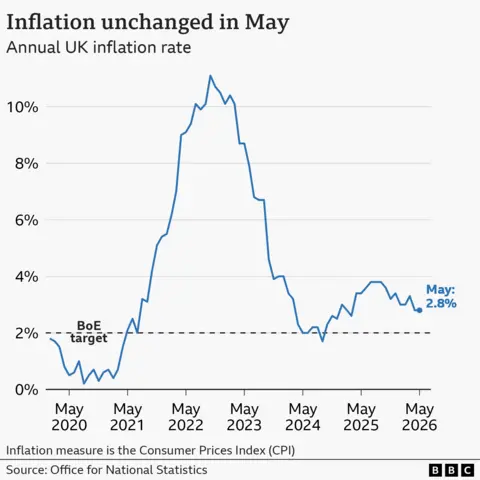
Inflation remained at 2.8% in the year to May as the pace of food price rises slowed to a 17-month low, according to new figures.
Over the year to May, transport costs rose by the fastest rate, the Office for National Statistics (ONS) said, while the rate of price increases in meat, dairy and vegetables eased.
Experts had expected inflation — the rate at which the cost of goods and services is rising — to rise to 3% in May, and were widely expecting it to steadily increasing over the coming months due to the ongoing impact of the war in the Middle East.
But the peace deal agreed between the US and Iran means further increases could be smaller, according to analysts.
Grant Fitzner, the ONS's chief economist, said that airfares, vehicle taxes and petrol prices all pushed up inflation.
Motor fuels were 24.6% higher in May than the same last year, according to ONS figures. Overall transport inflation was 6.8%, the highest annual rate since December 2022.
But that was "offset by lower food prices, with decreases in inflation seen across a range of meat, dairy and vegetable items compared to last month", Fitzner said.
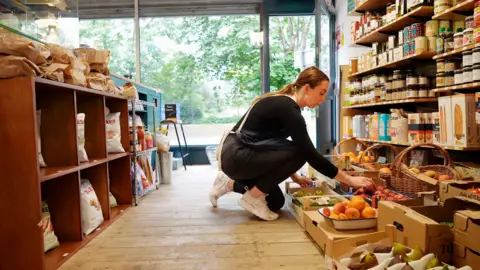
Food inflation fell from 3% in the year to April to 2.2% in the year to May, the slowest rate of food inflation since December 2024.
The price of meat is particularly high, but the rate of increase is slowing: beef and veal went up by 9.4% in the year to May, compared to 13.2% in the year to April and 18.8% in the year to March.
Responding to the figures, the British Retail Consortium (BRC) said easing food inflation showed that the British supermarket sector was highly competitive, but food inflation was likely to rise in the coming months.
Similarly, the Food and Drink Federation said prices "prices still don't reflect the inflation caused by the closure of the Strait of Hormuz".
Its chief executive Karen Betts explained: "It generally takes several months for the increased costs paid by farmers, processors and manufacturers to filter into raised prices at the tills.
This is partly because of "the widespread use of long-term contracts for energy and ingredients".
Energy prices
Domestic heating oil — which does not have a price cap like energy bills — also fell after rising sharply due to the war.
Charlotte O'Leary, associate economist at the National Institute of Economic and Social Research, said there is expected to be a "sizeable" upward impact on inflation when Ofgem sets its energy price cap in July.
"The lagged effects of higher oil prices are still feeding through," she said.
She also cautioned that "should the [US-Iran] deal collapse, oil may rebound and reinstate upward pressure on inflation".
Chancellor Rachel Reeves said the government was "protecting families and businesses from rising costs, with cuts in energy bills and freezes in fuel duty and rail fares".
"While the war in the Middle East pushes prices up globally, we have got the right economic plan and inflation has held steady."
Shadow Chancellor Mel Stride said "prices are still rising too fast".
"Thanks to Labour's choices the UK went into the latest energy crisis with the highest inflation in the G7," he said.
Interest rates decision
The inflation figures come ahead of the Bank of England's next interest rate decision on Thursday. Economists widely expect the Bank to hold the core interest rate at its current level of 3.75%.
Many economists had predicted inflation would peak at between 3.5% and 4% in the second half of 2026, as the effects of the conflict in the Middle East filter down to household costs.The Bank's target for inflation is 2%.
The good news of slower food inflation has already been "somewhat surpassed" by the prospect of price rises slowing even further due to a US-Iran peace deal, according to Suren Thiru, chief economist at the Institute of Chartered Accountants in England and Wales.
But "even with hostilities seemingly over, the UK faces a painful hangover from the Iran conflict, with energy and other supply chains likely to take months to normalise, delaying any meaningful easing in inflation until late 2026", she said.
Yael Selfin, chief economist at KPMG UK, said the new figures "strengthen the case" for a hold on interest rates by the Bank of England on Thursday.
"Underlying inflationary pressures have yet to show clear signs of strengthening, which is likely to underpin a majority decision within the Monetary Policy Committee to hold interest rates at Thursday's meeting," she said.
