How chess 'boom' is building young minds

 Joe Bilton
From traps to checkmate, chess has fascinated generations of players. Now, experts say a "boom" in the game means young players are solving problems, forging friendships and building confidence.
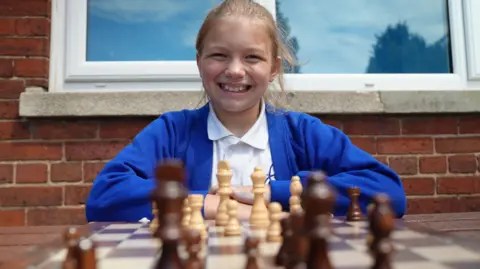
As 10-year-old Evie gradually moves her white pieces against the enemy king, one thing is very clear: she has a plan.
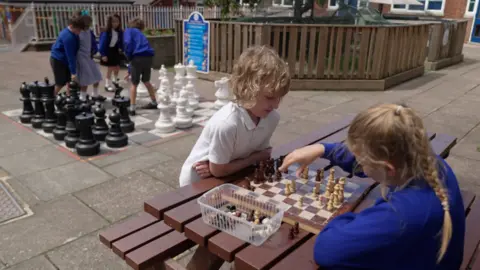
Her opponent across the board is eight-year-old Toby and although the game is in a school playground, the match is tense.
"I like how all the pieces can move in different ways," Evie says with a smile.
She took up the game at the age of six and developed her skills on the education app Duolingo. Now, she plays daily with friends at St Faith and St Martin Church of England Junior School, in Lincoln.
Evie says the game has made her "more confident" and believes anyone can play.
"It doesn't matter what age you are, just have fun and play," she says.
 Joe Bilton
Evie's friendly chess rival Toby is one determined player. He started learning the game after seeing his dad and grandad play and it wasn't long before he was giving them a run for their money.
"I beat my dad twice," he says.
Playing at school is often "relaxing", Toby adds, "but then you have to use your brain at the same time to think of different things to move, if like someone sets up a trap or something".
According to the head of global chess, the benefits of playing the game "are enormous".
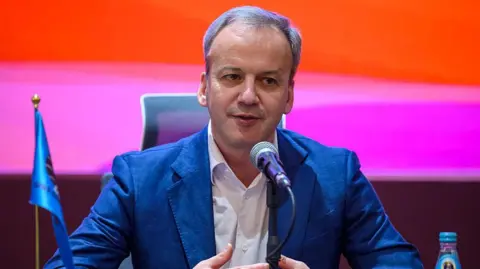
"I can see that it helps millions of children," says Arkady Dvorkovich, president of the International Chess Federation (Fide).
He believes the game encourages players to "think logically and build strategies", while understanding the "risks associated with any of the positions on the board".
Most importantly, he says the game's reactive nature and need for quick responses is "crucial in modern life".
"In chess, you're the only one who is responsible for your decision, nobody else," he says. "You take a decision and you take responsibility for all the consequences of this decision."
 NurPhoto/ Getty
Dvorkovich, a former Russian Deputy Prime Minister, began playing at the age of five.
He has witnessed a "boom" in chess over the past 20 years, partly thanks to online chess websites during the pandemic, along with the Netflix hit series The Queen's Gambit.
He describes Fide's "mission" as improving access to chess around the world.
"When you have a teacher who understands chess and who helps you to start at least to know the basics, that helps enormously to enter the chess world," he says.
The global chess market was valued at about $3.45bn (£2.5bn) in 2025, according to the market researcher Fortune Business Insights – and analysts expect it to grow to $7.66bn (£5.7bn) by 2034.
Its influence is also being seen in the biggest global sport of all – football.
In March this year, Manchester City and Norway striker Erling Haaland invested in a new global chess tour.
He has drawn similarities between chess and football because the former "sharpens your mind" and helps to build strategies.
 Joe Bilton
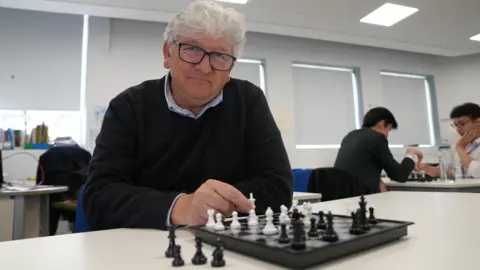
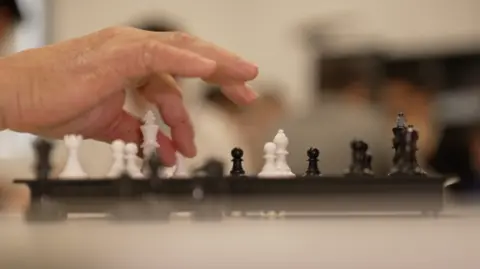
Andrew Maffessanti, 60, runs a chess club at Lincoln University Technical College.
He says playing the game has taught students humility and respect, as well as building their problem-solving skills and concentration.
"You find a lot out about yourself when you make mistakes and the consequences for making mistakes," he says.
"And to be respectful to your opponent when they beat you and you say congratulations and shake their hand."
Maffessanti, who is head of maths at the college, says the game has helped with some lessons.
"A lot about maths is problem solving and looking for the appropriate move at the right time," he explains.
 Joe Bilton
Oli, 17, is a regular at the chess club and enjoys the "communal experience".
"It's a great way to connect with people and develop your own problem-solving skills in order to get a bit of fun out of it," he says.
He points to the need to visualise different paths before taking them.
"A chessboard has so many, so many combinations to it," he adds. "There's no one game is going to be like the next."
Across the Humber Bridge in Hull's Pearson Park, I meet Graham Chesters, the president of the Hull and East Riding Chess Association.
A steady drizzle is falling, but it cannot put us off playing a game on a concrete board installed by the council next to a duck pond.
"It's been proven that there's so much to be gained from playing chess," Chesters says as his white pieces move rather swiftly towards my black ones.
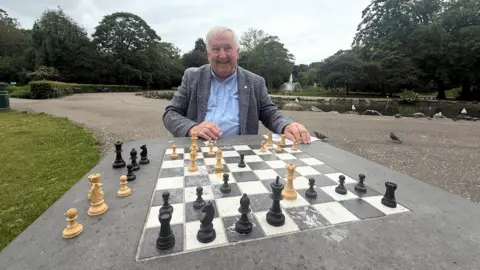
With an ELO rating of 2,000 (grandmasters are rated 2,500 and above), he is one of the most experienced local players and certainly knows a thing or two about winning.
But he has also seen more young people taking up the game over the past few years.
"There are four or five junior clubs now which didn't exist four or five years ago and they are thriving," he says.
He also believes the game is becoming more equal after struggling for "centuries" to attract women.
It does not take long before Chesters is mere moves away from checkmating me.
"As long as you don't take it too seriously, it can be great fun," he remarks. "You learn a lot about yourself and you learn a lot about others."
His queen attacks my king and I have no moves left.
The game is over.
Listen to highlights from Hull and East Yorkshire or Lincolnshire on BBC Sounds, watch the latest episode of Look North.
Download the BBC News app from the App Store for iPhone and iPad or Google Play for Android devices