'I've written off two cars': The Highland village overrun with marauding deer

 Amy Davidson
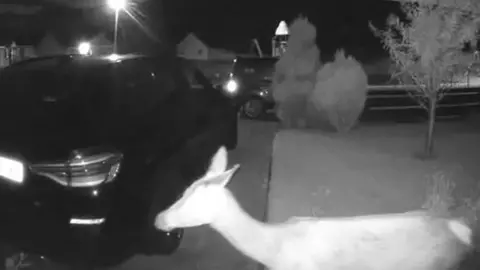
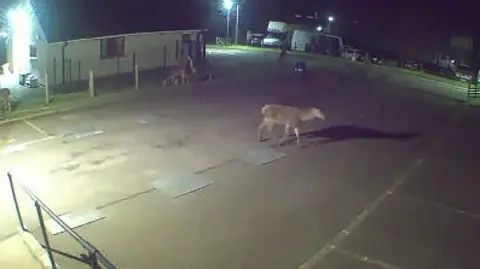
To many visitors to the Highland village of Helmsdale, the red deer that wander its streets are a quirky photo opportunity.
To residents who have seen their numbers increase in recent years, they are a dangerous nuisance.
They have been blamed for causing road accidents that have left cars written off and for leaving parasitic ticks in a children's play park.
Now local councillor Richard Gale has called for additional culls, among other measures, to reduce their numbers.
Scotland's nature body, NatureScot, said it was working closely with the community to reduce issues caused by deer.
 Getty Images
 Amy Davidson
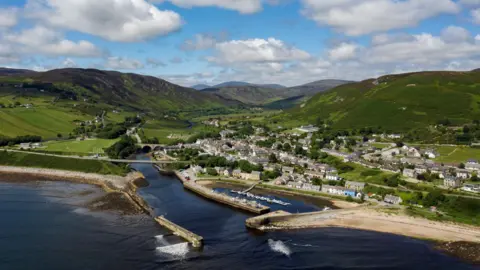
Helmsdale is a small village on Sutherland's east coast, and is surrounded by hills, woods and moorland.
A nearby stretch of the A9 trunk road is a "hotspot" for deer collisions.
Jacquie Aitken, a heritage curator at local museum Timespan, is among those who have had first-hand experience of deer collisions.
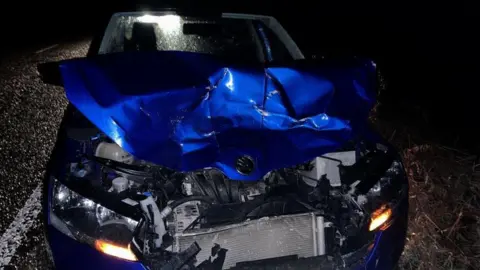
"Deer are a big problem on the roads here and, unbelievable as it may sound, I have written off two cars in the space of three years with full frontal impacts with two massive deer," she said.
The first time it happened Aitken was driving home after work in March three years ago.
"Not even with a second's notice a huge deer was in front of my car," she said.
"All I could think to do was hold on to the steering wheel. The deer was on my car and the car's airbag went off. I was in shock."
Aitken had hoped it was one-off, but she was in a collision with another deer while in a queue of traffic in April this year.
She said the experience had left her anxious about driving.
"You don't know what to expect," she said.
 Jacquie Aitken
The animals are also known for carrying ticks, tiny spider-like blood-sucking parasites.
Lyme disease, a bacterial infection which causes a range of health problems, can be spread to humans from some tick bites.
Gale, a Liberal Democrat councillor for East Sutherland and Edderton, said: "We don't want to eradicate deer, they are an earner for the economy."
But he added: "We need to stop them coming into the village in the numbers they are at the moment."
Gale praised the efforts of landowners and NatureScot, but said additional culling was needed along with other measures, including clearing areas of gorse where deer shelter near the village.
He said: "There have always been deer in this area but their numbers have just shot through the roof, and they are now roaming around the village eating people's vegetables.
"They are bad for leaving ticks and we are finding that kids coming home from primary school are having to be checked for ticks."
The councillor said visitors, impressed by the sight of stags, were putting themselves in danger.
"A red deer stag is a big animal," he said.
"Visitors are petting them and the danger is that somebody could be seriously injured.
"Ticks aside they could be knocked over or gored. These are wild animals, not something you should be walking up to."
'Recognise concerns'
Scotland has up to 505,000 red deer, one of the country's most iconic species that is celebrated in Sir Edwin Landseer's painting Monarch of the Glen.
There also up to 300,000 roe deer, 25,000 sika and at least 8,000 fallow deer, according to NatureScot.
Thousands of deer are culled every year to control their numbers, and to protect native woodlands and other habitats.
NatureScot said efforts to reduce the impact of deer in and around Helmsdale included granting licences for out-of-season and night shooting.
It has also been liaising with local deer controllers, used drones to help assess numbers and working with Transport Scotland to try to reduce deer vehicle collisions.
NatureScot said 75 deer had been culled in Helmsdale since autumn last year.
A spokesperson said: "We believe real progress is being made through this voluntary approach, but we recognise that concerns remain."