The Lincolnshire roots of the American dream

 Karl Bird / BBC
Four centuries ago, a small market town in rural Lincolnshire found itself at the heart of events that would help shape a nation an ocean away.
From the Pilgrims who passed through Boston to the later Puritan settlers who founded the city that bears its name, the town played a remarkable role in the story of the United States' origins.
Today, with Americans marking 250 years since the signing of the Declaration of Independence, this corner of eastern England has a unique place in the nation's history.
Karl Bird explores how one Lincolnshire town helped sow the seeds of the American dream.
The first English settlement
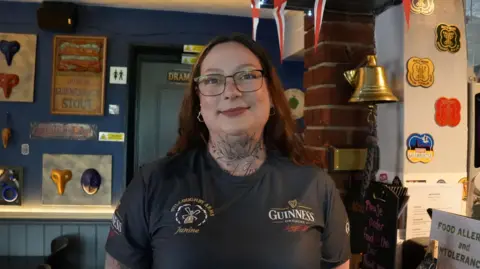
In the village of Willoughby, near Alford, a local pub honours Capt John Smith who was baptised there in 1580.
Smith is famous for his role in the founding of the first permanent English settlement in Jamestown, Virginia, in 1607.
He is also remembered for his connection to Pocahontas, the daughter of Wahunsenacawh, leader of the Powhatan confederacy.
Pocahontas is credited with helping the struggling English settlers survive during their early years - a story that inspired a Disney film.
After leaving Virginia, Smith explored and mapped the coastline of present-day Maine and Massachusetts, helping popularise the name New England.
Today, his Lincolnshire roots remain a global attraction.
"We get people from America and from the Netherlands... they go and look where John Smith would have grown up," Willoughby Arms landlady, Janine Bird, says.
 Karl Bird / BBC
The Pilgrims
While Smith was exploring the New World, many people in England were under pressure to conform to the Church of England, with those who rejected its teachings risking punishment.
Among them was a group known as the Separatists, who met in secret at places including Gainsborough Old Hall.
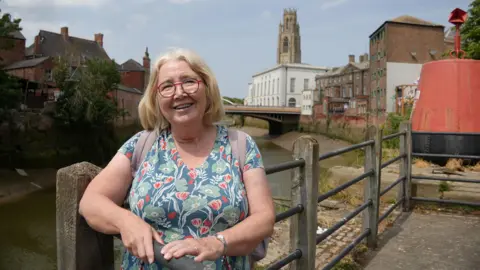
Local historian Jane Keightly said: "It was illegal in those days in James I's reign to escape to religious freedom, so they had to do it all secretly."
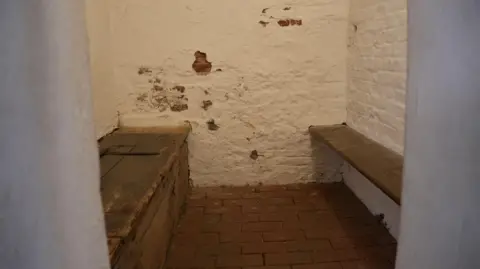
As pressure on the group increased, they attempted to flee to Holland from the port of Boston in 1607. Instead, they were betrayed and imprisoned in the town's Guildhall.
After their release, many eventually reached Holland before some later sailed to America aboard the Mayflower in 1620.
The Pilgrims' journey came from a desire for religious freedom, an ideal that remains a central part of the United States' national story.
 Karl Bird / BBC
The founding of Boston Massachusetts
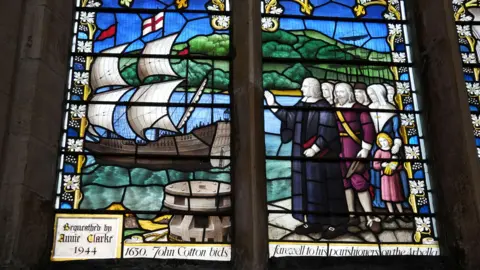
Thirteen years after the Separatists' voyage, another wave of emigrants left Boston for New England, settling in the Massachusetts Bay Colony.
Among them was John Cotton, the influential vicar of St Botolph's Church.
Boston, Massachusetts, would later take its name from the Lincolnshire town many of those settlers had left behind.
Father David Stephenson, the current priest-in-charge of St Botolph's, believes Cotton's legacy remains profound.
"Without John Cotton, the whole Boston history would be completely different," he says.
He says Cotton helped establish the legal principles and way of life that shaped early America.
 Karl Bird / BBC
Independence
"When it came to the American Revolution, Boston was almost the first of the colonies to become actively hostile to the British government," Neil Wright from the Lincolnshire Historical and Archaeological Society says.
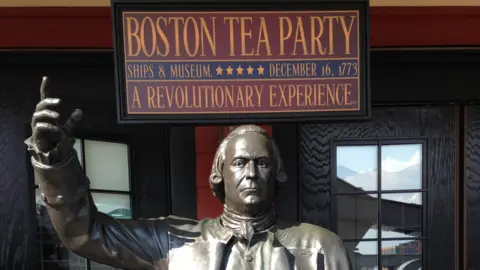
Tensions reached a turning point in 1773 with the Boston Tea Party, when protesters boarded ships in Boston Harbor and threw chests of tea into the water.
The demonstration was sparked by growing anger over British taxation and colonial representation.
"We see this historical event as a catalyst that led directly to the American Revolution," says Evan O'Brien, from the Tea Party Museum.
In 1776, America's Founding Fathers adopted the Declaration of Independence.
But some historians trace the roots of the nation's democratic traditions back to the Mayflower Compact, a legal agreement signed aboard the Mayflower in 1620.
The document bound the settlers together in a "civil body politic" and committed them to governing through "just and equal laws", according to Pilgrim Hall Museum.
The influence of England can also be seen in the foundations of the US legal system.
Historians have long pointed to Magna Carta as an important influence on the Constitution and Bill of Rights.
The landmark charter is closely associated with Stephen Langton, the Lincolnshire-born Archbishop of Canterbury who played a key role in its creation in 1215.
 Karl Bird / BBC
Bringing America to Lincolnshire
More than four centuries after Lincolnshire helped shape some of the people, ideas and events behind America's founding, the ties between the county and the United States remain as visible as ever.
Visitors still travel to Boston Guildhall to see the cells where would-be Pilgrims were held, while others follow the story of John Smith in Willoughby or John Cotton at the Boston Stump.
"We do get a lot of American tourists here," Boston councillor Sarah Sharpe says.
"They're really fascinated by it and they always want to come to our amazing Boston Guildhall to see the cells, to see the courtroom."
And this year, as Americans celebrate Independence Day, Lincolnshire will have a place in the festivities.
Red Arrows Wing Cdr John Bond says: "We've got a massive flypast over New York on the Fourth of July.
"An incredible amount of aeroplanes and we really look forward to putting out the red, white and blue over the Hudson."
Listen to highlights from Lincolnshire on BBC Sounds, watch the latest episode of Look North.
Download the BBC News app from the App Store for iPhone and iPad or Google Play for Android devices