Fans look back to the future as club begins new era
In a back garden in the middle of Lincoln, Rob Bradley is building his own mini-football stand.
He shows off four bright-red plastic seats purchased from Sincil Bank, where his beloved Lincoln City have played since 1895.
This summer, the Imps, as they are known, have ploughed £10m into refurbishing the ground as they prepare to play in the Championship for the first time since 1961.
Fans were offered a chance to buy some of the old seats.
"I saw an advert for seats for sale from the ground, which is something, frankly, I've always wanted," says Rob, a fan for 70 years.
He is happy to have a "little bit of Sincil Bank" as a souvenir and jokes that he is looking forward to sitting in the seats to watch his grandchildren play football.

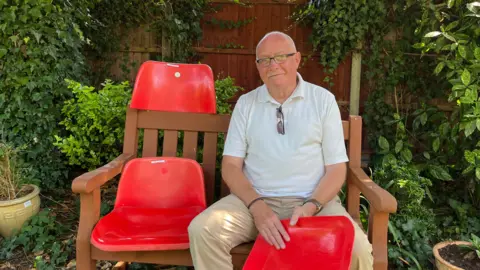 BBC / Patrycja Boryka
Rob, who has been going to games since he was five years old, says the stadium holds many memories.
"I just think my quirky little purchase of them is just a tiny, tiny little example of the impact the football club has on us," he adds.
For most of their history, the Imps – the nickname comes from a famous stone carving of a grotesque figure at Lincoln Cathedral – have played at the lower end of the Football League.
But while glory has been fleeting over the decades, "City" have always been at the heart of Lincoln life, as the Secret Lincolnshire podcast has been hearing.
Today, a heritage trail highlights the club's rich past, as fan Gary Parle explains.
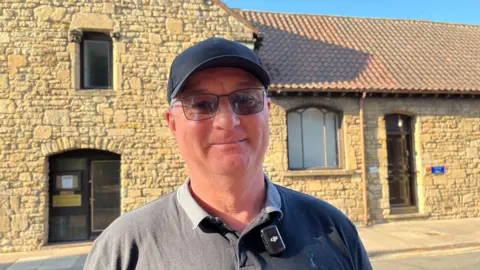
"It's very nice to be able to look back at where it all started," he says.
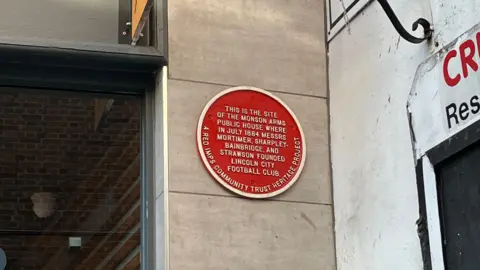
The first stop is in upper High Street, where the club was born at the Monson Arms Hotel, in 1884.
That year, all of the local teams got knocked out of the Lincoln County Cup by Spilsby, a small town about 30 miles away.
"So the feeling was that they needed a club to represent the capital of Lincolnshire," Gary says.
The pub is long gone, but a red plaque marks the site where William Mortimer, Sharpley Bainbridge and John Henry "Jack" Strawson met to form the club.
Another plaque sits on the side of the cathedral as a nod to the Lincoln Imp.
The third is on a house in Sibthorp Street, which stands next to a church hall.
It is hard to imagine today, but this was the site of Lincoln City's first ground, known as John O'Gaunts, where they played until 1895.
Sincil Bank has been home since then and remains one of the country's more traditional football grounds, with fans still walking through terraced streets to reach the turnstiles.
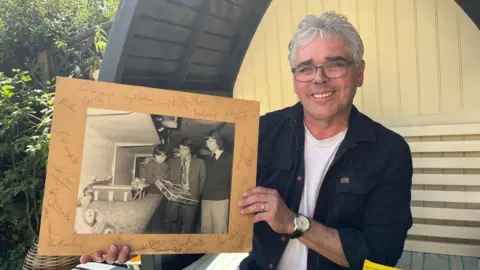
Jonathan Battersby, a fourth-generation fan, says he "can't quite believe" that the ground is undergoing a big redevelopment.
He chairs the 1884 Collective, a fans' group dedicated to preserving the club's heritage and history.
"Most fans are really, really pleased that we're developing where we are.
"It's the heart of the community, it's a special atmosphere and we're probably seeing development that we've not seen for decades."
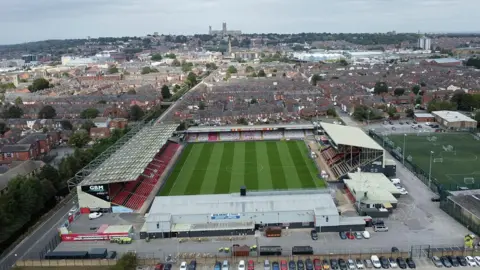
Battersby remembers the days when Sincil Bank was a "wooden stadium". His first match was in 1970, aged five, and he has been hooked ever since.
"To most fans it's Sincil Bank or 'Sinny Bank' or 'down the bank' and people know what you're talking about.
"You can still see the cathedral when you sit in the stand.
"This is just a new version, but at the end of the day it'll always be Sincil Bank and it'll always be the same place to the fans."
 AllsportUK/Getty Images
For years, Lincoln's average attendance rarely topped 4,000, but all that has changed over the past decade due to a run of success that has seen the club rise from the National League to the Championship.
Last season, that figure was over 9,400, with a high of 10,235 for the visit of Bolton Wanderers.
Gavin Gordon, a former striker who played for Lincoln between 1997 and 2000, is still involved with the club, as well as the 1884 Collective.
He says he never expected to see that rate of growth from the days when he was a striker and the "atmosphere now is tremendous".
Gordon is pleased to see community and heritage at the heart of the redevelopment.
"That's what football clubs are," he adds. "They're histories that will always be here."
Listen to highlights from Lincolnshire on BBC Sounds, watch the latest episode of Look North.
Download the BBC News app from the App Store for iPhone and iPad or Google Play for Android devices