The seafront station link to Europe's front line

 Tony Hill
Today, Folkestone's Harbour Arm houses cafes, food shops and bars, but once upon a time it was here that thousands of soldiers would have been sent off to war - many never to return.
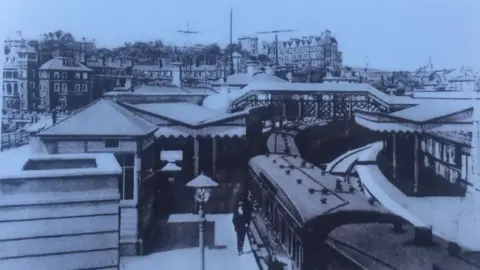
Folkestone's Harbour railway station, first opened in 1850, was originally a travel hub for the UK's elite - a gateway to Europe through which hundreds of thousands of people would pass to board boats bound for France.
But, as 1914 brought continental conflict, the station would become a site for those bound for the World War One front line.
Local historian Tony Hill told Secret Kent: "There was a cafe here, and that would be where people would have their last cup of tea and a slice of cake in England."
He added: "Dozens of trains would be coming in and going out throughout the day with thousands and thousands of troops. You can imagine the bustle and smells, what a place it would have been.
"People from all over the Commonwealth nations who helped Britain fight in Europe would have gone down what is now called the Road of Remembrance."
Despite its wartime importance, Folkestone Harbour's railway station was originally a key route through which travellers to Europe would arrive at the Kent coast, promptly leaving for trips abroad.
Opened by South Eastern Railway, the station was a direct competitor to the London Chatham and Dover Railway, also operating in Kent to help people reach France.
By 1900, about 200,000 passengers were believed to be using Folkestone Harbour each year, and that number had risen to half a million by 1911.
After the war, the station's fortunes began to fade.
"The Channel Tunnel saw the end of the station," Hill says.
He added: "It was becoming very, very tired with not a lot of investment."
Nowadays, the surrounding Harbour Arm has been repurposed as a site for people to have a drink, a bite to eat and a day out, but the station still remains as a walkway to services across the seafront.
But despite its changes, its history is still of huge significance to visitors, Hill says.
He said: "I'm very proud to still be sitting on the edge of the platform.
"A lot of residents still remember it as it was, but it has been gentrified now - it's become a very nice place to visit."
Follow BBC Kent on Facebook, on X, on Instagram and listen to BBC Radio Kent on Sounds. Send your story ideas to southeasttoday@bbc.co.uk or WhatsApp us on 08081 002250.