Iran begins public mourning for Ayatollah killed in February
Iran has begun several days of public mourning and funeral processions for its former Supreme Leader, Ayatollah Ali Khamenei, more than four months after he was killed in strikes launched by the US and Israel.
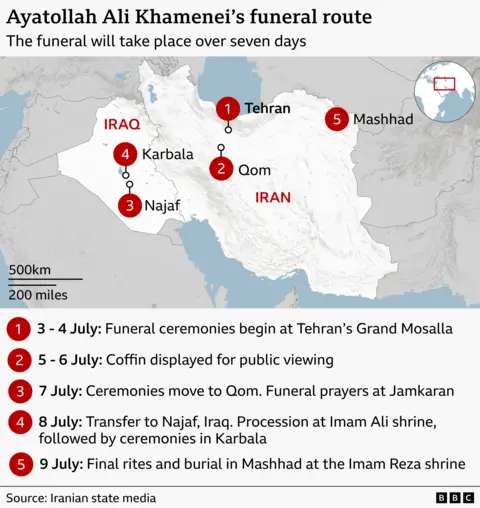
The former Ayatollah's body is currently lying in state at Tehran's Grand Mosalla, ahead of his burial in his hometown of Mashhad next Thursday.
Iranian authorities said 12 to 20 million people were expected to attend the ceremonies, which are part of what they are calling the "funeral of the century".
It comes as Iran and the US observe a fragile ceasefire after signing a preliminary deal to halt their conflict, in which Khamenei was killed in an air strike.

 Reuters
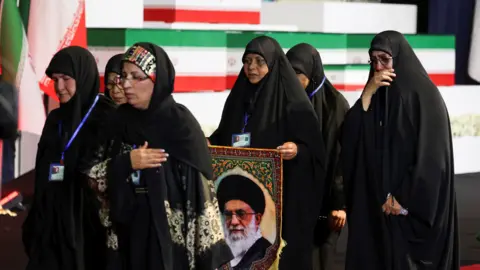
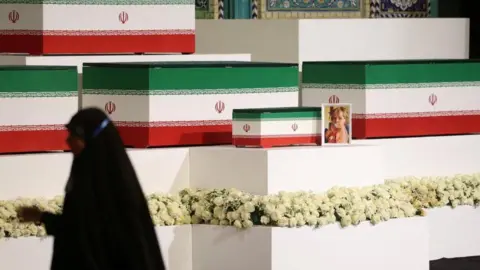
Footage showed Khamenei's coffin, bearing the colours of the Islamic Republic, being carried aloft at the Grand Mosalla on Friday.
Iran's President Masoud Pezeshkian was among those paying their respects after the coffin was placed at the vast religious complex.
Pakistan's Prime Minister Shehbaz Sharif, whose country has mediated peace talks between the US and Iran, former Russian President Dmitry Medvedev and the Afghan Taliban's Foreign Minister Amir Khan Muttaqi were in attendance.
Representatives from Iraq, Armenia, Turkey and several Gulf states – Saudi Arabia, Qatar and Oman among them – have also arrived for the processions.
There will be an official funeral ceremony in Tehran on Saturday, which the Tehran-based Mohammad Rasulullah Corps is leading, as part of six days of ceremonies.
Khamenei's body will lie in the Grand Mosalla for three days, alongside the remains of family members who were also killed in the US and Israeli strikes in February.
Mohammad Rasulullah Corps commander Hassan Hassanzadeh said Khamenei's coffin would be displayed on an elevated platform, with crowd flows designed to allow visitors to enter and leave within 15 to 20 minutes.
The supreme leader was killed during joint Israeli and US strikes on Iran in late February, precipitating a major regional war in the following months.
US President Donald Trump acknowledged the week of mourning taking place in Iran on Friday night, adding that the country was "dying to settle" as negotiations to end the war continue.
"We gave them [Iran] a week off for a funeral because we're nice," he told a crowd gathered at Mount Rushmore for his address on the eve of 4 July celebrations marking the 250th anniversary of US independence.
 Reuters
Authorities have ordered public and private offices in Tehran to close from Saturday through to Monday, while traffic restrictions will shut down most of the city centre to private vehicles, AFP reported. The airspace over Tehran was partially closed on Friday and will be fully closed on Monday.
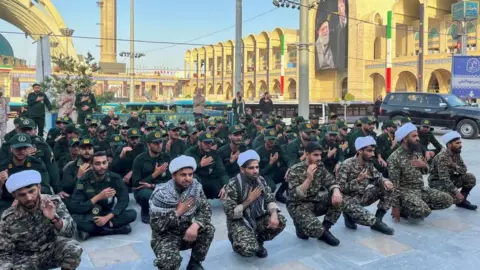
On Tuesday, events will move to Qom, just south of Tehran, where a senior Shia cleric will lead funeral prayers at Jamkaran - one of Iran's most prominent and symbolic religious sites.
 Reuters
Khamenei's body will then travel to Najaf in Iraq on Wednesday. Following a procession at the shrine of Imam Ali, Shia Islam's first imam, ceremonies will continue in Karbala before the body returns to Iran.
Iranian officials say the Iraq events follow requests from Iraqi groups, with some analysts seeing them as representative of Khamenei's influence across the Shia Muslim world and Iran's religious and political ties across the region.
Iranian Foreign Minister Abbas Araghchi visited Baghdad to co-ordinate the arrangements, saying the funeral had a "symbolic importance".
On Thursday, Khamenei will be buried in the city of his birth, Mashhad, at the Imam Reza Shrine, the mausoleum of Shia Islam's eighth imam and Iran's most important pilgrimage site, which attracts millions of visitors each year.
Ceremonies will continue across the country for 40 days, with commemorative events planned until the first anniversary of Khamenei's burial.
 Reuters
Khamenei was succeeded by his son, Mojtaba, who has not been seen in public since becoming supreme leader.
Key questions around the ceremony centre on whether Mojtaba will attend the funeral.
Last week, secretary of the organising committee, Ali Akbar Pourjamshidian, said any decision on Mojtaba's attendance would be announced by the offices of the armed forces commander-in-chief and the supreme leader.
Questions also remain about who will lead the funeral prayer, as in Shia tradition the role carries religious and political significance.