The Paleoartists bringing dinosaurs to life

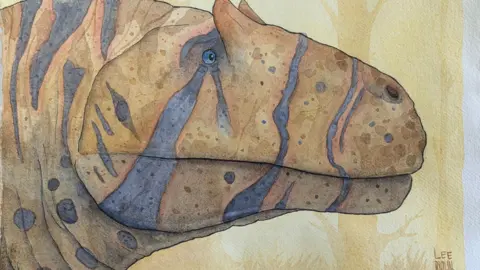 Lee Brown
Paleoartists from Devon are hoping exhibitions of their artwork will get young people interested in newly discovered dinosaurs and the South West's Jurassic coastline.
Paleoart merges science with creativity with artists creating images or sculptures of prehistoric creatures.
Using scientific research from bones and fossils, artist Alex Pritchard has recreated dinosaur skeletons for museums across the world and is hosting an exhibition of his work in Kents Cavern, in his home town of Torquay.
Lee Brown, from Newton Poppleford, will have his watercolour depictions of carnivorous dinosaurs displayed with the work of 17 other artists at the Fossil Festival in Lyme Regis this weekend.
Lyme Regis Museum, which runs the festival, said it had seen an increase in interest in paleoart in recent years and it had decided to dedicate more of the event to it, with talks, demonstrations and workshops by paleoartists from across the country.
Bridget Houseago, the museum's director, said paleoart "is hugely important for our understanding of what the Jurassic world looked like, but also, as science develops and we get more knowledge, those images develop too".
Some events focus on well-known paleo-reconstruction artists like Bob Nicholls, whose talk will span his whole career.
While other exhibitors are just starting out recreating prehistoric creatures and showing their artwork for the first time.
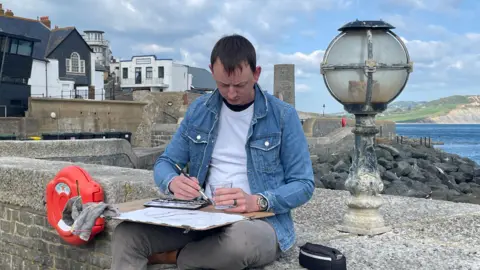
Brown paints and sketches dinosaurs in coloured pencil and watercolours, using as much scientific research as possible to inform the texture of their skin, scales and feathers
He said there was room though for some artistic license.
Keen to avoid the cliched portrayal of carnivorous dinosaurs with their jaws gaping wide, his paintings aim to give them more character and personality.
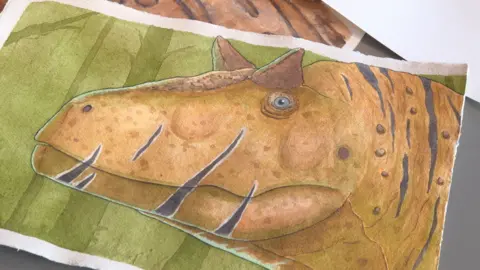 Lee Brown
Brown said specimen artists work from a snapshot of what that creature looked like when it died, the particular time of year, its sex and the age it perished.
He said: "It could have looked entirely different in a year's time, it's important to know that just one painting won't be exact."
New things are being discovered about the prehistoric world all the time and Brown said he still found it inspiring to bring something so old to life.
He said painting life-sized dinosaurs had helped him visualise their scale: "One day, I wonder... how big is an Albertosaurus head?
"I draw it and go that big apparently!"
Global audience
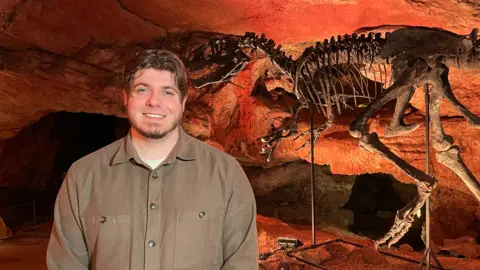
Alex Pritchard started out designing dinosaur figures for a toy manufacturer, but his life size, scientifically accurate, models of dinosaur skeletons for museums are on a whole different scale.
It took the paleoartist 12 hours to assemble the Allosaurus, which is 10m (33ft) long and 3m (10ft) tall, he made for the exhibition.
He sells these replica sculptures to institutions and collectors all over the world - they can be seen in museums in Japan, Canada and Australia.
Pritchard runs his firm Dinosaur Skeletons from his workshop in Cockington, Torquay.
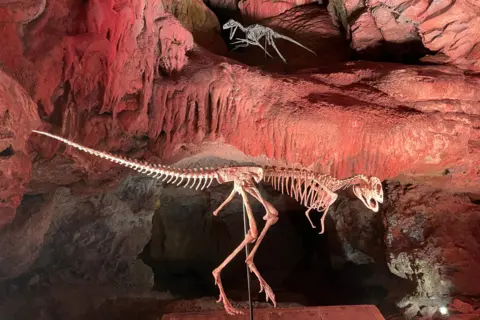
He uses a number of techniques to make the skeletons look as realistic as possible, including using 3D resin printers, resin casting, moulding and traditional sculpting in clay.
Each bone is planned out on a computer and reassembled like a giant three dimensional jigsaw puzzle in the museum.
He said: "You need a lot of attention to detail.
"You have to make sure you have all the bones numbered.
"If a box (of bones) is out of place, you need to reorder all of the vertebrae."
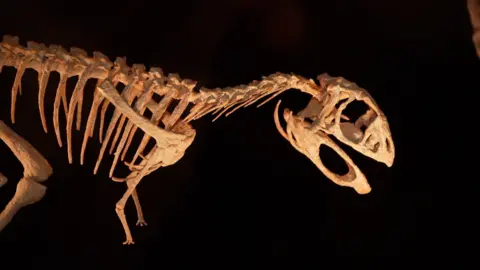
Pritchard added: "The most exciting thing I've worked on is the new specimens Berthasaura Leopoldinae and Shri Rapax.
"They are two dinosaurs where we were the first people in the world to recreate them.
"We looked at the scientific information available when they were announced and it was amazing creating them in 3D and people seeing them for the first time ever."
Kents Cavern is nearby to his workshop and he said he wanted to give Torbay families the opportunity to see as many dinosaurs as possible without travelling to London, like he had to as a child.
The age of the dinosaurs exhibition can be seen at Kents Cavern until 31 October and The Lyme Regis Fossil Festival is on from the 13-14 June throughout venues in the town.
Follow BBC Devon on X, Facebook and Instagram. Send your story ideas to spotlight@bbc.co.uk.