Hours each day in an iron lung kept her breathing, her will to live kept her alive

 Cindy McVey Handout
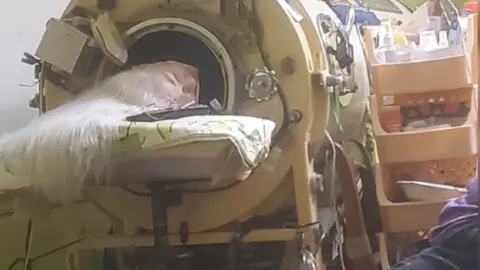
Martha Lillard was the last polio patient in the US who used an iron lung but her family told the BBC she never let it slow her down.
Even with the large metal device encircling her body for hours each day for most of her life, Lillard found a way to drive a vehicle, took up painting and cared for her beloved beagles.
"[Lillard] was resilient, she would find a way, or make do," her younger sister, Cindy McVey, said.
The Oklahoma resident passed away at the age of 78 late last month. While her official cause of death was listed as post-polio syndrome and chronic pulmonary failure, McVey attributes her sister's death to the effects of long Covid-19.
The iron lung uses a negative pressure system. Powered by a motor, its bellows suck air out of the cylinder, creating a vacuum around the patient's body and forcing the lungs to expand and take in air. When the air is let back in, the same process in reverse makes the lungs deflate.
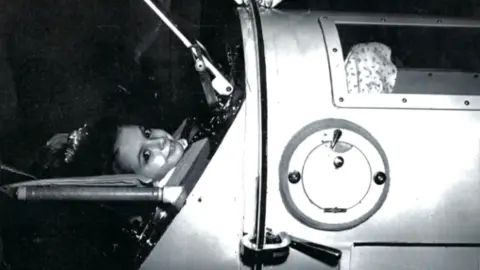
Tens of thousands of people relied on iron lungs to live, following polio's peak in the 1950's. For some 73 years Lillard used the machine to stay alive.
 Cindy McVey Handout
She did not fear the machine, the way some children did.
"It recharged her and made her feel better," McVey said.
When Lillard was diagnosed in the mid 1950's, talk and concern of the incurable disease was all consuming.
Even Lillard herself, as a five-year-old, knew and worried about the disease, her sister said.
"Martha woke up and she couldn't lift her head off the pillow, she said she knew right away that she had polio, because she heard so much about it," McVey said.
Following a stint in the hospital, Lillard and her family were focused on recovery. Lillard was in physical therapy, occupational therapy and water therapy, trying to retain as much strength as she could, ultimately regaining partial use of her left arm and use of her legs.
It was not just Lillard who was determined to live life like her peers, her family insisted and committed to doing whatever they could.
Lillard's uncle and grandfather created a contraption that would open the iron lung so Lillard could live alone and get in out of the iron lung herself.
"She could do things most iron lung patients couldn't do," McVey said.
A vehicle was retrofitted so that Lillard could drive. Placing the wheel in a position so it would sit in her lap and be accessible to her.
The turn signals were on the floor, also accessible for Lillard, who had limited arm mobility.
She was an artist and an intellectual, McVey said, describing the detailed landscapes her sister would paint and the numerous questions she would ask her Alexa device.
Lillard enjoyed spending time talking with her partner of more than 20 years, Baha Salh, who upon getting a visa this year moved to the US from Egypt and married Lillard in February, McVey said.
Lillard died on 26 June, her sister said.
'The disease disfigures, disables and leaves people trapped'
Primarily affecting children, polio wrecked havoc in the late 19th and early 20th centuries, killing and maiming scores of children.
According to the World Health Organization, one in 200 polio infections leads to irreversible paralysis. Among those paralysed, 5-10% die when their breathing muscles become immobilised.
A vaccine for polio became available beginning in 1955. In the US, where Lillard was born, polio was declared eliminated in 1979, meaning it no longer routinely spread among the population.
That was thanks a US-wide vaccination campaign.
But today, vaccine hesitancy in the US is growing and health officials in the Trump administration are suggesting more vaccines become optional.
Kirk Milhoan, the chair of the Advisory Committee on Immunization Practices (ACIP) at the Centers for Disease Control and Prevention, suggested earlier this year that polio vaccines should be optional.
"As you look at polio, we need to not be afraid to consider that we are in a different time now than we were then," Milhoan said. "Our sanitation is different, our risk of disease is different, and so those all play into the evaluation of whether this is worthwhile of taking a risk for a vaccine or not."
That type of rhetoric worries McVey.
"Polio is terrible" she said through tears. "The disease disfigures, disables and leaves people trapped. We had it under control here and now we have all these people who aren't vaccinating their children."
McVey worries that memories of polio are too far removed to remember how serious it can be.
"They may think there's problems with the vaccine, but there's a whole lot more problems if they don't vaccinate," she said.
Lillard got polio the year before the vaccine came out.
"I had a friend who got to test that vaccine the year Martha got polio," she said.
"It was that close."