From coking plant to cutting-edge technology - AMRC turns 25

 BBC/Laura Jones
It's 25 years since the site of the former Orgreave colliery and coking works was transformed into the high-tech Advanced Manufacturing Research Centre (AMRC).
As a new facility opened its doors at the centre near Rotherham, the BBC spoke to those based there about their work.
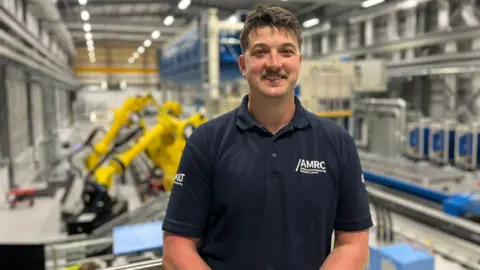
Ricky Rowett is the factory manager of the new Compass (Composites at Scale And Speed) facility, the latest addition to the University of Sheffield's Advanced Manufacturing Research Centre.
"We're making eight metre (26ft) long wing spars for single corridor aircraft," he says.
"We have five large robots, three of which are the biggest in Europe."
He said the facility would help take away the risk for companies wanting to try new ways of making huge parts for projects like planes.
Once up and running, it will take as few as eight people to keep the factory operational - a stark contrast to the manual labour carried out by hundreds of miners at the former colliery.
The robots, from the brand FANUC, are the future of manufacturing now, Rowett says.
"When these are moving at speed, you're in awe. How quiet they are, how flexible they are, and how precise they can be, and how elegantly they move, they can fit between such tight spaces."
Rowett is now in his 19th year at he AMRC, having started as an apprentice aged 16.
Hailing from nearby Stocksbridge he was brought up with "heavy influences" from the steel industry, but is now part of the centre's cutting-edge developments.
"Watching these robots move around, and do that automatically at the speed they can do it and the accuracy they can do it, is phenomenal," he says.
"You go back 70 years and we were at the forefront of creating aircraft for the Second World War, now we're using newer technologies and doing that at speed and scale. It's brilliant."
 BBC/Laura Jones
The AMRC was created 25 years ago to revitalise the area after the demise of the mining industry and has attracted global names such as Boeing and McLaren.
It was the brain child of Prof Keith Ridgway of the University of Sheffield and businessman Adrian Allen who were working toghther on a project with Boeing.
The two men wanted to find a way to bridge the gap between the cutting edge research happening in university labs and the day-to-day needs of the production line.
Now, leading academics work with industry to improve manufacturing processes and solve their trickiest problems, with a particular focus on aerospace, defence and nuclear sectors.
Boeing has its only European manufacturing facility here, making parts for its world famous 737s.
Look out of a plane window during landing as the flaps lift up and you may see green parts underneath – those are manufactured here.
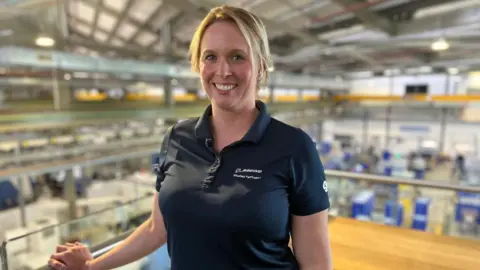
"These are the inner workings of that system which is really important for the control of the aircraft," Boeing site lead Katy Greatbatch told BBC Radio 4.
"We have one main production hall in Boeing Sheffield crammed full with a lot of machines.
"Boeing were one of the initial members of the setup of the AMRC, it makes good ideas into practical solutions.
"We have a lot of short burst research projects where we have challenges within production and the AMRC is extremely reactive and responsive to help us out, which is a little bit different to what you'd get from a normal research centre.
"This is not just academics behind a screen. These are people that can physically make parts and make a difference."
 BBC/Laura Jones
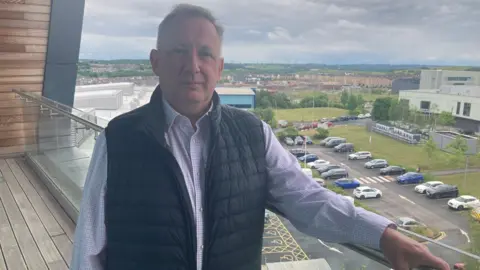
Prof Rab Scott was one of the first people based at the AMRC, and went on to become the centre's director of industrial digitalisation before retiring in 2025.
"I was one of the original eight people, when we started here in 2001 we had no idea of what this would become," he says.
"I remember sitting in our very first building in 2004, just seeing the old 100-tonne tipper trucks going backwards and forwards, getting filled with the spoil from the old open cast site where we now see 2,000 houses.
"The vision was to put South Yorkshire back on the map for industry, metallurgy and machining, back where it came from.
"The mining villages are benefiting from the effects of the advanced manufacturing park, it's not just about people getting parachuted into the AMRC and then going home to somewhere else at the end of the working day."
The Northern Powerhouse Partnership says the part of Rotherham where most of the industrial park is based saw a tripling in the value of goods and services generated in the area between 2004 and 2023.
Meanwhile, Oxford Economics say the increase in Rotherham's manufacturing growth as a whole has been better than the UK average.
Anthony Breach, director of policy and research at Centre for Cities, said deindustrialisation hit places like South Yorkshire hard, as it relied on industrial jobs for its economic success, but that the AMRC had worked to find new outlets for those skills.
"We are seeing, like in the AMRC, there is still this kernel of highly skilled, highly specialised manufacturing expertise," he said.
"It's a highly productive, successful hotspot of manufacturing activity but it can't replace all of the employment that was in manufacturing and mining in the past.
"It's one arrow in the quiver of the local economy that has to be paired with other interventions such as transport to make the whole city region an attractive place."
Listen to highlights from South Yorkshire on BBC Sounds, catch up with the latest episode of Look North