'It's video game territory' - Royal Navy drone tester

 PO Phot Rory Arnold
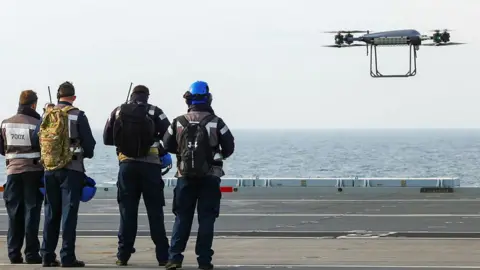
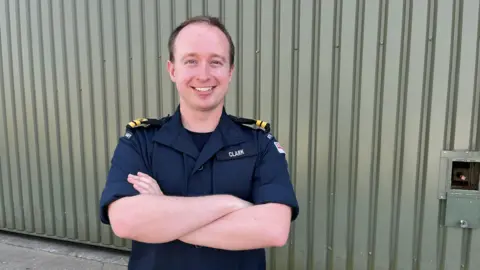
"The vast majority is video game territory," says Royal Navy drone tester Lt Jack Clark. "It's all about experimentation."
Clark is based at Royal Naval Air Station Culdrose on the most southerly tip of mainland Britain where he and colleagues are at the vanguard of the Royal Navy's drone testing programme - likely to be a key element of the delayed defence spending strategy.
Culdrose, which is one of two Royal Navy helicopter headquarters and home to a fleet of submarine-hunting Merlin helicopters, is also the base for the men and women of Clark's team - the 700X Naval Air Squadron.
As well as testing drones, they are also skilled at operating them from warships and work both at the nearby remote Predannack Airfield and across the world.
 PO Phot Chris Sellars
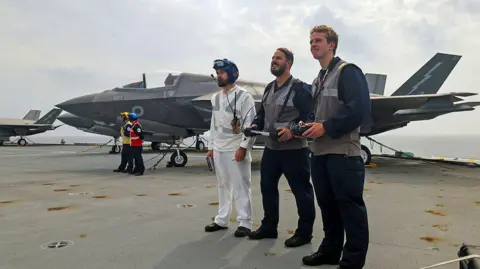
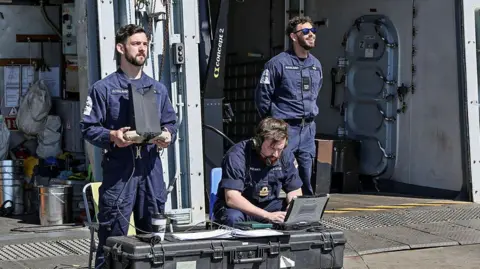
"We have two laptops, a joy stick for manual flying... we send it where it needs to go on a map on a screen on a laptop," says Clark.
"So for the video game generation this is kind of built with you in mind."
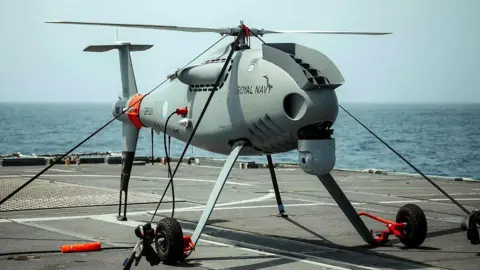
He is part of an aircrew which flies Peregrine - the first remotely-piloted helicopter operated by the Royal Navy.
Equipped with a powerful radar for night surveillance in "complex maritime and coastline areas", it was deployed in 2025 to look for drug-smugglers in the Middle East.
Clark is now back in Cornwall as part of a training team at Predannack, which is set on exposed heathland with a "big safe area" - meaning uncongested air space -where drones can be tested safely before their deployment.
He helps to maintain crew "currency", or the hours of flying time needed to remain proficient.
He says "drones are out there for everyone" - but points out few have the range and endurance of their elite fleet.
Although aircrew may be operating at arms' length, Clark is also keen to emphasise the skill and concentration required for high stakes drone manoeuvres.
"We're still driving it... making sure temperatures and pressures are happy," he says.
"It's all about load management, what are the camera and radar seeing - and interpreting that for operational gain."
Squadron members are recruited from across the Royal Navy from previous roles including sailors, engineers and air crew.
They also provide drone training for Royal Marine Commandos.
While the RAF and Army have their own drone units - and the Royal Navy has a department that looks at autonomous boats and submarines - 700X is the only unit that deploys drone flights to sea on warships.
Drone Profile: The Peregrine
 Lt Cdr Fraser Simon
- The Royal Navy's first remotely-controlled helicopter was tested at Culdrose and has now been deployed to gather intelligence, surveillance and for reconnaissance
- Launched from the flight deck of frigate HMS Lancaster, it was used last year during sweeps of the Indian Ocean and Gulf of Oman looking for smugglers and drug-runners on the so-called 'Hash Highway'
- At just 3m (10ft) long, it is capable of sorties lasting up to five hours at ranges well over the horizon
- It is able to send data and live radar pictures back to the warship's operations room
'Take a human out of danger'
Big delays to the report on government defence spending, led to warnings from the Public Accounts Committee (PAC) of higher costs in procurement.
Now it has been published, the Ministry of Defence (MoD) says the Defence Investment Plan will "fix the outdated, overcommitted and underfunded programme we inherited".
Under the strategy, plans to replace ageing warships would be scrapped in favour of a £5bn "advanced uncrewed systems" scheme, with £1.5bn earmarked for a new modern "hybrid" fleet - combining autonomous vessels and AI with warships and aircraft - as as well as £1.6bn new investment in drones.
When it comes to this hybrid revolution, 700X Naval Air Squadron is ahead of the curve, as explained by Culdrose Commanding Officer Capt James Hall.
"There are many roles a drone can do," he says.
He says the goal is to look for where you can "either take a human out of danger" or "do something that gives you more persistence or more capability".
"Our target is to be crewed wherever necessary and uncrewed wherever possible," he adds.
This "exciting target" means drones can, for example "complement a Merlin helicopter on an anti-submarine warfare mission".
In this case, he says, the drone could "extend the reach" of the aircraft or "provide a presence" when the helicopter needs to "rearm and resupply".
 LPhot Robert Oates
Hall describes drones with "exquisite cameras" or "sensors which decide or affect what is happening in the airspace".
Of the base near Helston, he says the "unique location" gives "access to air space in a low population density", allowing them to "test and evaluate" new equipment with industry partners and small companies.
The next stage is collaboration with academics and regulators - before the drone is finally placed in the hands of personnel and tested in a "war environment".
He describes the squadron's "operational tempo" as the highest he's known it since he joined the Royal Navy more than 20 years ago.
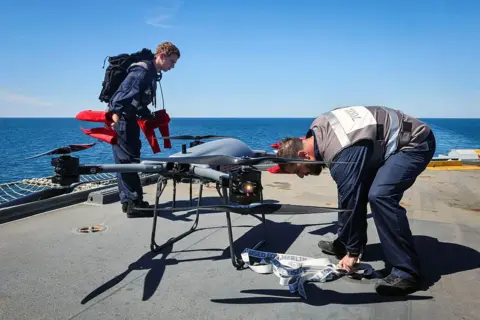
Drone profile: Malloy T-150 'Octocopter'
 LPhot Bill Spurr
- Dubbed the Octocopter, it has eight 2ft (60cm) rotor blades
- It underwent two years of trials and development by 700X Naval Air Squadron, in the Arctic and the Indian Ocean
- Needs a team of two to fly - one remote pilot and a second to monitor the command unit and can be flown manually or autonomously with an "underslung cargo"
- Can run for 40 minutes at up to 60mph (96.5km/h), with the ability to lift 68kg (10.7st)
- Now deemed "ready for use", to be deployed to carry ammunition, weaponry, food, personal and medical supplies to Royal Marines Commandos operating in extreme environments
- Used by marines in the Troms region of Norway earlier this year to support NATO mission rehearsals, including transporting a bomb disposal robot across the battlefield
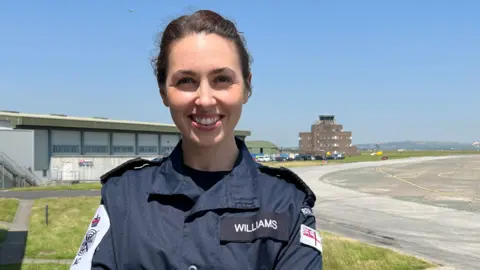
The technology that enables drones and AI is now increasingly integrated into life beyond defence - a fact PO Megan Williams sees regularly in her air traffic controller role when dealing with civilians flying their own drones for fun in their restricted airspace.
"They've just got them and are excited to fly them and get pretty photos because we're in a beautiful area," she says.
"They believe they can fly them wherever they want to."
Which, she adds, makes a subsequent police escort "unwelcome".
With the defence spending plan came a clear message - AI and drone warfare have arrived.
At its launch, Defence Secretary Dan Jarvis referenced an "increasingly dangerous and unpredictable time", with "uncrewed systems" defining the conflicts in Ukraine and the Middle East.
He said investment in evolving technologies would help the Armed Forces "stay ahead of adversaries".
Units like 700X are at the cutting edge of this new world.
"We're embracing emerging technology around drones because the pace of technological change will never again be as slow as it is today," says commanding officer Hall.
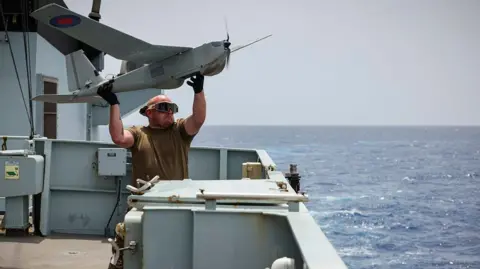
Drone Profile: The Puma
 LPhot Matt Bradley
- At just over 4.5ft (137cm) long with a wingspan of 9ft (274cm), the fixed wing Puma is one of the smallest drones operated by the Fleet Air Arm
- Operated by controllers on a ship or on land and flies for up to two hours feeding back imagery and gathering intelligence
- In service with 700X Naval Air Squadron for several years
- During testing in the Atlantic, a Merlin helicopter turned off the radar and instead relied on the Puma