Missing eagle found safe after two weeks in the wild

 Huxley's Birds of Prey Centre
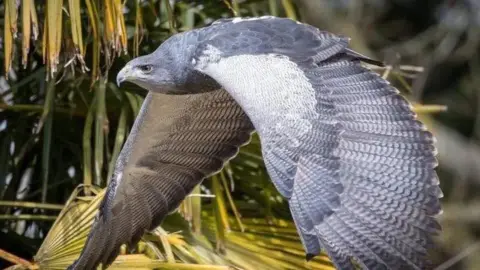
An eagle which was missing for nearly two weeks after flying away from a country show in Surrey has been found alive and well.
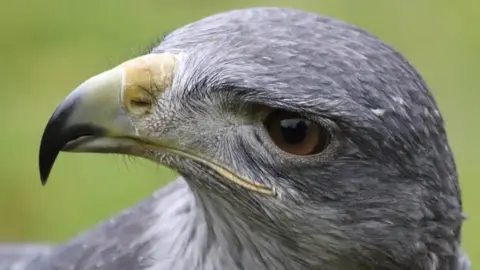
Cillian, the Chilean blue eagle, vanished from the Cowpie Country Show in Lingfield on 14 June, but was found in a nearby field on Saturday.
Luke Lloyd, from Huxley's Birds of Prey Centre in Horsham, said Cillian was found in the field of a farm next door to the country show site.
"I went out there and saw him sat on a gate in a barn," he said. "As soon as he saw me he came running over and jumped on my glove, had some food and sat there really nicely."
 Huxley's Bird of Prey Centre
"We're relieved, he wouldn't hunt for himself in the wild. If he was out for too long and we couldn't find him, the chances of him surviving were pretty slim.
"He had lost a bit of weight, so it suggests he hadn't really been eating much. It wasn't too much to the point that it required veterinary treatment or we were concerned."
Chilean blue eagles, also known as black-chested buzzard-eagles, are indigenous to large, open areas of South America.
The birds can have a wingspan of between 149cm (4.9ft) and 200cm (6.5ft), with males averaging about 2kg.
Cillian, who the centre estimates has a 152cm (5ft) wingspan, has been at the centre for three or four years, Lloyd said, having been sent to them by another centre in the UK.
Lloyd said: "They're birds that are bred in captivity, they're used to being cared for, being given food, given veterinary treatment.
"They don't start looking to roam, they're looking for someone to feed them."
He said Cillian may have scavenged some food but had not eaten much. He added that the transmitter they use for their birds had failed so they could not track Cillian when he flew off.
Lloyd added: "They tend to get their water from their food. Given the heat, he would have survived off fat reserves and he knew where the shade was. He was sensible in that regard."
Follow BBC Sussex on Facebook, X, and Instagram and listen to BBC Radio Sussex on Sounds. Send your story ideas to southeasttoday@bbc.co.uk or WhatsApp us on 08081 002250.