Hundreds of council workers face wages cut in end to equal pay row

 Getty Images
Hundreds of Glasgow City Council workers are facing a loss in wages as the local authority seeks to end a long-running equal pay dispute.
While a majority of employees would be better off under a proposed settlement, unions claims some individuals could see their pay cut by as much as £10,000 a year.
The local authority previously paid out about £770m after it emerged female workers in roles such as catering or cleaning had for years been receiving up to £3 an hour less than those in male-dominated areas such as refuse collection.
The latest proposals would see new terms and conditions aimed at ending unequal pay introduced on a phased basis from 4 April next year.
The council acknowledged that the plan, which came about following a lengthy job evaluation exercise, would leave some roles in "in detriment"
In these cases - which it has termed "red circles" - it said pay protection would be applied for six months, meaning the salary changes would not take effect until October 2027.
The council says it will "explore every possible mitigation" to help affected staff.
The new terms and conditions would apply to nearly 24,000 workers with 11% of that number negatively affected.
About 63% of the council's staff would gain financially and 26% will see little or no change to wages.
The job evaluation provided a score for each role within the council, with those scores then used to establish which pay grade - out of a possible 12 - that each job should sit in.
However, some staff are currently on pay above the maximum of their new grade.
A joint response to the council paper by several trade unions warned some employees will be left in "serious financial difficulty" as a result.
It added that female staff make up 60% of the "red circle", and that "there are employees losing over £10,000" as a result. It also claimed the majority of those facing the pay cuts work in lower-paid roles at the council .
The unions response said: "The scale of losses for certain groups of workers is unacceptable."
The response also raised several other concerns, including being "firmly opposed to phased implementation" of the scheme and to rates proposed for overtime work.
 Getty Images
Susan Aitken, the leader of Glasgow City Council, said she was "very conscious that while this process is the end of a decades-long fight for equality for many of our staff, a smaller number are going to find it difficult."
She admitted there would be a "a very real and very personal impact" for some staff, but added the new scheme would be "crucial" in ending unequal pay at the local authority.
In 2017 two judgements at the Court of Session that ruled parts of the council's Workforce Pay and Benefits Review - introduced in 2006 when Labour were in power - had discriminated against women workers.
The local authority, by then under SNP control, announced in January 2018 it planned to reach a negotiated settlement on thousands of equal pay claims arising from discrepancies in pay.
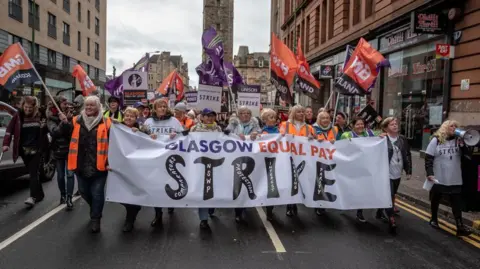
Frustration over the length of time this took led to strike action by thousands of workers later that year.
By 2022 about 19,000 cases were settled, with the council paying out £770m to cover a "gap period" between the initial agreement in 2018 and implementation of the new pay and grading system.
Aitken said: "This has been one of the most complex and challenging projects this or any other council has ever embarked on – and I'm incredibly grateful, not only for all of the hard work that has gone into getting us to this point, but for the resilience and the patience that so many of our women have shown over a number of years.
"It hasn't been an easy road and it has taken longer than any of us would have liked, but this is their moment."
She said the council had been attempting to "out-run" the problem when she took over as leader, and that "the consequences of not stepping forward to negotiate in good faith would have been catastrophic."
Councillors will decide whether to approve the proposed scheme at a meeting on Thursday. If approved, trade union members will then be balloted on whether to accept or not.
The plan will also introduce a new system of allowances and standardise the approach to public holidays across the council.