Will Le Pen rise again? French nationalist leader defiant after court's ruling
France is waking up bleary-eyed on Wednesday, with many still incredulous at the political uproar triggered by right-wing nationalist figurehead Marine Le Pen the night before.
Within hours of a court of appeal in Paris confirming her guilty verdict for misuse of public funds, she not only defiantly announced she would be running in next year's French presidential election, but she had already launched her social media campaign, too.
Pour la France - For France - reads her online poster, featuring the country's tricolour flag and a smiling Le Pen, her arms outstretched.
"Just like (the actress) Kate Winslet aboard the Titanic," muttered a French journalist I was chatting to. "France feels like the Titanic right now - sinking - at least politically!"
But Le Pen's campaign promises quite the opposite. "La Renaissance" is its subtitle - rebirth.
Le Pen has always claimed to be a woman who listens, a woman of the people. Many in France (as in a lot of European countries) feel disillusioned with politics and traditional politicians. They look at gaping inequalities in society and yearn for change.
Le Pen swims happily in these divided waters. You often hear her talk of "The People" versus the "The Metropolitan Elite" or "The Patriots" - whom, she says, she represents - fighting politically for a France that puts French people first, versus those she dismissively labels "Globalists", including her political nemesis, the current French President Emmanuel Macron.
The name of his political party is Renaissance, by the way. The fact that word features so prominently in Le Pen's new online campaign can be no coincidence. It's a dig at the man who, when he was first elected president almost a decade ago, promised he would ensure no French citizen would ever again feel the need to vote for what he called political extremes.
He made clear that he put Le Pen's National Rally Party in the extremist camp. It's not without some irony that the decisive round in France's presidential election next year could potentially feature Le Pen versus Jean-Luc Mélenchon of the far left in France.
Le Pen lost out twice to Macron in previous presidential elections. He is prevented by law in France from running for a third term, while she has never looked so strong in public opinion polls.
Rebirth is also a pertinent concept when it comes to Le Pen because she has been written off as a career politician a number of times (such as after her car crash televised debate against Macron in the lead-up to the 2017 presidential election) only to come back more powerful.
Her outstretched arms on the social media campaign poster are perhaps supposed to make us think of a phoenix rising from the ashes.
The majority in France had believed the court of appeal would not only reaffirm Le Pen's conviction for embezzlement on Tuesday but also the original sentence condemning her to a five-year ban on running for public office. Many predicted the end of her political career.
In fact, with so much political scrutiny on this case, the appeal court shortened the ban, leaving the decision to Le Pen. It allowed her to campaign for president if she chose, while insisting she wear an electronic tag for a year.

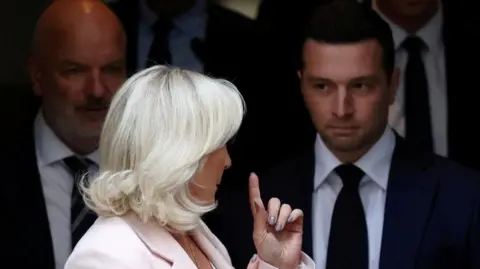 EPA
EPABut Le Pen came out swinging on French TV soon after.
"I am running for president," she announced in tones echoing her traditional discourse of standing against the French Establishment. She said she would challenge her guilty verdict and sentence in France's highest court and, before it ruled on her case, she wouldn't be wearing an ankle tag. She insisted the French people would decide who was right and who was wrong.
Critics in France describe her actions as Trumpian. They are certainly a huge gamble.
Le Pen and her legal team are possibly banking on the normally glacial pace the Court of Cassation operates at. If the court decision lands next spring, Le Pen could potentially already be president, granting her immunity for her full five-year term in office.
But the court may speed up proceedings because of the political importance of this case. Le Pen could end up having to wear an electronic tag after all, hampering her movements in the important closing weeks of the presidential campaign and reminding voters of her guilty verdict.
While that's unlikely to deter loyal Le Pen supporters, traditionally conservative voters, whom she so hopes to attract to her ranks, may be put off by the improbity of it all.
"She has been found guilty twice of embezzling €4.1m (£3.5m) in public funds stolen from French taxpayers. And so, she is a criminal. That is the only conclusion one can draw from this court ruling," commented Francois Ruffin, head of the left-leaning Debout! Party on Tuesday. "So, logically, she shouldn't be running in the presidential election."
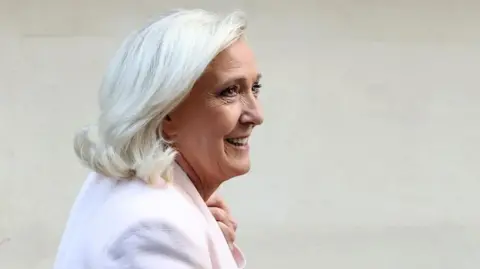 Reuters
Who runs, and most importantly, who wins the French presidential election matters, outside the country, as well as in.
France is the EU's second largest economy. It's a nuclear power and a mighty military, by European standards. It's a political heavyweight at a time Europe feels under threat from Russia and China, and increasingly isolated from its former best buddy, the United States.
Le Pen, and her 30-year-old protégé Jordan Bardella, who, if she becomes French president, is her first choice for prime minister, are both Eurosceptics and far from keen on Nato, funding Ukraine militarily or significantly boosting military spending as Macron has promised.
This makes European allies nervous.
The shape of France's political future has an impact way beyond its borders and polls suggest, regardless of the challenges before her, Le Pen has a good chance of becoming president. Though she's no shoo-in.