Campaigners to fight on after stadium challenge refused

 Oxford United
The group trying to halt plans for Oxford United's new 16,000-seater stadium has said it will fight on after it had its appeal for a judicial review turned down.
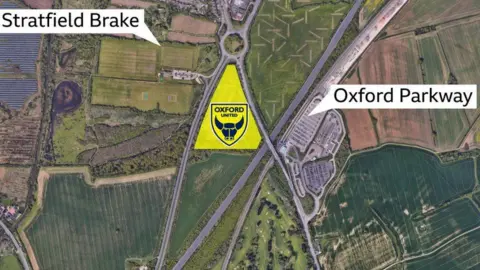
The club's plans to build on land known as the Triangle, near Kidlington, were approved by Cherwell District Council and the government last year.
Campaign group Friends of Stratfield Brake (FoSB) decided to challenge the council's decision, lodging a challenge with the High Court. It said the judge's refusal was "not unusual at this stage" and that the "scenario" was built into its legal fees budget.
Oxford United has previously suggested that the club's future could be in jeopardy were the ground not to be built.
FoSB lodged the legal complaint over the new ground's potential impact on local wildlife and aspects of the planned road closures.
It said its lawyers had applied for a permission hearing in which a barrister would set out why they believed permission for the judicial review should be granted.
It previously launched a fundraiser to cover the legal costs of the appeal.
The group expects a new hearing to be held in late July or early August.
 Google
Cherwell District Council previously said in a statement that it was "confident in its decision and in the event of any judicial review will robustly defend its position".
In a statement, Oxford United said it would continue to work with the council "to ensure the court fully understands the strength of the planning decision".
"The club remains confident that the claim will ultimately be dismissed," it added.
 OUFC
OUFCAny interested party in English planning decisions can challenge a verdict in the High Court via a judicial review.
This can only analyse the legality of the process through which a decision was reached by a planning body, and is not concerned with the conclusions of that process.
In launching proceedings, FoSB is arguing that Cherwell District Council acted unlawfully in approving the development on green belt land.
If successful, a hearing would take place at the Royal Courts of Justice with the points of law argued by both sides before the judge comes to a verdict.
You can follow BBC Oxfordshire on Facebook, X (Twitter), or Instagram.