Team with a head for heights keeps cathedral safe from lightning

 Joe Bilton/BBC
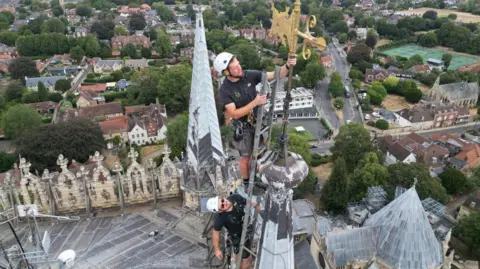
"It's a weird job, to say you're going to be up that high on a Monday morning when most people might be sat in an office," says Neil Fillery, peering out from the highest point of Lincoln Cathedral.
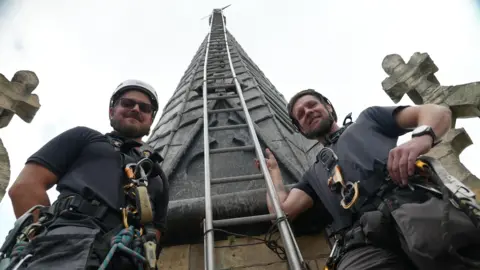
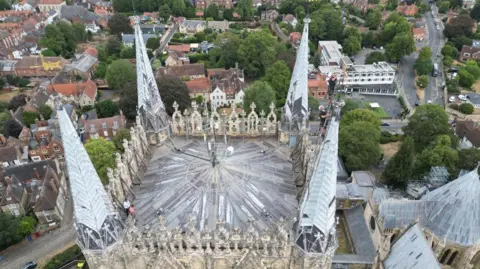
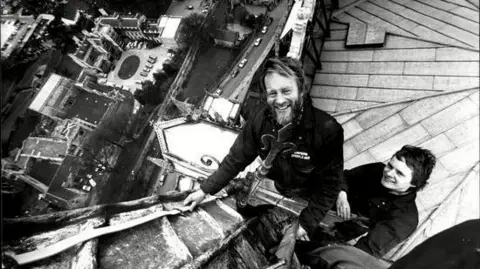
Surrounded by the cries of the resident peregrine falcons, lightning protection engineer Fillery and steeplejack Mateusz Pierwola climb a ladder to the top of the central tower's four pinnacles.
"It's such a thrill when you get up there," he says.
"Even though you've done it a number of times before, you still get a bit of a buzz from it."
The pair are reaching for the sky as they carry out checks on the cathedral's lightning protection system.
Looking out at 271ft (83m) above the hustle and bustle of the city, it is safe to say Fillery and Pierwola have a head for heights.
 Joe Bilton/BBC
The pair from Weston-super-Mare, Somerset, work for Dawson Steeplejacks, which has been looking after Lincoln Cathedral's lightning protection system since 2007.
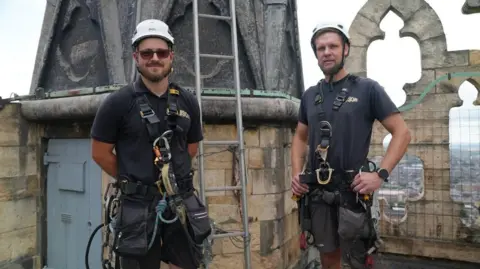
After already climbing the 338 steps to reach the central tower – there is no luxury of a lift – Fillery and Pierwola secure themselves with helmets and rope access harnesses.
"You don't want to forget anything from the van. If you do, there's a long way down," 36-year-old Pierwola says.
 Joe Bilton/BBC
Pierwola, who has been a qualified steeplejack for seven years, says his competitive streak is partly what attracted him to such a challenging job, and the views make it even more worth it.
"I love to climb up the highest things in England. The view from the top is amazing – you can just look around and just enjoy it," he says.
The pair work on cathedrals, churches and abbeys across the country.
Fillery, 35, says: "It's awesome. You get to see behind the scenes of some of the most historic and incredible buildings ever built.
"I love that it's different every day. I love that it's got a bit of exercise to it, [going] up and down stairs and up and down ladders.
"When you look out, you see a view that most people don't get to see."
The peregrine falcons occasionally keep Fillery and Pierwola company.
"You see them chasing pigeons every now and then," Fillery says.
 Joe Bilton/BBC
The two men have undertaken a lot of training in order to feel comfortable working at such heights, and Pierwola says it now feels like he is "walking on the floor".
"When I started, there was a moment when I was feeling a bit shaky up there," he says.
"When you get to know your equipment a bit more and plan your job safely, in your head you know you're safe.
"As the years go on, the height isn't a problem. You look down and you just get used to it."
 Dawson Steeplejacks
Pierwola and Fillery work together to clamber up the ladder secured to the pinnacles.
They ensure they attach the clips from their harnesses to the ladder so they are always safe.
Once they reach the top of each pinnacle, they test the air terminals for the lightning protection system. This involves checking that the connections between the metal components and lightning conductors are working.
Pierwola explains: "The lightning protection on buildings like this is very important as they are historic buildings, really old, and the maintenance on them is really important.
"The first place lightning would strike is likely to be the top of the main tower."
Ed Atherton, facilities manager at the cathedral, explains how the lightning protection system works.
"If lightning hits a particular area, usually the highest point, it runs down and into the ground and doesn't touch the rest of the building," he says.
 Joe Bilton/BBC
Atherton says the fire caused by a lightning strike that hit York Minster in 1984 is a reminder of why it is important to have a protection system in place.
"It became really important around managing fires in cathedrals and historic buildings not long after [that fire]," he says.
Dawsons Steeplejacks returns every year to check the lower levels of the building, but the lightning system is checked only every 10 years.
It means Lincoln Cathedral's four central tower pinnacles might have to wait another decade for their next human interaction, and will have to make do with the peregrines until then.
Listen to highlights from Lincolnshire on BBC Sounds, and watch the latest episode of Look North.
Download the BBC News app from the App Store for iPhone and iPad or Google Play for Android devices