'Forgotten' thatchers warn trade will die without recruits

 BBC
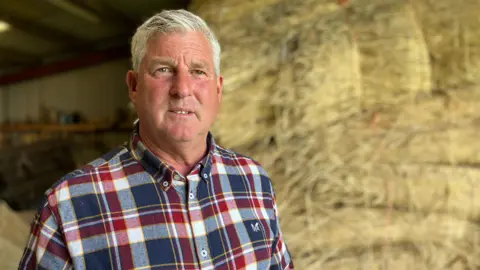
BBCThatchers say their centuries-old craft is under threat due to a lack of training opportunities, funding shortages and difficulties sourcing materials.
There are now no dedicated thatching training schools in England, meaning tradespeople must cover the cost of training apprentices themselves, something many say is no longer viable.
Steven Hewlett, a third-generation thatcher from Salisbury in Wiltshire, said the system is failing young people who want to enter the trade. When his son wanted to join the family business, he found it "very tough" to get access to training or funding,
"There's nothing in this country, no colleges for apprentices for rural crafts at all," he said.
Hewlett, based in Salisbury, said it "wasn't an easy process" but he eventually managed to secure an apprenticeship for his son, Rudy, through his membership to the National Society of Master Thatchers.
He was then directed to the Queen Elizabeth Scholarship Trust (QEST), where Rudy successfully applied for funding.
"We went up to London for an interview and he became a QEST apprentice," said Mr Hewlett.
"But he still needs family support - it's not straightforward.
"You've got to invest in the future."
'Training costs are high'
For many thatchers, the cost of taking on trainees is a major barrier.
Stephen Packham, a thatcher in Ilminster in Somerset, has been working in the trade for 47 years and uses equipment from 1918.
He has apprentices working with him currently but agrees the costs are high, especially when it comes to tax and National Insurance.
"You're spending £500 a week on an apprentice… there's nothing out there to help you teach them," he said.
"You have to stop working to teach them and it becomes quite expensive."
Training can take several years, adding to the difficulty.
"It's a four-year apprenticeship – it does take quite a long time," Packham added.
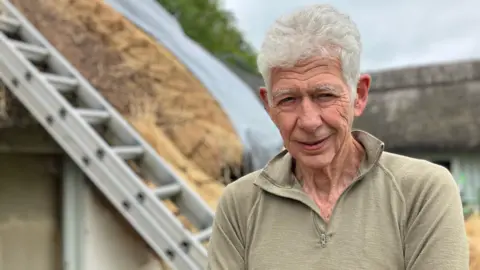
Alan Lewis, 75, from Pewsey, has been thatching since he started as an apprentice when he was just 24.
He said when he entered the trade in the 1970s, structured funding and training were readily available.
He was able to secure a grant for a thatched apprenticeship upon leaving the Royal Navy.
It was something he had no previous experience in but it fit the bill in terms of being able to work outside and the option to go self-employed once qualified.
The grant covered his wages for the first three years and also included a two-year part-time course at Knuston Hall, a training school run by the Council for Small Industries in Rural Areas (CoSIRA) in Northamptonshire.
It was the only training school in the UK, and closed in 2012.
"It's had a negative impact on the industry's ability to provide a fully trained, skilled workforce in sufficient numbers to meet the demand," said Lewis.
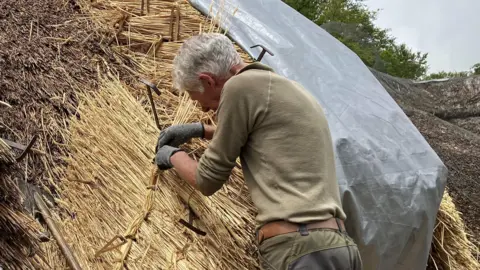
It is estimated that there are around 800 thatchers in the country, with around 60,000 thatched buildings in the UK - 45,000 of which are listed.
Despite this, Lewis fears the industry is a "dying art" which has become "a little bit forgotten".
He is now part of a group of Wiltshire thatchers calling for a new training facility and greater financial support for apprentices.
"Those who are drawn to thatching require nurturing with the correct guidance and training, not left to fend for themselves," he said.
Weather presents challenges
Experienced thatcher Brian Chalk, who has worked in the trade for nearly 50 years, said sourcing suitable materials has become another growing challenge.
Thatching requires large quantities of high-quality straw, traditionally grown and cut using specialist tools, some more than a century old.
But recent weather conditions have made production more difficult.
"It's all labour intensive and you need rain so the straw can grow tall enough," said Chalk, based in Salisbury, who has two sons who also run their own thatching businesses.
"We've had two or three years of very dry Aprils. This year we were looking for rain all the time, and it came a bit late really, we're hoping it's not too late."
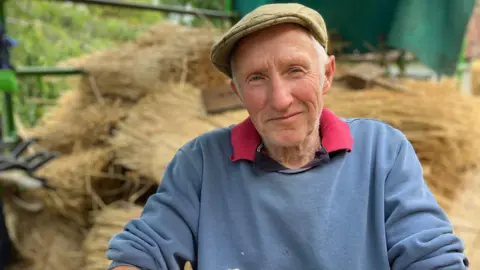
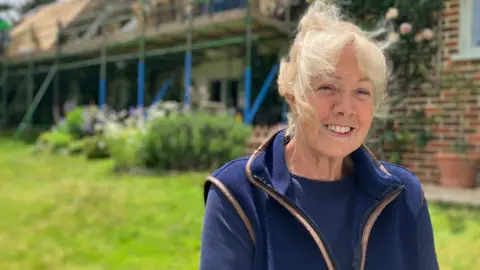
Angie Langley lives in a thatched cottage in Amesbury and said she waited more than two years for Chalk and Lewis to be available to rethatch her roof.
"I think I had a dream even as a little girl to live somewhere like this and I consider myself quite privileged to live here but it does have a cost though," she said.
Having a full roof rethatched can cost tens of thousands of pounds and take months to complete.
Follow BBC Wiltshire on Facebook, X and Instagram. Send your story ideas to us on email or via WhatsApp on 0800 313 4630.