Why an anti-sacrilege law in India's Punjab has sparked controversy

 Getty Images
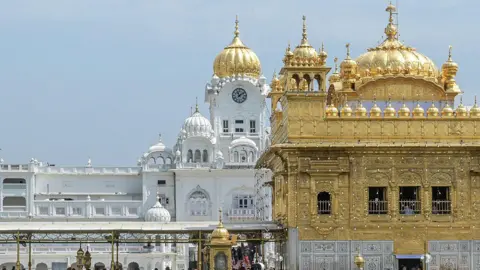
A recent attempt by the government in India's northern state of Punjab to introduce a tougher law punishing sacrilege against the Sikh holy scripture, the Guru Granth Sahib, has triggered a controversy.
The Aam Aadmi Party (AAP) government passed the legislation in April, saying it would strengthen punishment for acts of sacrilege and help deter offences against the Guru Granth Sahib.
The holy scripture contains the hymns and teachings of the Sikh Gurus, along with compositions by saint-poets from different spiritual traditions. Sikhs regard it not only as their holy scripture but also as their eternal living Guru.
But the move has been challenged by the Akal Takht, the highest seat of temporal and spiritual affairs of Sikhs.
The Akal Takht says the law does not limit itself to criminalising acts of sacrilege but also encroaches on matters that should be decided by Sikh religious institutions. It has also objected to provisions on the handling, registration and custody of the Guru Granth Sahib, saying it was not consulted before the law was passed.
What does the new law say?
The law defines sacrilege in legal terms for the first time, covering the deliberate desecration, damage, burning, tearing, theft or defacement of the Guru Granth Sahib, as well as words, signs or electronic communication intended to insult it or offend Sikh religious sentiments.
The offences are cognisable and non-bailable, allowing police to arrest suspects without a warrant and making bail harder to obtain.
Sacrilege carries prison terms of seven to 20 years and fines of 200,000 rupees ($2,096; £1,573) to one million rupees. Penalties can be higher if the offence is committed as part of a criminal conspiracy to disrupt peace or religious harmony.
Beyond criminal penalties, the law introduces new rules governing the administration of the Guru Granth Sahib, including its registration, the responsibilities of those entrusted with its care and the state government's powers to frame implementing rules.
It is these administrative provisions, rather than the harsher punishments, that lie at the heart of the Akal Takht's objections.
Why was the law passed?
In Punjab, India's only Sikh-majority state, sacrilege against the Guru Granth Sahib is among the most sensitive issues.
A series of alleged desecrations of the Guru Granth Sahib in 2015 sparked widespread protests across Punjab. Two protesters were killed when police opened fire on demonstrators in Behbal Kalan, turning the issue into a lasting political and religious flashpoint.
The handling of the 2015 incidents is widely seen as a factor in the defeat of the Shiromani Akali Dal-Bharatiya Janata Party (SAD-BJP) government in the 2017 election.
The Congress government that succeeded it also faced criticism over delays in pursuing the case.
Delivering justice in the unresolved sacrilege cases was one of the AAP's key promises in the 2022 Punjab election. After taking office, the government reopened investigations before introducing the tougher law in April.
 Getty Images
Why has Punjab tried repeatedly to bring such a law?
This is Punjab's third attempt in a decade to introduce tougher punishment for sacrilege against the Guru Granth Sahib.
The first came in 2016, when the SAD-BJP government proposed life imprisonment for desecrating the Sikh scripture, but the federal government refused clearance, saying a law protecting only one religion would be inconsistent with India's constitution.
The Congress government tried again in 2018, expanding the proposal to cover other sacred texts, including the Bhagavad Gita, the Quran and the Bible. But the bills never received presidential assent and did not become law.
The failure of successive governments to enact such a law fuelled frustration among those seeking tougher punishment for sacrilege, increasing pressure on the AAP government to act.
In 2025, the state government first introduced a broader bill covering the holy scriptures of several religions, but it was referred to a committee of lawmakers for further scrutiny.
It later took a different route by amending the existing Jaagat Jot Sri Guru Granth Sahib Satkar Act, 2008.
The 2008 law, enacted by the SAD-BJP government, regulated the printing, publication, distribution and handling of the Guru Granth Sahib and barred its unauthorised printing or publication.
The current government amended it to introduce tougher criminal penalties for sacrilege, arguing that harsher punishment was needed to deter future offences.
 Getty Images
Why did the law become controversial?
Days after the law was passed, the Akal Takht raised objections - not to the tougher punishments, but to provisions on terminology, the registration and custody of physical forms of the Guru Granth Sahib, and its administration.
It argued these were matters of Sikh religious practice that should be decided by Sikh institutions, not the state. It also opposed plans to assign unique identification numbers to physical copies of the Guru Granth Sahib and maintain a central register, saying such decisions should not rest with the government.
The Akal Takht summoned the Punjab Assembly speaker on 8 May to explain why Sikh religious institutions had not been consulted before the law was enacted. The speaker, Kultar Singh Sandhwan, from the AAP, appeared before the Akal Takht and defended the law, saying it was needed to protect the Guru Granth Sahib.
Although the Akal Takht has no constitutional authority over elected governments, it wields immense religious influence among Sikhs.
In Punjab, where religion and politics have long been intertwined, political leaders across party lines have traditionally responded to its directives on matters affecting the Sikh faith, making its views difficult for governments to ignore.
The controversy has since deepened.
The Akal Takht summoned Sikh ministers and legislators from across parties, including the AAP, to explain why they had backed the law.
During the proceedings, Akal Takht head Kuldip Singh Gargajj asked whether they had read the legislation before voting on it. Several lawmakers admitted they had not, saying copies of the bill were circulated only shortly before the debate, according to the PTI news agency.
Calling this "serious negligence", the Akal Takht head asked the Punjab government to amend the law within a month and urged it not to implement the disputed provisions until then.
The row has also become a political issue.
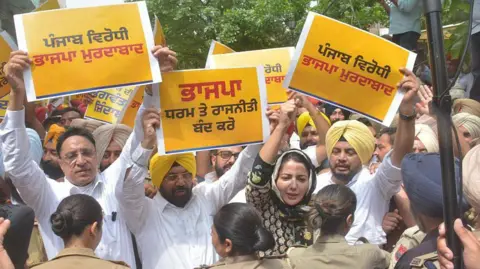
Punjab's three main opposition parties - the Congress, the Shiromani Akali Dal and the BJP - accuse the AAP government of rushing the law through the assembly without properly consulting Sikh religious institutions.
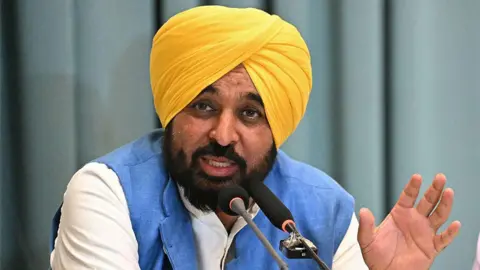
The dispute comes at a sensitive time, with state elections due early next year, adding to the pressure on Chief Minister Bhagwant Mann, who is also facing a separate controversy over an alleged sacrilege-related video.
Opposition parties have accused Mann of hurting Sikh sentiments over a video they claim shows him consuming alcohol and splashing it on photographs of Sikh Gurus. Mann has dismissed the video as "fabricated".
He has defended the law, saying it will not be withdrawn, but has indicated the government is open to considering the Akal Takht's suggestions before deciding whether to amend it.