Does Reform's plan to cut £50bn in welfare spending add up?

 BBC
BBCReform UK has set out plans it says will save more than £50bn a year from the welfare bill by 2030 if it gets into government.
The party believes it can deliver much of this by stopping foreign nationals from getting most benefits and also reforming disability payments while protecting the most "severely disabled".
BBC Verify has been breaking down what Reform says it wants to do - and how realistic it is.
Reform plans 25% cut in welfare spending
The UK government will spend £353bn on welfare benefits this year - just under half of that goes on the state pension, which Reform has said it will not cut.
That leaves £207bn - so cutting £50bn a year like Reform proposes would represent roughly 25% of total remaining welfare spending, which would be extremely ambitious.
One of the benefits Reform is looking at is Personal Independence Payments (PIP) - a working age payment that helps individuals deal with the extra costs of having a physical or mental health condition or disability.
The number of people claiming it has risen from around 2.4 million before the pandemic to four million this year in England and Wales.
Reform says around £21bn of its planned £50bn savings would come from changes to health and disability benefits including PIP.
While saying those with the most severe disabilities would be protected - Reform said around 2.89 million people in receipt of PIP will be "reassessed over time" which would lead to current payments being "modified or withdrawn" and replaced with its proposed "Disability Needs Assessment".
Analysts warn that these savings are by no means guaranteed. The Institute for Fiscal Studies think tank says there is "relatively little detail" about what Reform's plan entails.
Foreign nationals and benefits
Another big element of Reform's planned cuts comes from taking away benefits from foreign nationals. It claims around £20bn could be saved from its £50bn target if they were banned from getting benefits including Universal Credit (UC).
More than a million UC claimants were born overseas including around 700,000 EU citizens who arrived in the UK before Brexit and have the right to live and work in the country.
It's important to bear in mind that around half of EU citizens claiming UC are in employment.
The government doesn't provide figures for the number of foreign nationals claiming other benefits.
But taking away these benefit rights would not be a simple thing to do because it risks putting the UK on a collision course with the EU.
Around 4.5 million EU citizens have long-term settlement rights in the UK which means they are eligible to claim benefits.
An estimated one million UK citizens living in the EU have similar rights. Stripping EU citizens of their rights could lead to member states retaliating against the UK.
Reform says it would renegotiate the post-Brexit deal that underpins these rights but that would mean re-opening a process that was supposed to have been settled in 2020.
Another wrinkle in Reform's plan is that its planned savings could disappear if a large number of EU nationals apply to become UK citizens and were able to keep their entitlement to benefits.
Where else could savings come from?
Reform has said it is considering using a less generous measure of inflation to calculate how much benefits will go up each year to save £4.8bn a year. It also says it wants to spend extra money on tackling benefit fraud which it predicts will save as much as £2.8bn a year. However, other governments have tried to tackle fraud in the past with varying degrees of success.
The party has also pledged that people who are long-term welfare claimants and fit to work would be forced to do 20 hours of work a week in the community on council-run schemes.
It's not clear how this saves significant amounts of money on welfare given it will cost councils money to run the programmes.
Reform is by no means alone among the political parties in proposing welfare reform.
A recent review of the PIP system by Labour minister Sir Stephen Timms concluded it was "not fit for purpose". The government is expected to outline its own reforms later this year.
But analysts stress that achieving significant savings from the welfare bill is easier said than done.
Overhauling welfare can be a tricky political sell
It's also worth bearing in mind the number of PIP claimants in the constituencies of several prominent Reform MPs - such as Boston and Skegness and Ashfield - is higher than the national average.
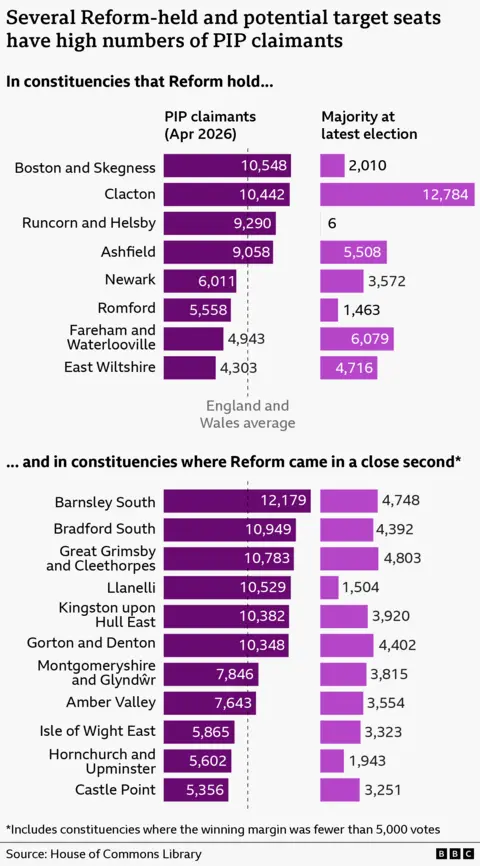
And in some cases the number of PIP claimants is higher than the size of the MPs' majorities. The same is true of some of Reform's main target seats.
This appears to be a political risk the party is willing to take.
Additional reporting by Anthony Reuben and Tamara Kovacevic
Graphics by Jess Carr and Phil Leake
