Free school meal pupils falling further behind their peers, report warns
 Getty
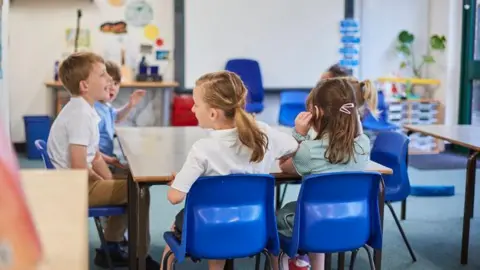
GettyThe gap between how well pupils from better-off backgrounds perform at school compared with their classmates from lower-income households has widened, according to a new report.
Despite some improvements in the years since Covid, the Education Policy Institute (EPI) said the disadvantage gap had widened again in England and was still bigger "at every phase" of school than it was before the pandemic.
The difference was "particularly stark" in early education, the report said.
The Department for Education said it was working to close the disadvantage gap by delivering opportunities for every child, including expanding government-funded childcare and extending eligibility for free school meals.
The government had previously set itself a target to halve the disadvantage gap by the time the current generation of children finish secondary school.
For its measure of who counts as disadvantaged, the EPI looked at the educational outcomes of children who had ever been eligible for free school meals, compared with those who had not.
It also categorised its data by gender, ethnicity and whether children had special educational needs and disabilities (SEND).
The EPI said the overall difference in academic achievement between low-income students and their wealthier peers was now 17% greater for children in early years than it was before Covid.
Although gaps at some school stages had begun to close post-pandemic, the report said they were widening again in the early years and at Key Stage 4, when pupils sit their GCSEs.
Disadvantaged pupils were, on average, 19 months behind their classmates from better-off backgrounds by the time they got to Key Stage 4, the report said.
For pupils with SEND, the EPI found that attainment gaps had narrowed for older age groups, but were at their highest levels on record for children who had education, health and care plans - the legal documents setting out what additional support some children with SEND are entitled to.
Disadvantaged pupils in London outperformed those from similar backgrounds in all other regions, the report said, while the gap between well-off and worse-off pupils had grown most in the South-East and South-West of England.
'Scourge on our society'
"The size of the gap between the educational outcomes of children from more and less advantaged backgrounds is a scourge on our society," Julie McCulloch, chief executive of the EPI said.
The government's "ambitious target" to halve the gap was "right and welcome", she added, but said it had to be "more exacting" about how to achieve it.
McCulloch also called on the incoming prime minister to have a "laser-like focus" to deliver on that target.
The EPI made a number of recommendations in its report for how to achieve it, including widening access to free funded childcare to all children, and increasing the amount of money schools can receive for the number of children they teach who are eligible for free school meals.
Daniel Kebede, general secretary of the National Education Union, said current tests and assessments in schools "set many students up to fail, overwhelmingly those from less advantaged backgrounds".
"Statutory testing in primary must be ended and assessment approaches in secondary must broaden beyond end-of-course exams to allow all students to achieve and thrive," he said.
The Local Government Association called for more investment in the SEND workforce, and for a review into which children qualify for funded childcare hours, to make sure "those on lower incomes do not miss out".
Last week, Education Secretary Bridget Phillipson said in a speech that the time had come to build towards a "bolder future" of "universal early years education", so that disadvantaged children would no longer miss out.
The Department for Education said the government would do "whatever it takes" to ensure every child had access to opportunity, regardless of their background.
