Influx of migrants to Ceuta gives Spain diplomatic headache

 Getty Images
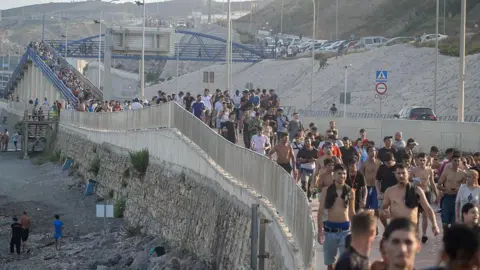
As many of the 60,000 migrants who swam or scrambled their way into Ceuta trickle back into Morocco, the prospect of a dramatic crisis has begun to gently recede.
The political and diplomatic pressure that had piled onto prime minister Pedro Sánchez after the breaching of this key border outpost may begin to fade as an expanded military and police deployment makes itself felt and the authorities process and return those new arrivals who don't leave of their own volition and fail to qualify for a right to remain.
Many appeared to be Moroccan locals, quite unprepared for the sort of arduous long distance trek undertaken by sub-Saharan migrants who cross the Sahara or risk their lives in fishing boats crossing to the Canary Islands.
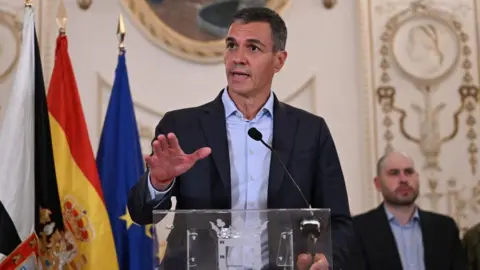
Sánchez had rushed to Ceuta on Friday morning to accuse migrant traffickers of exploiting a recent supreme court decision that had constrained the government's right to immediately deport people who had arrived by sea.
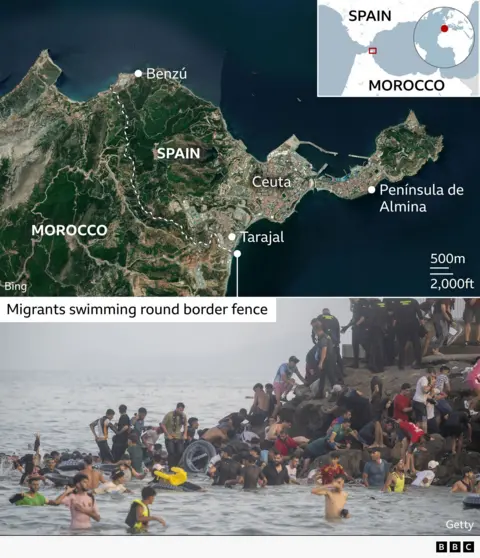
The last such big incursion into Ceuta, in 2021, saw 10,000 break into the territory, just a sixth of the number estimated to have climbed over or through or swum around its boundary fence in less than 24 hours this time.
In immediate practical terms this episode appears to have been encouraged by Moroccan border guards' readiness to stand aside and allow anyone – mostly younger or middle aged men but also some women and children - to try to penetrate this nugget of European Union territory on the North African coast, whatever the risks.
And those were considerable: at least 57 people died in the attempt, many seemingly drowned.
But the bigger question is why Morocco allowed its normally efficient forces to take such a laissez-faire approach.
And that harks back to acute sensitivities surrounding the kingdom's relations with both Europe and its neighbour Algeria – a context in which Spain plays a special role.
For it is now more than 50 years since Madrid surrendered the control of what had been its Spanish Sahara territory, in the face of a takeover by the then king of Morocco, Hassan II, while Algeria instead opted to support the indigenous independence movement Polisario, going on to house its supporters in desert refugee camps and host its political leaders.
Today the two Maghreb governments remain locked in a bitter diplomatic cold war over the territory, known as Western Sahara, a dispute that still keeps a large UN peacekeeping force positioned to monitor the fragile calm between Polisario guerrillas and the Moroccan army.
It is an issue over which European governments for decades tried to avoid taking sides.
But occasionally they have toppled off the diplomatic tightrope, provoking fury in either Algiers or Rabat.
And the latter has already shown its readiness to deploy migration pressure as a retaliatory tactic against Spain, which is particularly vulnerable to such pressure because it has two small city-territories, Ceuta and Melilla, on the North African coast, their only land borders with Morocco.
The May 2021 influx of 10,000 migrants into Ceuta followed Madrid's decision to allow the Polisario president Brahim Ghali to be treated for Coronavirus in a Spanish hospital.
Yesterday's equally sudden, albeit much larger surge of incomers, comes after a recent visit to Algiers by Sánchez.
And that trip itself had been an exercise in diplomatic fence-mending to sooth Algerian anger at a 2022 Spanish decision to abandon neutrality and back Morocco's plan to grant Western Sahara autonomy but deny it independence. The UK has taken the same position.
 Moncloa HANDOUT/EPA/Shutterstock
France too has struggled to maintain warm relations with the two bitterly opposed Maghreb rivals. But it is Spain that finds itself particularly vulnerable because of Ceuta and Melilla.
Both towns have origins dating back millennia to the Phoenician era, then later fell under Arab rule before being seized by Spain in the 16th Century, in the aftermath of the Christian reconquest of the Iberian peninsula.
But in practical modern terms, both are outposts of EU terrain on the southern shore of the Mediterranean, bounded on the landward side only by Morocco.
So yesterday's influx of migrants, however temporary, is a practical challenge for Sánchez and a political and diplomatic headache. Spain's mainstream conservatives - the Partido Popular - and hard right Vox have seized on the issue, while several other European governments have raised concerns, with Italy talking of suspending Spanish membership of the Schengen open borders regime.
But actually, because of the distinctive geographical position of Ceuta and Melilla, Spain operates a strict internal border on flights and ferries from these two cities to the mainland, thus controlling travellers' access to the rest of Schengen Europe.
Behind the fuss over yesterday's dramatic influx of people lies a deeper difference in outlook and policy.
Sanchez has pursued an "immigration positive" agenda starkly contrasting with the more restrictive attitudes of most EU states or the UK, even instigating a programme to bring Senegalese to Spain on a temporary basis as seasonal workers, mainly for the horticultural sector.
The long term political and economic sustainability of that approach remains to be tested. But it sends out a public messaging that some other European governments perhaps find unsettling and may explain their reaction to events in Ceuta.
Paul Melly is a consulting fellow with the Africa Programme at Chatham House in London