Moves to protect 'climate hero' saltmarshes

 BBC
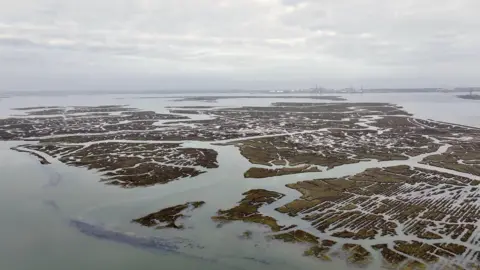
BBCThe fragile Nor Marsh saltmarshes that line the Medway estuary are under threat, scientists say.
Saltmarshes can capture more carbon than rainforests and are now recognised as one of the country's most important natural sea defences, studies from Cambridge University show.
Leading scientists have been gathering to discuss why the north Kent marshes are being recast as "climate heroes", and what needs to be done to protect them.
Along the estuary the reality of the protecting work is already visible in the creeks, mudflats and the slow rebuilding of marsh itself.
At first glance, the marshes appear still, but they are constantly changing due to the tides, weather and movement of sediment.
And, increasingly, by human intervention, the UK Centre for Ecology and Hydrology says.
"The whole of the south of England is slowly, slowly sinking, while the north is rising," said Adam Taylor, marine asset manager at Medway Council.
"Combine that with sea level rise and it becomes a double whammy for these important ecological sites."
That "double whammy" is already being felt in places like Nor Marsh, where erosion eats into the edges of the landscape.
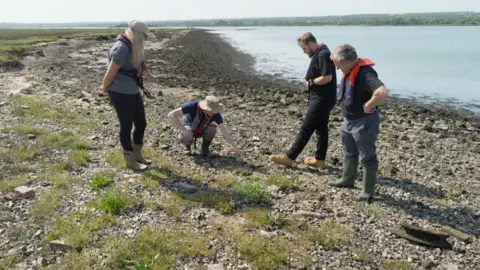
The challenge is how to protect the saltmarsh without damaging what makes it so valuable. Because these are not just flood defences, they are living ecosystems.
At high tide, the marsh fills with life. Fish move inland to feed, birds sweep in to hunt, and the shallow waters provide shelter.
At low tide, what looks barren is actually a network of roots and channels that holds the marsh together. Those roots are key.
Binding sediment and trapping silt, saltmarsh plants slowly build up land to create a natural barrier that helps absorb wave energy and protect coastal communities, the UK Centre for Ecology and Hydrology says.
That protective role is one of the reasons interest in saltmarsh restoration is growing. But it has to be done carefully.
"It's a place full of birds, even in the summer," said Medway councillor Simon Curry.
"In the winter there are far more, as birds move from the northern hemisphere to overwinter on marshes like this along the coast of England — the East Coast Flyway."
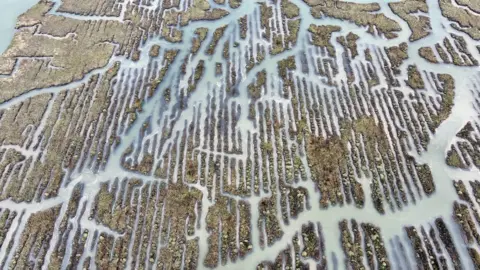
Marshes like Nor Marsh are a crucial stop-off, providing food and shelter for thousands of birds on long migrations.
That makes any change to the landscape a delicate balancing act. Protecting the marsh to defend people, while preserving it for wildlife.
Back on the River Medway, restoration work is focusing on allowing natural processes to recover - encouraging silt to settle, rebuilding vegetation, and slowing the rate of erosion.
It is a slow process, but scientists believe could have long-term impact, because what is happening in north Kent is part of a much bigger picture.
As sea levels rise and coastlines come under increasing pressure, places like the Medway estuary are becoming test sites for how nature itself might provide the answer.
Follow BBC Kent on Facebook, on X, and on Instagram and listen to BBC Radio Kent on Sounds. Send your story ideas to southeasttoday@bbc.co.uk or WhatsApp us on 08081 002250.