The food banks buying in supplies to meet demand

 BBC
BBCAt a huge warehouse in South Yorkshire, pallets of tinned carrots are being unloaded from an articulated lorry and forklifted inside. They have come from China to stock shelves in a food bank in Meadowhall.
It is a far cry from the small bags of donated items that kept food banks going five years ago.
These days, food banks are increasingly buying their own products simply to meet demand.
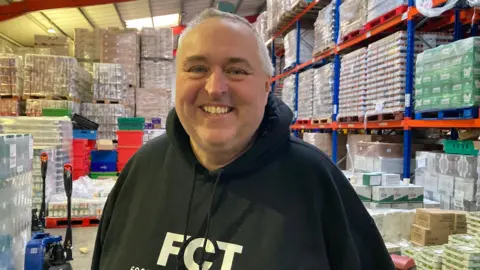
Chris Hardy, who manages Sheffield S6 Foodbank, a charity that runs 12 food banks in the city, says they used to rely on donated food, "but, unfortunately, donations are unreliable, so we've gone to a model of purchasing food".
Buying food guarantees a controllable supply of the items needed to fill crates for families in need, he explains.
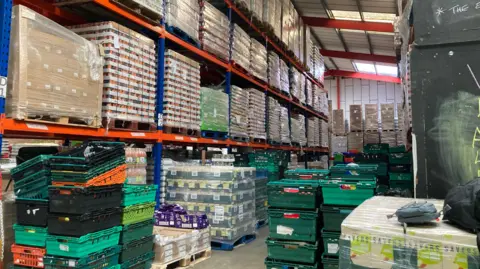
Mr Hardy is just finalising the move into the Meadowhall warehouse, because the charity needs more space.
He says he has overseen a huge change in the way the food banks are run and he never thought he would become a food importer.
He describes the development of the food banks he has been involved with over the past few years as "crazy".
"We got here just by the sheer need of people needing food banks and the scale of the need in Sheffield and further afield," he says.
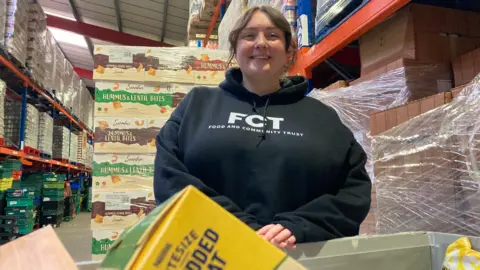
The Sheffield S6 Foodbank feeds 1,200 people, including 400 children, each week.
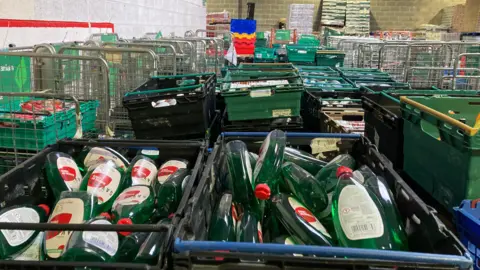
The crates they send out typically contain 30 items including toiletries and loo roll, alongside tinned tuna, tomatoes, chilli and various vegetables.
"One of our biggest imports is tomatoes," Mr Hardy explains.
"We buy around seven containers of tomatoes every year which is 350,000-400,000 tins of tomatoes.
"Those tins in a supermarket are about 43p and we're paying about 33p for them, so we're saving about 10p per tin.
"Over the 300,000 tins, it's a good chunk of saving."
That saving is now passed on to other food banks in the UK.
"When we worked out we were saving money for ourselves, it just made sense that we helped our other food banks in our area and nationally," he says.
"We're all trying to make sure we're there for every person in our community - and we do that by saving money together."
In the Yorkshire and Humber region, the latest figures from The Trussell Trust, one of the country's major food bank charities, show 211,604 emergency food parcels were given out in 2024-25 - a rise of 95% over the last five years.
Recently though, the numbers have started to fall, and Bethany Willcox, logistics manager at Sheffield S6 Foodbank, says that is something to be welcomed, even as she chases cheap deals abroad and appeals for money to be donated rather than actual food.
"The need is there and we all feel it's our duty and our calling to meet that need to make sure that nobody in Sheffield or the UK is going hungry," Ms Willcox says.
"That's the heart of what we do - seeing that person in front of us and supporting them with what they need."
Listen to highlights from South Yorkshire on BBC Sounds, catch up with the latest episode of Look North