The teenage killer who talked his way into the noose

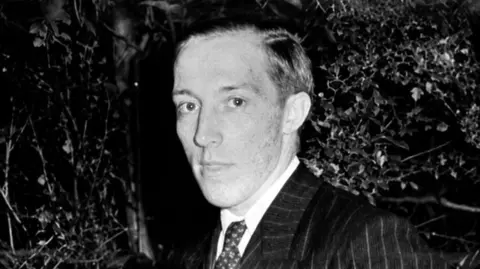 Steve Fielding
Herbert Leonard Mills stated "I am quite proud of my achievement" as he confessed to murdering housewife Mabel Tattershaw.
The 19-year-old had not made the admission to the police, rather News of the World reporter Norman Rae in the lobby of a hotel in Nottingham on 25 August 1951.
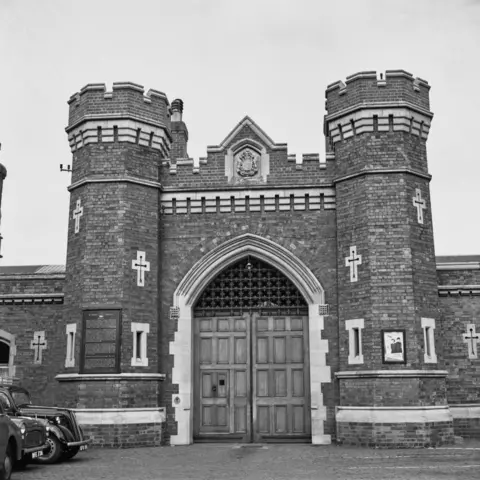
Rae promptly marched Mills to a police station. He was convicted of murder after a trial and was hanged at Lincoln Prison just months after the killing.
It had once been ranked alongside infamous British crimes such as the Jigsaw and Brighton Trunk murders, but today the Mills case has been largely forgotten.
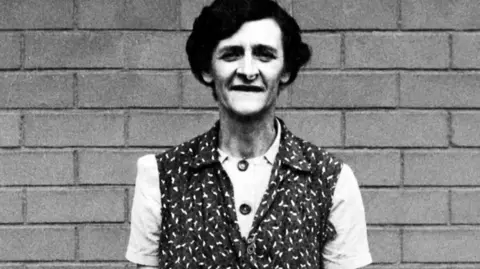 Steve Fielding
Mabel had been initially reported missing by one of her two teenage daughters, but little effort appeared to have been made to trace her.
The 48-year-old, from the Daybrook area of Nottingham, vanished after saying she was going on a routine visit to her brother on 3 August 1951.
However, she had apparently taken unusual care with her appearance, including putting on make-up.
Despite the unsolved murder of another woman, Florence Weatherall, just months earlier, Tattershaw's disappearance made no headlines.
That changed on 9 August.

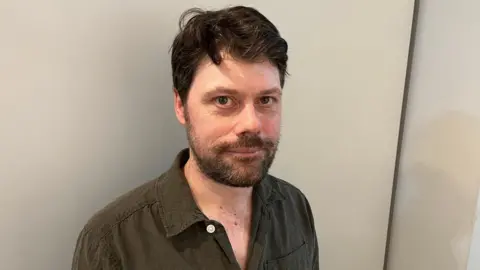
Stephen Dennis, head interpreter at the National Justice Museum in Nottingham, said: "No one discovered the body so Mills decided to 'discover' it himself.
"But instead of ringing the police, he actually rang the News of the World and talked to the reporters.
"And he talked a lot, so much so he gave away a lot of details about the crime.
"And of course the reporters thought this was suspicious, along with the fact he hadn't called police."
The victim, quickly identified as Tattershaw, had been left in a bush-covered ditch in an old orchard called The Jungle, in the Sherwood area, next to the present day Woodthorpe Park area.
Steve Fielding, crime historian and host of The Hangman's Record YouTube channel, said: "It was a national news story and made the front pages of the morning papers, like The Express and The Mirror.
"It's not surprising because it involved the News of the World and Norman Rae, who was the biggest crime reporter of the day.
"For him to be involved, it would always make headlines, but other aspects made it quite sensational."
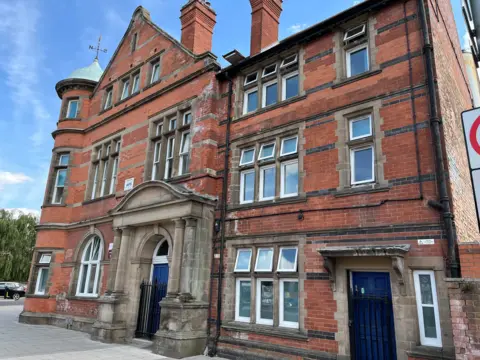
Mills was arrested and questioned at Leenside Police Station in Canal Street, Nottingham, but with no obvious link to the victim, he was allowed to go.
With Rae on the case though, and Mills enjoying the spotlight, there was no question of the story ending there.
Fielding said police suspected Mills from the start, adding "his story never rang true".
He described Mills as a "fantasist" and said: "I think Norman Rae also suspected him from the off.
"It was just a case of, 'If he talks long enough, he'll say something that incriminates him'."
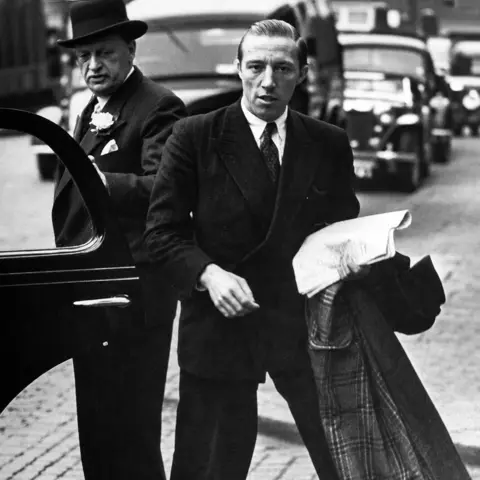 Steve Fielding
Rae travelled to Nottingham and met Mills on 24 August at the Black Boy Hotel, which once stood on Long Row in the city centre, promising £80 for the story.
Fielding said: "He gets him to write statement after statement, probably told him, 'If you let me tell your story, I'll tell it the right way'.
"And that would have fed Mills' need for credit and attention and, incredible as it seems, he ended up boasting about what he had done, despite the consequences."
Over a series of interviews, Mills revealed more and more about himself and the crime.
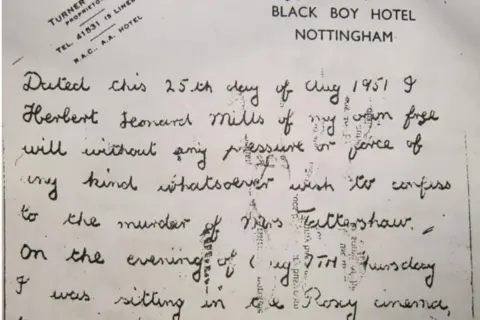
Eventually, late on 25 August, the full story came out in a carefully written document on the hotel's headed notepaper.
 Steve Fielding
Part of the statement read: "I had always considered the possibility of the perfect crime of murder. I am very much interested in crime.
"Here was my opportunity. I have been most successful, no motive, no clues.
"Why, if I had not reported finding the body, I should not have been connected in any way whatsoever.
"I am quite proud of my achievement."
In his handwritten statement, Mills described talking to Tattershaw at a cinema before taking her to The Jungle, where he pinned her to the ground with a coat and strangled her.
Dennis, from the National Justice Museum, said: "It was almost at random.
"He was only 19, she was 30 years older and after they got talking at a cinema she was likely quite flattered by the attention.
"But the attention was only so he could find a victim, one which had no previous background with him."
After reading Mills' confession, Rae let him go to bed at the hotel and, the next morning, walked him to the police station where the statement was handed over.
Mills was charged with murder on 26 August 1951.
Dennis said: "He was strangely delusional. What was he trying to prove? That he was some sort of criminal mastermind?
"He clearly was nothing of the sort. He hid the body but when no one found it, instead of keeping quiet, he did the opposite."
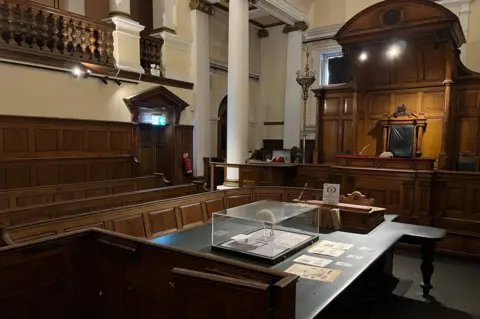
Mills' trial started in Nottingham on 19 November and lasted just four days.
The prosecution described Tattershaw as "a woman of small significance, unattractive in appearance and very poor... there could be no reason for destroying such an inoffensive person".
The defence called Mills a "desperately lonely, hateful boy, whose character was a mixture of cruelty and boastfulness".
Despite all he had done, Mills pleaded not guilty, claiming the confession had been a ruse to make his story more valuable.
However, hair and fibres from the victim's body were linked to Mills, and any suggestion of insanity was dismissed under the strict criteria then in force.
The jury took 25 minutes to find him guilty.
Mills did not appeal and was hanged at Lincoln Prison on 11 December.
 Getty Images
Reflecting on what Fielding described as a "quite unique" case, he said: "It's normally the journalist who approaches the suspect, not the other way round.
"I think he just got bored that his crime hasn't been reported.
"He was trying to do what he called the 'perfect murder' but the body has laid there for the best part of a week and he got impatient.
"So he pretended to discover his own murder and so set off this chain of events."
Dennis said: "Mills was the last man to be sentenced to death in our courtroom.
"We discuss many crimes and murders here but they are usually Georgian and Victorian.
"When we mention the Mills case, and that it was in 1951, people are taken by surprise, they say, 'Goodness, that's quite recent'.
"It's just about in living memory, that someone can go from crime to confession to hanging in just four months.
"It's a very odd case, the motives are strange, but ultimately, it's a horrible murder."
Listen to BBC Radio Nottingham on Sounds and follow BBC Nottingham on Facebook, on X, or on Instagram. Send your story ideas to eastmidsnews@bbc.co.uk or via WhatsApp on 0808 100 2210.