How to watch the partial lunar eclipse from Northern Ireland

 EPA
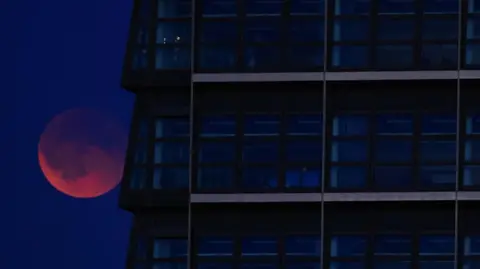
EPAStargazers have the chance to see a stunning partial lunar eclipse early on Friday morning, as the moon enters Earth's shadow.
At its peak, roughly 93% of the Moon's diameter will be covered, making the event look close to a total eclipse.
For people in Northern Ireland hoping to catch a glimpse, the biggest challenge will be the early start, possible cloud cover, and the Moon's low position in the western sky.
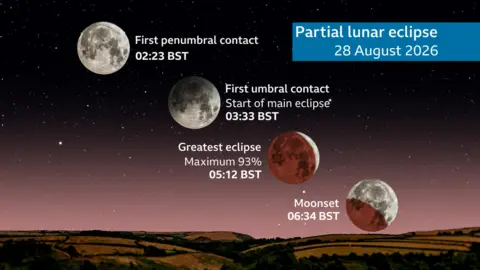
More than 90% of the Moon will be eclipsed shortly after 5am.
What time is the lunar eclipse?
The first phase of the eclipse begins at 02:23 BST when the Moon enters the lighter outer part of Earth's shadow, known as the penumbra.
The much more obvious stage starts at 03:33, as Earth's darker central shadow begins moving across the lunar surface, with maximum eclipse occurring at 05:12.
In Belfast, the Moon will be will be low in the western sky at about nine degrees with the eclipse ending at 06:34. In Dublin, it will be slightly higher in the sky and last until 06:38.
Further west, viewers may have slightly longer before the moon disappears. In Enniskillen, moonset is 06:41.
This means that visibility will not only depend on cloud cover, but also having an unobstructed view towards the west.
What is a lunar eclipse?
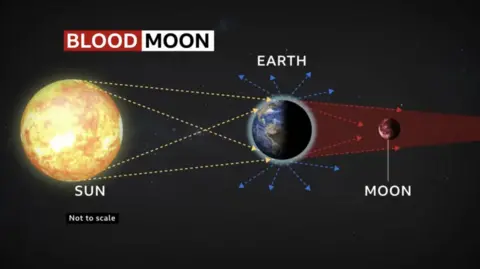
A lunar eclipse happens when the Sun, Earth, and Moon become aligned, allowing the Moon to pass through Earth's shadow.
During a partial eclipse, only part of the Moon enters the darkest section of that shadow, known as the umbra.
The moon is not completely cut off from sunlight, however.
Why could the Moon turn red?
Although Earth's shadow blocks direct sunlight from reaching most of the Moon, some still passes through Earth's atmosphere.
Shorter blue wavelengths scattering more easily, while more of the longer wavelength red light reaches the moon.
"That'll be enough for it to turn a reddish colour," according to Terry Moseley from the Irish Astronomical Association.
"This is sometimes called a blood moon - which is a nice dramatic name - but it's not always the colour of blood.
"It can turn anything from orange to a deep red, but the part near the centre of the eclipse will be the most spectacular."
How to watch the the 2026 partial lunar eclipse
As the moon will be low on the western horizon, viewers will need a clear view towards the west as buildings, hills and trees could block the view as the Moon gets lower toward dawn.
Unlike a solar eclipse, no protective glasses are needed to watch a lunar eclipse - it is safe to look directly at the moon.
No equipment such as binoculars or telescopes are necessary, although they could make viewing the changing colours of the Moon's surface easier to see.
Clear sky will be crucial and the current forecast suggests that western areas will more favoured, with cloudier skies for central and eastern parts.