How painless blood tests changed teenager's life

 BBC
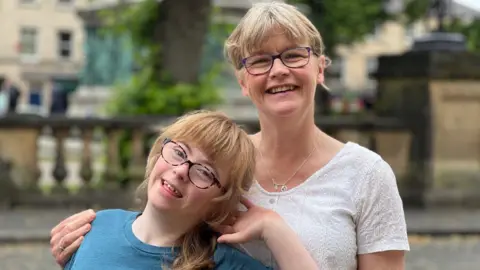
BBCA mum whose daughter needs regular blood tests has said replacing needles with a new painless device has made a "huge difference" to a usually frightening and traumatic experience.
Heather said the tests had been "horrible" for her 16-year-old daughter Abi, who has Down's syndrome and autism, until the pilot of the Touch Activated Phlebotomy (TAP) device, which uses a vacuum to remove blood.
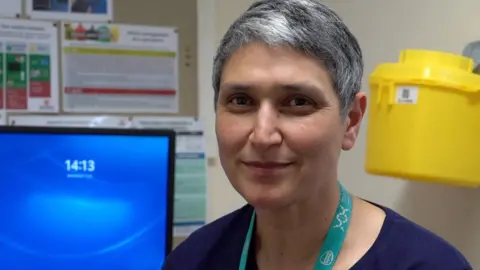
The method was stumbled across by Dr Karen Perkins at Morecambe Bay Hospital NHS Trust, which has pioneered use of the technology with patients with learning disabilities.
Dr Perkins said the "promising" devices could be rolled out nationally after attracting attention from charities and NHS England.
Until quite recently, blood tests for 16-year-old Abi meant trauma for everyone involved.
"Abi would be quite distressed," Heather said.
"She would typically curl up into a ball and would get herself on to the floor so that she physically couldn't be got.
"She'd be crying out and it was horrible."
She said Abi needed blood checks every three to six months to monitor her hypothyroidism, which can lead to serious heart and other health problems if not properly treated.
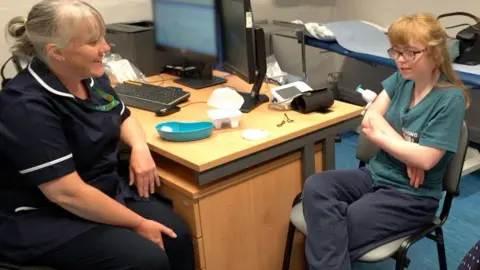
Heather said preparing for blood tests had required an elaborate and time-consuming programme of monthly visits to the hospital clinic, where Abi was prepared for the test but not given one, and nightly sessions where she would practice on her doll, Dora.
But even after all that, Abi found the tests terrifying.
"I'm a bit needle-phobic," she said.
"I was a bit frightened and sad."
Heather said the visits became so bad she had to take someone to the hospital to support her because she was "in such a state" when she came out.
Abi's reaction is not uncommon among patients with learning disabilities, who often struggle to understand why a needle is being stuck into their arm.
"Trying to get a venous blood sample from somebody who really doesn't want to do it is really hard work," practice nurse Lizzie Holmes said.
"A lot of people have lived through a lot of trauma with blood tests and going to the hospital, they've been investigated for lots of thing over the years.
"It's stressful for everybody.
"Stressful for me, stressful for the carer and most of all for the patient."
Patients with learning disabilities can often have related health conditions which mean those blood tests are essential, so research into alternatives began.
"I just got looking on the internet one day and came across transdermal sampling capillary devices," Dr Perkins said.
"We thought 'that looks like a good idea' – so gave it a go."
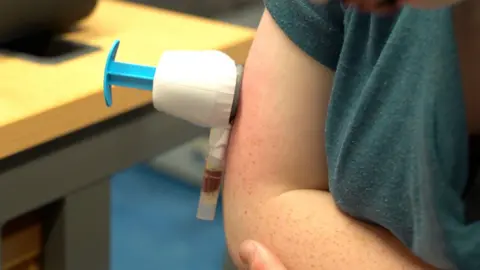
The devices, of which TAP is one, use a vacuum to extract blood from the capillaries just under the surface of the upper arm with a series of microneedles too small to cause pain.
They have been used in the USA for years but largely as a means for general patients in rural areas to gather their own blood samples.
The idea to apply the technology to learning disabled patients was pioneered in the NHS by the Morecambe Bay Trust.
As the trust's principal clinical scientist, Dr Perkins is responsible for analysing the samples.
Before launching the pilot, the team had to research whether capillary blood would give the same results as blood from veins and alter equipment to cope with a smaller blood sample size.
But the results have been life-changing for many.
The Lancaster Medical Practice, where Lizzie Holmes works, was one of the surgeries which took part in the pilot. It is also where Abi and Heather now make their regular trips.
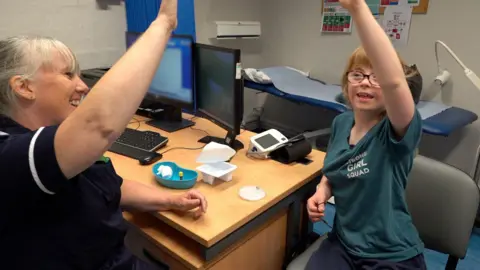
On a recent visit, Abi sat with a warm gel pad on her arm chatting to Lizzie.
The warmth of the pad makes the blood rise to the surface, enabling the TAP device to work.
Lizzie placed the TAP on Abi's arm and asked her: "Shall we push the plunger [which activates the vacuum] together?"
Abi looked slightly nervous but placed her hand on top of Lizzie's.
"One two three – done," said Lizzie and clicked the small plunger down, adding: "Well done Abi.'
Within seconds, blood trickled down into the collection tube.
"How was that Abi?" Heather asked.
"Good," Abi replied, observing her arm. Ten minutes later, it was all over.
The pilot scheme has already won a number of awards and attracted national attention after a post from the trust on Facebook sparked huge interest.
"There are lots of people coming forward from clinical laboratories, from learning disability nursing staff, from community healthcare staff, from general practitioners, paediatricians all over the country and more importantly some national charities who are really keen to help support it to go national as well," Dr Perkins said.
"We've got a lot of work to do but it's looking promising."
Heather said the device has transformed visits and made a "huge difference".
And importantly, Abi agreed.
"TAP bloods is fun," she said.
"That's Abi's strapline now, isn't it?" her mum added.
And that's a positive outcome for nurse Lizzie.
"TAP bloods has really changed how we do bloods in general practice with our patients," she said.
"The number of people who've gone out with a smile on their face rather than in tears, it's just changed everything for us."
Listen to the best of BBC Radio Lancashire on Sounds and follow BBC Lancashire on Facebook, X and Instagram. You can also send story ideas via Whatsapp to 0808 100 2230.