'I'm going to have fun either way' - Canadian fans navigate split loyalties in World Cup

 Reuters
Nikola Vukelic is torn on who to cheer for in Canada's first Fifa World Cup game against Bosnia.
The Toronto resident has been a football fan for most of his life, supporting local clubs in his home country of Bosnia and Herzegovina. Witnessing the Bosnian national team defeat fan-favourite Italy to qualify for this year's World Cup was "surreal", he said.
But Vukelic has also called Canada home since 1999.
So, Vukelic's strategy is to mix his Team Bosnia jersey with Team Canada shorts on Friday to watch the match at home with friends near Toronto's BMO stadium, where Canada's opening game is set to take place.
The game's victor does not matter much to him. "I'm going to have fun either way," he said.
Many Canadians, like Vukelic, are used to navigating dual identities. More than 35% of the population - or 13 million people - identify as having multiple ethnic or cultural origins, according to the last census.
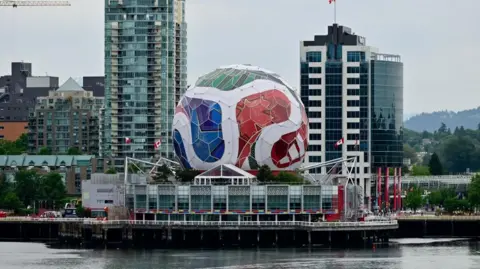
That multiculturalism has been on full display on the streets of host cities Toronto and Vancouver in the lead up to the World Cup, where watch parties are being held in an Australian bar by Turkish fans, in the parking lot of a Balkan specialty food store, and at an Iraqi-owned hookah lounge – to name a few.
It has also been a selling point for Canadian football officials ahead of the North American tournament, which in the lead up has been complicated by US visa policies, travel bans and politics.
In his opening remarks at this year's Fifa World Congress in Vancouver, Canada Soccer President Peter Augruso said the country's diversity stands out "in a world that can feel divided".
"Here, the world doesn't just visit," he said. "The world lives, works, learns, and thrives together."
 Supplied/Nikola Vukelic
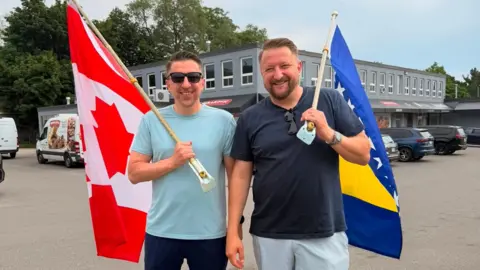
For Adis and Amir Mrakovic, the Bosnian-Canadian owners of Mrakovic Fine Foods in the Toronto suburb of Etobicoke, Canada's inaugural match against Bosnia is a "perfect storm", Adis said.
"And we're right in the middle of it," his brother Amir added.
The pair first came to Canada in 1994. Their father started the family business soon after, selling smoked meat products. Over the coming years, the store grew in size and began serving foods to the wider Balkan diaspora – they're particularly known for their grilled ćevapi kebabs – and has now become "a staple in the community", Adis said.
The Mrakovic brothers watched Bosnia's road to the World Cup with excitement, but not too many expectations. The national team had not qualified for the tournament since 2014 and was facing fierce competitors like Austria and Italy.
"It was a shock for everybody," Amir said, when Bosnia defeated Italy in penalties at the fateful 31 March qualifying game, where the winner was set to face Canada in the first group round of the World Cup.
 Supplied/Adis Mrakovic
The brothers quickly decided to host a large watch party for the coming Canada-Bosnia match outside their Etobicoke store, complete with a 26-foot screen, a DJ and of course, grilled ćevapi. They are expecting hundreds of attendees, some travelling from as far as Montreal.
The event is not meant to just celebrate Bosnia, they said, but also their Canadian identity. "We felt an obligation to bring people together," said Adis.
His brother, Amir, added that the best case scenario for the game is a tie.
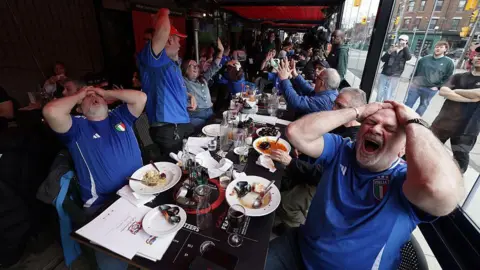
Across the city in Toronto's Little Italy, the Azzuri's loss was met with stunning disappointment, as many in the city's Italian diaspora were looking forward to watch their ancestral home take on their adopted home.
A week after Italy's loss, dozens lined up to swap their Team Italy kits with Team Canada ones at Cafe Diplomatico, an Italian restaurant that has doubled as a gathering place for Canadian football fans for decades, as part of a promotional campaign by Canada Soccer.
When fans arrived to the front of the line, organisers told them that they did not have to give up their Italian jerseys after all, but could hold on to both - a revelation met with tears by some, Canada Soccer's spokesperson Paulo Senra told the Canadian Press at the time.
"It's very rare to be in a country like ours where you're allowed to have multiple homes in your hearts," Senra said.
 Getty Images
Excitement is also brewing across the country in Vancouver, home to several match-ups including Australia versus Turkey, New Zealand versus Egypt and Switzerland versus Canada.
While Australia and Turkey may be geographically far apart, both country's fans will be gathered at the same Vancouver bar on Sunday for a watch party hosted by a local Turkish band.
Ilyas Kayran, a member of Istanbul the Band, told the BBC that rivals cheering side-by-side is a normal sight in the western Canadian city. "This is Canadian identity," he said.
Even Canada's own national team is a reflection of the country's diversity. Their captain and star player, Alphonso Davies, was born in a refugee camp in Ghana before his family emigrated and settled in Edmonton, Alberta, where he launched his playing career.
It's the third time the country has qualified for the tournament - this time as a co-host - and first on home soil.
They face long odds but the squad hopes to be the first Canadian team to reach the tournament's knockout round.
Among the three host nations, Canada arguably has the smallest role hosting the global tournament of the world's most popular sport. While Mexico has three cities participating, Canada only has two. Both are hosting 13 matches each compared to the sprawling 78 taking place in the US.
The price-tag for Canada, however, is still steep. The Parliamentary Budget Officer, an independent parliamentary watchdog, estimated the cost to taxpayers to be just over C$1bn ($720m; £540m) – or C$82m a game.
Like other host cities, the cheapest tickets to attend Canadian games cost several hundred dollars, prompting criticism from fans who feel priced out from enjoying the tournament in-person in cities where the cost of living is already high.
Hundreds of tickets remain unsold in both Vancouver and Toronto, and hotel and Airbnb demand in both cities is also lower than what was anticipated.
But federal and provincial Canadian officials have embraced their hosting duties. Adam van Koeverden, Canada's FIFA Sherpa and secretary of state for sport, called it a "once-in-a-generation opportunity".
As have fans like Vukelic, who admitted that the Bosnia versus Canada game he is highly anticipating is too costly to attend in person. That hasn't stopped him from soaking up the World Cup spirit and the "buzz" it will bring.
"The only thing we have to be careful about is the traffic here," he said half-heartedly. "Other than that, Toronto is ready for this."