More than 40 schools affected by heatwave

 Getty Images
More than 40 schools in Shropshire are closing or partially closing due to the heatwave.
Parts of the county are expected to see temperatures reach 31C on Wednesday and 34C on Thursday.
The UK Health Security Agency (UKHSA) has issued a red weather warning for the whole of the West Midlands, with an amber Met Office warning covering the county until the end of Thursday.
On Wednesday, 15 schools in the Telford and Shropshire local authority areas were affected, but more announced plans to close or partially close on Thursday, with some sending children home early.
Holy Trinity Academy in Telford said it would close and move to online learning on Wednesday and Thursday, while Meole Brace Secondary School, in Shrewsbury, said it would do so on Friday.
Holy Trinity said all pupils were expected to log on at 08:25 BST and follow their usual timetable.
The hottest temperatures are expected in the afternoon, and Church Stretton School said it would close at 13:00 on 24 and 25 June.
A number of other schools have announced similar measures, including Mary Webb School, in Pontesbury, and four education support units.
Eight primary schools in the Shropshire Council area have also said they will close early, while others have given parents the option of collecting their children from 13:00.
Meadows Primary School, in Oswestry said it did not have air conditioning and as a result would close completely on 25 June due to the extreme heat conditions.
In Telford, a number of schools have said they will close early, at 13:00, while Langley School said it was asking Year 8 and Year 9 pupils to remain at home if possible on Wednesday and Thursday.
Health alert
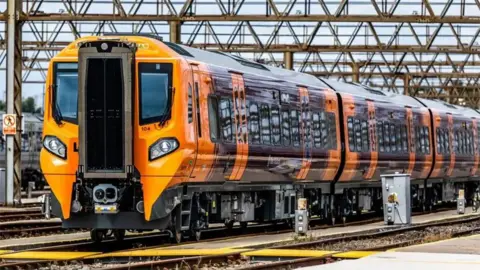
Transport is also affected, with West Midlands Railway advising essential travel only on Wednesday and Thursday, and it is running a reduced service across its network until Friday.
The UKHSA said it was only the second time it had issued a red heat-health alert.
It said it indicated the heatwave could have an impact beyond health and social care, and potentially affect transport systems, food, water, energy supplies and businesses, and that there was a risk to life for even the healthy population.
West Midlands science, environment and rural affairs correspondent David Gregory-Kumar said when he started in his role he felt heatwaves like the current one were expected with climate change, but it was not possible to say for sure they were caused by it.
He said that 25 years later "the science is very different" and not only "can we say climate change is making this heatwave worse, scientists can say by how much".
He said scientists for Climameter, a consortium of researchers that puts weather events in a climate change context, said climate change was making "the current weather patterns" 2C to 4C warmer than "we typically saw for the last half of the 20th Century".
Follow BBC Shropshire on BBC Sounds, Facebook, X and Instagram.