Donaldson trial 'struck blow' against culture that 'didn't hear women'

 BBC
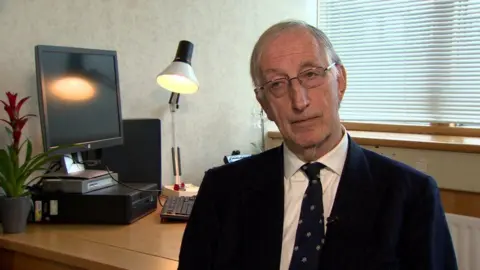
BBCThe handling of the child sex abuse trial of Jeffrey Donaldson has shown that changes to the way such criminal cases are dealt with have been "monumental", according to a retired judge.
Sir John Gillen conducted a major review into how sexual offences are handled in Northern Ireland and made 250 recommendations in 2019.
On Monday, Donaldson, the former Democratic Unionist Party leader, was convicted of 18 counts of sex abuse, including one count of rape, against two women when they were children.
Gillen said the trial has "struck a blow" against a culture in Northern Ireland which "hasn't properly heard women and girls and children in the past".
He said "there's much to be done," but that the outcome of the trial has "spoken to women and victims".
One of the main recommendations in Gillen's review was for the use of video-recorded interviews between the police and complainant.
He said this was an example of things "changing radically" with remote evidence centres being a "move towards privacy and dignity".
Gillen thinks "the changes that have been made will now make it a lot easier for victims to come forward."
Another recommendation suggested that measures be brought in to combat rape myths and stereotypes.
He described myths as "impediments to justice in the past".
Gillen said: "Anyone who has witnessed these trials will see now the sea change that has happened in the way that rape myths are dealt with."
Speaking on Good Morning Ulster, he said: "The judge conducted the trial in a way that protects the rights of the accused," but added: "There's a balance which has been established and I think this trial shows this."
He also said the accused has "rights as well" but a judge will not allow "cross examination to go on interminably".
In a statement, the Bar Council said there are "robust mechanisms" in a crown court trial through which our legal system ensures that only "appropriate questions" are asked of victims and witnesses.
They also said barristers and judges receive training on rape myths.
The statement added that the council understands that in the Donaldson trial these mechanisms "operated effectively to ensure a fair trial took place".
 PA Media
What were some of the recommendations?
- A call to exclude members of the public from the courtroom in serious sexual offence cases.
- Cross-examination of complainants to be pre-recorded and away from court.
- Video-recorded interviews with the police can be used to capture the testimony of complainants.
- New legislation to manage the dangers created by social media and have a more robust attitude by judges to prevent improper cross-examination about previous sexual history
- As of May 2026, 86% of Sir John's recommendations have been assessed as fully or partially completed.
In the Donaldson trial, the victims appeared by video link to give evidence and be cross-examined.
Why was there a review?
 Pacemaker Press
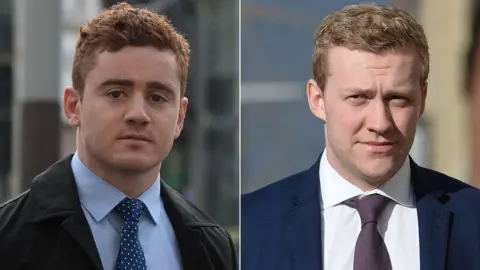
The review followed a wide-ranging public debate prompted by the trial of two Ulster Rugby players, Paddy Jackson and Stuart Olding, and two other men. Jackson and Olding were acquitted of rape in March 2018.
In 2018, Sir John said that social media "may force sex trial changes." He said that in a small place like Belfast if people post about a case on social media it can mean the "law becomes a farce" with photographs and the past history of the complainant, "completely untrue in most instances", being disseminated.
There was a change to the law in 2023 on who can attend sexual offence cases in the Crown court and means that access is restricted to people directly involved in the proceedings, and to "bona fide" journalists.