'Antisemitism felt relentless' - Jewish students on life at UK universities

 Oliver
Some Jewish students have said they feel antisemitism has become "normalised" at UK universities and they routinely hide signs of their identity for fear of abuse.
Students at more than 10 universities in England and Wales told the BBC they had faced hostility, and warned of a "culture of antisemitism" on campuses.
A report into the issue by the Union of Jewish students in March 2026 called for new enforceable standards for how universities investigate and punish hate crime.
Universities UK, which represents more than 140 higher education institutions, said universities were working to improve support, reporting and campus safety for Jewish students.
Cardiff University student Oliver, 21, said being Jewish had always been a central part of his identity.
He described his first week at the university in 2023 as "terrifying", because it had coincided with the 7 October attacks when Hamas militants attacked Israel, killing about 1,200 people and taking hundreds hostage.
Israel responded to the attack by launching a military campaign in Gaza, in which it is estimated more than 70,000 Palestinians have died.
 Aviva
AvivaLike many campuses across the UK, Cardiff University has seen pro-Palestine protests in recent years and Oliver said he believed some behaviour he witnessed crossed the line from criticism of Israel into antisemitism.
Holding Jewish people responsible for the actions of the Israeli government is a form of antisemitism, according to the International Holocaust Remembrance Alliance.
"That first year was absolutely terrifying," he said.
"You go home and think, 'do I carry on? Do I try to go to the next day?'"
Oliver said he stopped speaking Hebrew outside his home, and hid his Star of David pendant when on campus.
Over the following three years, Oliver said the antisemitic abuse he experienced at university became "relentless".
"I've been in clubs [or] just wandering around the uni and you hear these conversations and you see pamphlets being handed around where it's literally saying that your belief and your history is fake," he said.
"I've been at house parties where, when someone's found out I'm Jewish they started calling me Netanyahu behind my back.
"Like you found out my religion and you've decided I'm a bad person."
Oliver said when he had reported antisemitic incidents that had happened to him and others, he had felt they had been often "swept under the rug" by the university.
Although he said some positive action had been taken, he feels more needs to be done.
Cardiff University said it was sorry that "any student felt unsafe" on campus and that it adopts a "zero-tolerance approach to harassment and discrimination of all kinds".
It said there was no place for antisemitism or hatred at the university and they have "robust procedures" in place for investigating allegations of antisemitism. Where it is found, the university said appropriate action would be taken.
It said it had reached out to the university's Jewish Society and reminded students to report incidents to them.
'Hiding their identity'
Oliver is not alone in feeling this way.
There are about 9,000 Jewish students in the UK and reported antisemitic incidents on UK campuses rose by more than 400%, from 53 in the 2022-23 academic year, to 272 in 2023-24, according to the Community Security Trust, which monitors antisemitism in the UK.
Universities UK acknowledged antisemitism is a growing challenge.
Its chief executive, Vivienne Stern, said her organisation was committed to tackling campus antisemitism and was actively working with Jewish students to bring about change.
"I think that Jewish students should be able to wear signs that they are Jewish," she said.
"They should be able to wear their Star of David necklace or their kippah, and they should be able to celebrate Jewish life."
 Unknown
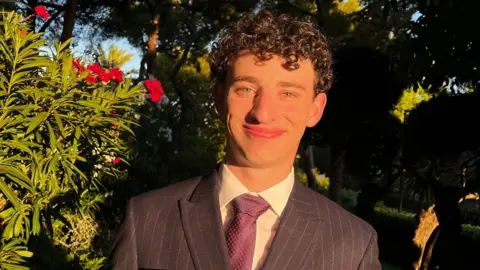
Daniel, the incoming Jewish Society vice-president at Manchester University, said Jewish students in the city had started "hiding their identity" after the 7 October attacks and later the Heaton Park attack in October 2025, when two Jewish people were killed after a car was driven into pedestrians outside a synagogue.
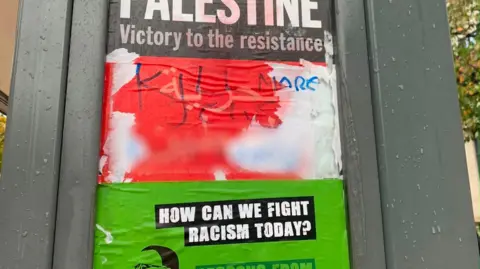
He said antisemitic slogans and swastikas had been daubed on walls and a swastika drawn on a fridge at a house party after partygoers had discovered the host was Jewish.
Daniel said he was aware a Jewish student wearing a kippah had also been warned by staff not to enter an academic building during protests for fear of their safety.
"To be Jewish at university is to have an identity that is inherently politicised by everyone around you," he said.
"That becomes very exhausting because it's a very difficult place to navigate."
A University of Manchester spokesperson said previous incidents of offensive graffiti on campus were removed promptly, with involvement from police.
They said the unversity took antisemitism "extremely seriously" and investigated it, and that the university has worked closely with civic and faith leaders to promote dialogue and understanding between communities.
They added: "We are working with Jewish students, staff and community representatives to strengthen our response to antisemitism.
"There is however more to do, and we are working with the Antisemitism Policy Trust and other universities to share learning, identify effective practice and strengthen our collective response to antisemitism."
 Daniel
The president of Swansea University's Jewish Society said she had to alert local counter-terrorism officers when organising routine activities for the society.
"I don't think anyone running, say, the Manga [Japanese comic books] Society has to consider whether there's a hate crime risk from having a stall," said Aviva.
"I'm a 20-year-old just going about university life. Getting calls from the police to tell me there isn't a terrorism risk isn't a normal experience."
Swansea University said it supports students through dedicated wellbeing, academic and faith services, and is maintaining a zero-tolerance approach to harassment and discrimination.
A recent survey of 1,000 students commissioned by the Union of Jewish Students, conducted by JL Partners between January and February 2026, said Jewish students were being "isolated by their peers" because of the Israel-Palestine conflict.
The poll suggested "apathy" towards antisemitism, with one in four (25%) students saying they did not care "very much" or "at all" if students are able to be open about their Jewish identity.
 Lloyd
LloydLloyd said he felt vulnerable for the first time after he had moved to Bangor University last year and witnessed students chanting "you're a Jew, Jew, Jew" at another student.
Lloyd said it was handled "really well" when he raised it with the society responsible.
But he said incidents like this could leave Jewish students feeling unsure about how and when to challenge antisemitic behaviour.
"I'm lucky. I'm a big guy, and I don't feel particularly scared for my physical safety," he said.
"[But] it's enough to make me very hesitant, most of the time, to say that I'm Jewish."
Bangor University said it had a zero-tolerance approach to harassment and discrimination, and any formal complaints would be thoroughly investigated.
Oliver has now graduated from university and said that, in his final year, he started wearing his Star of David again.
"I deserve to be here, I've earned my place, and I'm going to get the degree I've earned."