'Seeing fires destroying homes was like history repeating itself'

 Getty Images
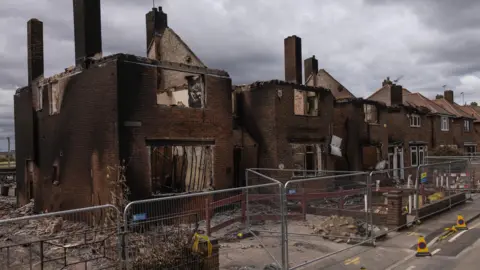
When the prime minister visited Stourbridge two weeks ago after the devastating wildfires destroyed 19 homes and damaged 18 others, he declared: "I've never seen scenes like this in Britain."
But in July 2022, in an almost identical set of circumstances to those in the West Midlands town, a blaze tore through 18 homes in the village of Wennington, in East London, during record-breaking temperatures.
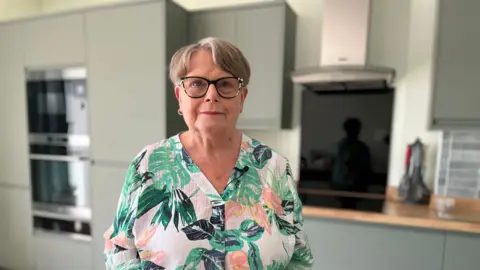
But in response to Andy Burnham's statement, Carole Hager, who lost her home of 58 years and all her belongings in that fire, said: "We feel forgotten."
The 82-year-old believes the government missed opportunities to act four years ago to protect communities from the increasing threat of wildfires in an era of climate change.
And the pensioner said she lived in fear of it happening again. "I've even packed a bag so I'm ready; that's how safe I feel. I don't feel safe."
She feels nothing has been done to reduce future risk in Wennington, which is surrounded by fields.
Burnham has pledged to look into the resources available to fire and rescue services, which could see the government commission firefighting planes in order to tackle future wildfires.
It took three years for the grandmother's semi-detached property to be rebuilt after it was destroyed in the wildfire.
She described it as "three years of uncertainty, trauma and tears".
After initially staying with family following the fire, Hager and her partner Ken rented a bungalow, the cost of which was covered by their home insurance.
But she said not all of her neighbours were so lucky, with some having to pay for temporary accommodation "out of their own pocket".
The process of rebuilding the house took time.
Planning permission took four months to come through; contractors had to be found. When work began, the house had to be demolished and the ground decontaminated.
In a further blow, Havering Council sent them a bill for £10,000 as part of a tax on new build homes, known as a Community Infrastructure Levy (CIL).
An exemption was later put in place as long as they lived in the property for three years, but Carol described the whole situation as "outrageous".
"Every day there was something to upset us, and I can't believe all the rigmarole we had to go through to actually get back in."
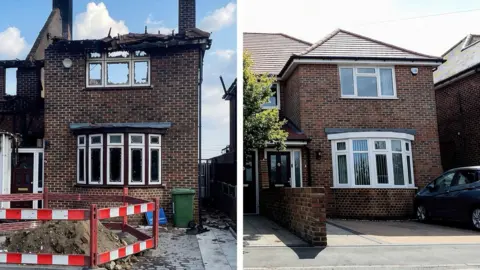
People in Wennington have expressed their shock at seeing history repeat itself after wildfires destroyed homes in Stourbridge on 13 August.
"I do know how they feel, and it's something that should never, ever have happened," said Hager, who has lived in her home since 1964 and brought up her two sons there.
"They've got to draw on their family and try and find the strength to get through because it's not going to be easy."
She believed that without the help of her partner, her sons and her faith, she would not have survived the last three years.
"A lot of people think it's like a death because you've lost everything; you're grieving your home," she said.
As well as the 19 homes recently lost in Stourbridge, about a dozen homes were destroyed in Birmingham, four in Stoke-on-Trent, three in Pershore, Worcestershire, and three in Willenhall, near Wolverhampton.
The Reverend Elise Peterson, from St Mary and St Peter's Church in Wennington, said seeing the devastation "felt like it was happening all over again".
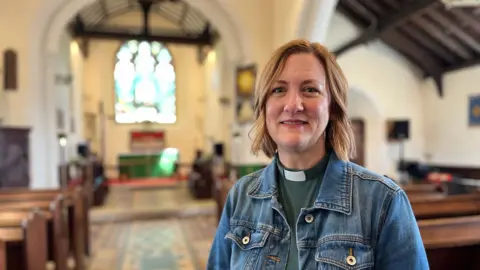
She said community had been trying to raise the alarm for the past four years.
"Residents of Wennington do feel a bit like what happened to us four years ago was ignored and lessons weren't learnt."
The vicar, who is originally from California, where wildfires are more common, said she would like to see firebreaks and cutting longer grass become more mainstream.
"The kind of things that I grew up learning that you always did but we wouldn't have thought about here before, we're not used to these kinds of fires popping up all the time."
Follow BBC Birmingham on BBC Sounds, Facebook, X and Instagram.