'I want to plant Sussex's first seaweed farm'

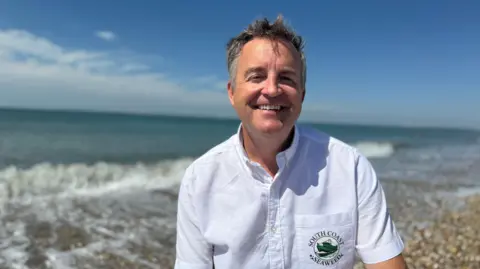 George Carden/BBC
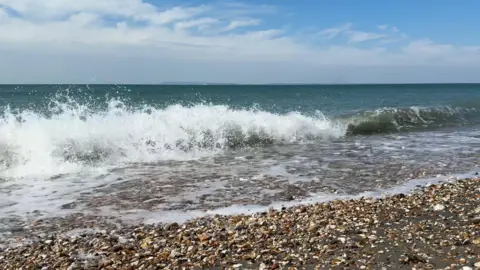
Most people come to Bracklesham Bay in West Sussex for a weekend by the seaside on its pebbly beach.
But for Andrew Payne-Cook, this is just a stone's throw from what he believes would be Sussex's first seaweed farm.
Five kilometres offshore, between Sussex and the Isle of Wight, the 48-year-old plans to plant a 25-hectare farm, equivalent to around 30 football pitches.
Payne-Cook will mainly grow sugar kelp two to four metres below the surface on long lines attached to buoys. He hopes to plant a trial farm by October, if his idea is approved.
'Massive future'
"I was watching Countryfile one night, I saw an article on seaweed farms. I live by the sea, [I thought] how hard can it be?", he said.
"My background was working in the fuel industry, I wanted to do something more sustainable and something to leave a legacy.
"Kelp farming has a massive future, it's a future billion dollar blue industry."
Seaweeds have been used in the UK for centuries as a food, feed, and fertiliser.
There are around 600 species of seaweed which can be found along the UK shore, with brown seaweed such as kelp and wracks, the most abundant type of seaweed.
Payne-Cook, who hopes to operate the business out of Portsmouth, said he would start with a 7.5 hectare (18.5 acre) trial farm and then move on to 25 hectares (62 acres) if it was successful.
 George Carden/BBC
He said once 25 hectares was planted, the farm would incorporate mussels and oysters too.
Payne-Cook added: "They will help by filtering the water, and the sugar kelp will capture nitrates, phosphates and carbon.
"The seaweed will go for fertiliser and can be food grade, as well as being used for pharmaceuticals. It all needs to be tested first."
There are already seaweed farms off the coast off North Devon, North Yorkshire and Scotland.
An application has been submitted to the Marine Management Organisation (MMO), which is the official regulator for England's seas.
A spokesperson said: "The MMO is continuing to work with the applicant regarding this marine licence application. Initial consultation with relevant organisations has been completed and the public consultation period has now closed.
"The application remains under consideration as part of the normal licensing process."
The Crown Estate owns the seabed out to 12 nautical miles and confirmed it is in early talks with Southcoast Seaweed.