'It's a bit odd at first': The robot helping with NHS health checks

 BBC
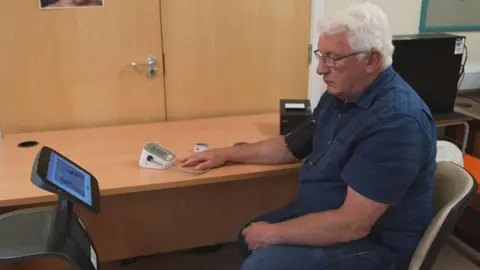
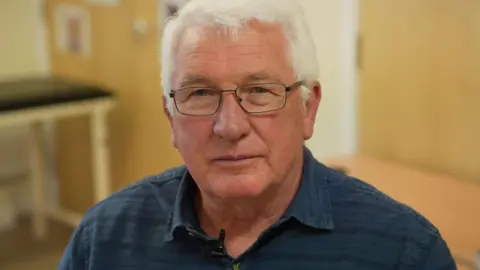
BBCGed Cashley suffered a cardiac arrest in 2018 and now has annual checks to monitor his health.
The 72-year-old's latest trip to the doctor was a little different to his previous ones.
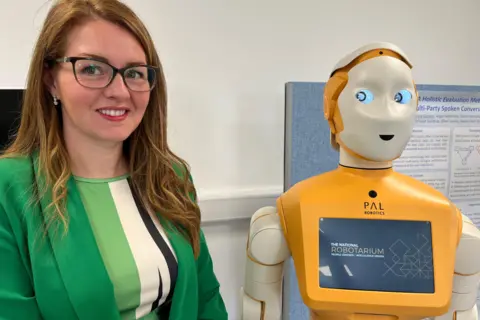
His GP practice in Dundee is trialling a 3ft-tall robot - called Teme - which glides across the waiting room and takes him through a series of checks before he sees the doctor.
"It's a bit odd at first, but you soon get used to it," says Ged.
“The first part of almost every patient consultation is spent collecting basic information.
"The little robot does that job - so by the time you sit down with your GP, they already have what they need and can spend their time actually talking to you.”
Ged's GP - Dr Gillian Chin - believes robots could play a key role in freeing up healthcare staff to see "more patients, more quickly".
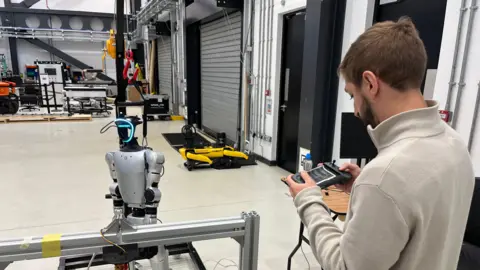
Her surgery took part in a two-day trial called HEART-POD, a collaboration with scientists at the National Robotarium at Heriot Watt University, who developed a prototype robot.
In total, 12 patients living with cardiovascular conditions took part.
For the trial, the robot carried out basic checks such as blood pressure monitoring, oxygen saturation as well as weight measurements.
The robot, which currently has an American accent, greets the patient in the waiting room and takes them to an examination room where it talks them through tasks such as how to unwrap the blood pressure cup, place their arm flat on the table and start the monitor.
Teme then speaks to the patients before printing out the results so they can be taken to the nurse or GP for further discussion.
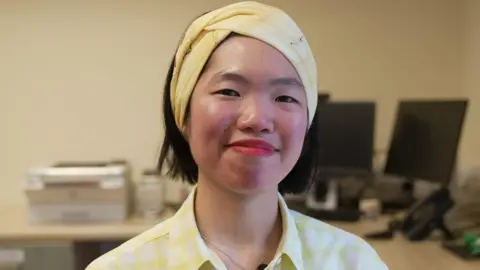
"It's undeniable that the NHS is under pressure," Dr Chin told BBC Scotland News.
"Demand on the system is increasing at a higher rate than the number of appointments and capacity that we're able to offer."
She said using the robot saved 50% of consultation time, allowing a doctor or nurse to either see more patients or go into greater detail with them.
According to Dr Chin, feedback was largely positive from staff and patients but it identified issues that would need to be addressed ahead of wider deployment.
Some patients in the trial expressed concerns about privacy, preferring not to talk to the robot in the waiting room.
The use of robots in the NHS is not an entirely new area.
Robotic assisted surgery has already been welcomed by surgeons who say it allows them to perform complex operations with faster recovery for patients.
Artificial intelligence (AI) tools have also been used successfully in some parts of the NHS, such as helping radiologists detect cancer.
However, the use of AI and robots has also prompted concern about diagnostic accuracy, patient confidentiality and workforce levels.
The Royal College of GPs Scotland believe robots performing simple tasks can have an important role in supporting doctors.
But its vice chair Dr Chris Williams said: "Technology should be seen as a tool to support healthcare professionals, not replace them.
"The human relationship between patients and clinicians cannot be replicated by technology alone."
Colin Poolman, executive director of the RCN in Scotland, said “Nursing staff welcome investment in solutions that support them to be more effective in their roles."
But he also said there had to be a balance.
"Technology is a support for nursing staff, not a substitute,” he said.
Those involved in developing robotic technology believe it could be moving at a faster pace and used more widely.
"We're seeing really quick developments in terms of humanoid robots that can help, perhaps, around the home, in our leisure and retail centres," said Lisa Farrell, business development lead for Healthcare Robotics at The National Robotarium.
"What we're not seeing at the moment is that uptake in our health services."
Farrell says healthcare robots are not designed to take jobs away from professionals but could be used to do some of the "dull, dirty or dangerous" tasks to free people up "to do what humans do best".
She said countries like the US and Japan are further ahead in the adoption of healthcare robots but says here in Scotland and the UK it needs "momentum and political will now".
'No national strategy' for robots
The National Robotarium is involved in several small scale pilots like the one in Dundee.
The centre also piloted healthcare robots in a hospital in Paris and is soon to carry out a test in a care home in Glasgow. Most are currently funded by private companies.
Professor of economics and project co-investigator Cristina Tealdi said the technology is improving at a fast pace and is adaptable to need.
What is missing, she said, is national investment and testing in real life situations to collect data on what offers best value to the NHS and patients.
"At the moment the implementation is very scattered and there is not a national strategy towards implementation of technology in healthcare," she said.
Health Secretary Angela Constance said innovation within the health and care system was central to plans for reform.
She said the government had already taken "significant measures" to use technology, including “supporting AI-powered physiotherapy services and a £1.8m investment in a national digital dermatology platform, now available to all GPs to cut waiting times and support earlier skin cancer diagnosis".