The Indian king who was not allowed to leave Britain

 Getty Images
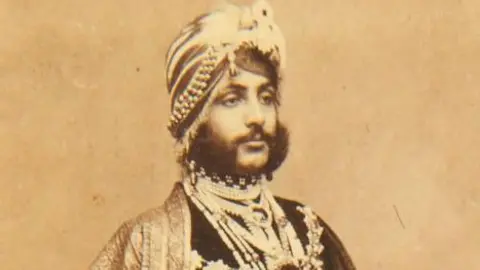
Duleep Singh (1838-1893) inherited the title of Sikh Maharaja at five years old, but after the annexation of the Sikh Empire by the British in 1849 he was exiled to Britain. The Maharaja tried to return to India but was always denied access.
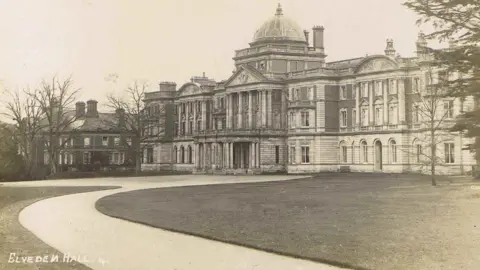
Eventually he bought Elveden Hall in Suffolk at 25 years old and settled down with his first wife Bamba Müller who was of German and Abyssinian descent.
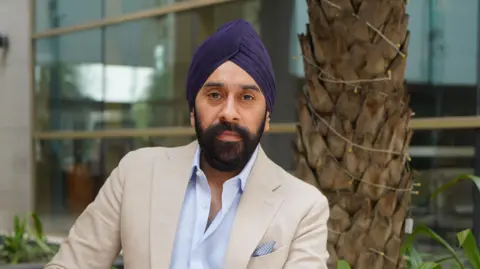
More than 100 years later, in 1996, Peter Bance, from Halstead in Essex, visited the home and was immediately intrigued by his life.
He went on to spend three decades collecting stories about the king and said it felt like he was researching his own roots.
 Peter Bance Collection
Singh's arrival in Britain in the 1850s demonstrated how far back Punjabi history went in this country, Bance said.
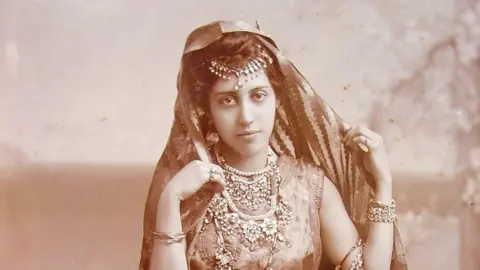
The couple had six children and Bance said his favourite princess was Catherine (1871-1942).
"Her story was largely untold," said the 52-year-old, speaking to the BBC as South Asian Heritage Month enters its final week.
"She saved all these Jewish families who were taken to concentration camps.
"She helped people not from her faith, not from her background, not from her heritage, they were total strangers to her. It was just pure humanity."
He continued: "I really wanted to know more about these children because I can relate to them as a child of immigrants myself.
"I grew up here [in England] and I was born here, so I wanted to know about these mixed race children because they were ethnically Punjabi - but they grew up here."
 Peter Bance Collection
In the 1990s, Bance placed adverts in local newspapers in Norfolk and Suffolk to see if anyone had more information about the princesses.
He said he got about 300 replies from people who knew them or worked for the family and a lot of people had been given gifts by the princesses.
Bance said he offered to buy the artefacts but a lot of people gave their treasured items for free, so they could be immortalised in his collection.
 Peter Bance Collection
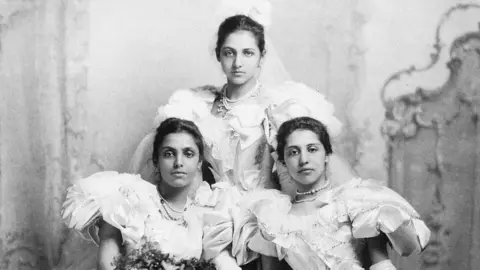
Calling the collection both his life's work and a hobby, he added: "I've got over 2,000 pieces belonging to the family and I've got to say, one of my favourite pieces is a beautiful photograph of three princesses at their debutante ball.
"It belonged to Princess Sophia Duleep Singh and she gave it to her goddaughter and it was Faraday House at Hampton Court (south-west London)."
 Peter Bance Collection
Bance said the youngest daughter Sophia played a pivotal part in fighting for women's rights throughout her life.
But he only found out that she was a suffragette after he spoke to one of her housekeeper's daughters.
His collection now consists of the Maharaja's jacket, the princesses' saris, toys, letters and paintings.
A lot of the artefacts are on display at Kensington Palace in west London until November as part of their exhibition called The Last Princesses of Punjab.
 Wimbledon BookFest
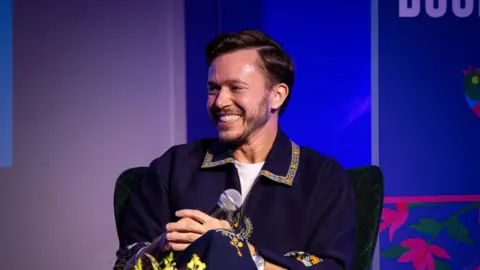
Jassa Ahluwalia worked as an adviser for the London-based exhibition with his own sister Ramanique.
The actor, activist and author, who has both Indian and English heritage, said he was able to draw parallels to his own experiences of mixed-heritage identity.
"These stories have impacted me and my sister and the similarities and difference in our experiences," he told the BBC.
"It [Elveden Hall] felt like a reflection of me, the external appears very English and the internal is very Indian."
 Family photo
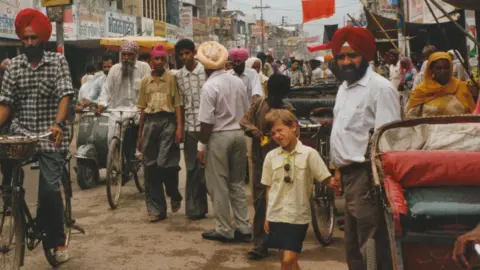
Ahluwalia continued: "We came to those stories as a way of figuring out who we were as mixed heritage Punjabis growing up in England in the 21st Century and realising that our story is not a uniquely modern story and that it has a history and we are part of an ongoing legacy of cross-pollination.
"It is a very living and alive history and it's the history of who we are as a nation.
"If you are not accurately telling the history of our nation then other people will do fictitious versions of it and that is not the story of who we are as a nation."
Do you have a story suggestion for Essex? Contact us below.
Follow Essex news on BBC Sounds, Facebook, Instagram and X.