Why are we being warned about toxic caterpillars?

 Harlow Council
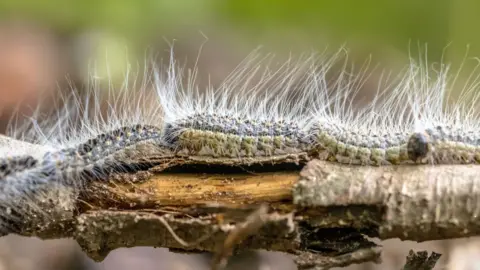
An increase in the number of invasive, toxic caterpillars being spotted in oak trees has prompted warnings from councils across parts of England.
In Harlow, Essex, the local authority says it has put up warning signs, cordoned off affected trees and contacted residents after two oak trees were found to have nests of oak processionary moth (OPM).
Earlier this month, the Forestry Commission warned the warm spring weather had led to an increase in the number of OPM nests and caterpillar reports.
So what do we need to know about these insects and how worried should we be about finding one?
What is an oak processionary moth caterpillar?
 PA Media
OPMs were accidentally introduced to England from mainland Europe on imported oak trees in 2006 and began to spread.
The caterpillars feed on oak leaves and are most commonly seen in late spring and early summer.
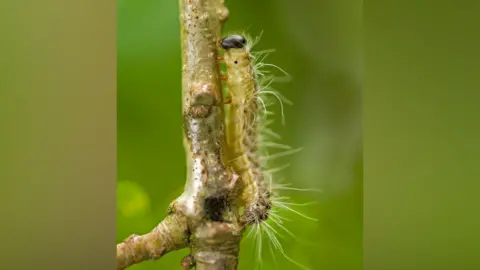
They are distinctive for the way they move in nose-to-tail processions - hence the name - and have a grey body, dark head and long, white hairs down the length of their bodies.
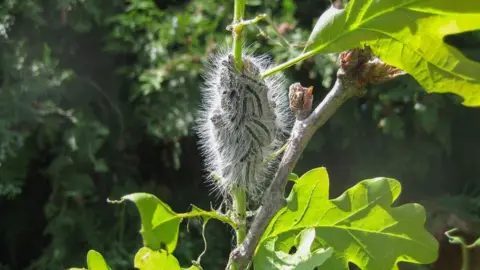
The white, silk-like nests they build in oak trees are also noteworthy as they can vary in size from as small as a 50p piece up to a melon.
The nests discolour over the summer, appearing dirty and brown by August.
The government leads a programme of surveys and controls to try to minimise the population, spread and impacts of OPM.
The Department for Environment, Food and Rural Affairs (Defra) said it was monitoring areas in Derbyshire and Dorset where OPMs have been spotted.
The Forestry Commission has also made a map of where OPM has been reported across Britain.
How dangerous are they?
 PA Media
According to Forest Research, OPM nests and caterpillars are a hazard to human and animal health.
The caterpillars have toxic, barbed hairs that can lead to itchy skin rashes, sore throats, breathing difficulties and eye irritation if touched or inhaled.
A report by Public Health England says there is particular concern about "the potential of the caterpillar setae to trigger anaphylaxis-like reactions".
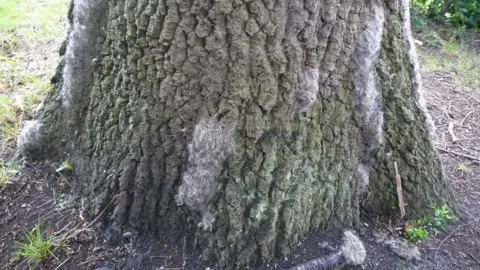
The insects can also shed their hairs when threatened or disturbed, and these hairs can then be blown by the wind before sticking to clothing, grass, branches and trunks.
The groups most vulnerable to OPM health hazards are:
- Children
- Pets
- People who work on or close to oak trees
- Anyone spending time close to infested trees
- Grazing and browsing livestock and wild animals
If you or someone else does come into contact with OPM and has skin or eye irritation, it is recommended that you visit a pharmacist or see a doctor/call 111 if it is a more serious allergic reaction.
What do I do if I see a nest or caterpillar?
 Bracknell Forest Council
The most important thing is to not touch or approach OPM nests or caterpillars. Do not let children or animals go near them either, and do not try to move them or their nests yourself.
It is worth trying to learn what OPM nests and caterpillars look like and teach children not to approach them.
Keeping horses and livestock away from infested oak trees is also important.
If you work in or near oak trees that are affected, you should wear full protective clothing.
If you think you have spotted an OPM nest or caterpillars anywhere in England, Wales or Scotland, you can report it to Forest Research via its TreeAlert service.
The reports are then assessed by scientists and forwarded to the plant health authorities for appropriate action.
They will need a photo too, but do not risk contact with the nest or caterpillars to take it.
Local councils such as Harlow have asked for sightings on council park land to be reported directly to the authority.
Do you have a story suggestion for Essex? Contact us below.
Follow Essex news on BBC Sounds, Facebook, Instagram and X.