Battery storage site given go-ahead after appeal

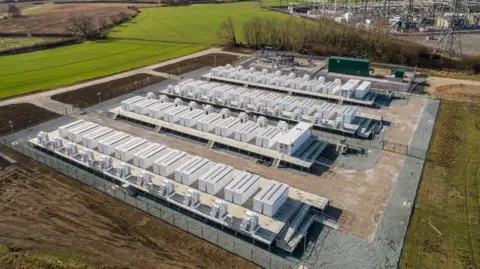 Harmony Energy
A decision to reject plans for a battery energy storage system (BESS) near a village in Wakefield has been overturned following an appeal.
The government's Planning Inspectorate has given the go-ahead for the facility, which releases the power it stores back to the National Grid when demand is high, to be installed at Heath following a public inquiry.
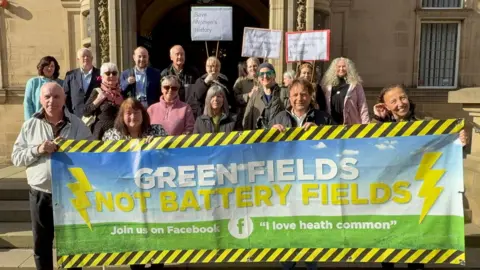
More than 2,000 residents, along with MPs and councillors, had objected to Harmony Energy's plan to install 72 containers for lithium ion batteries on nearby farmland.
However, the government's inspector ruled the need for the facility, which stores power from renewable energy sources, "far outweighs the low level of harm" to the village.
In July last year, members of Wakefield Council's planning and highways committee unanimously voted against its own officers' recommendation to approve the plan.
Harmony Energy then made an appeal to the Planning Inspectorate, saying the scheme would contribute to the government's green energy targets.
 LDRS
LDRSIn his decision published on Thursday, planning inspector John Braithwaite said: "Storage has a key role to play in achieving net zero and providing flexibility to the energy system."
"The world is in crisis: a climate crisis caused by carbon emissions. One of the remedies to the crisis is to reach net zero carbon emissions as soon as possible," he stated.
According the Local Democracy Reporting Service, Braithwaite added that if the climate crisis was "not successfully addressed, then the green belt might become no longer green and might have to be renamed the brown belt".
Jon Trickett, Labour MP for Normanton and Hemsworth, previously described the scheme as "environmental vandalism".
Following the ruling, he said he was "very annoyed" about the decision.
"I firmly believe that local people know what's best and am aghast at what has happened," Trickett said.
"I understand that a range of matters still may need to be resolved and I call on the new leadership of Wakefield Council to stand up for the local community."
 LDRS
LDRSDuring the inquiry, one of the main issues raised related to the impact on the green belt and on buildings close to the site.
The site lies within the setting of the Grade II listed Dame Mary Bolles Water Tower, which dates back to the 17th Century, and the Heath conservation area.
Harmony Energy claimed the site should be redefined as "grey belt", a concept introduced in 2024 aimed at freeing up some green belt areas for development.
Stephanie Hall, for Harmony, said the scheme would "assist the council and the UK in delivering meaningfully on climate and biodiversity agendas".
The council had failed to allocate any sites for renewable energy in its latest Local Plan, a document which outlines future development within the district, Hall said.
The heritage impacts would be reversible and temporary, and at a "lower level" than assessed by other parties, she added.
A spokesperson for the company said they were "pleased that the project can move forward following a thorough examination".
"We are committed to supporting a homegrown UK energy system that the nation can be proud of, and this decision is an essential step in reducing our reliance on foreign imports and exposure to global energy supply shocks," they said.
"Sites located next to existing substations play a vital role in strengthening energy security and reducing the nation's reliance on carbon-intensive resources and imported energy."
They added the company remained "committed to delivering significant heritage enhancements which are of clear importance to local residents and to the heritage of this part of Wakefield".
'Voices ignored'
Representing the council, Philip Robson had told the public inquiry that the authority "supported the principle of renewable and clean energy development", but the proposal "would physically alter the historic landscape".
"It would also harm the open, rural character of the fields in the west of the designated area through the introduction of modern infrastructure, as well as the expanding development of Wakefield city centre into the historic landscape itself," he said.
Local groups who also opposed the scheme included the Heath Residents' Association, Wakefield Civic Society, Wakefield and District Gypsy and Travellers' Association and The Forgotten Women of Wakefield.
A spokesperson for the I Love Heath Common campaign group, which was formed in opposition to the proposals shortly after they were submitted in 2022, said the result of the appeal was "a sad day for the thousands of people who have ever enjoyed the unique landscape of Heath".
"Over 2,000 people objected to this plan, including seven MPs from across the political spectrum and a host of heritage experts," they said.
"The people of Wakefield will not forget their voices were ignored."
Listen to highlights from West Yorkshire on BBC Sounds, catch up with the latest episode of Look North.