Should multibuy offers on unhealthy foods be banned?

 Getty Images
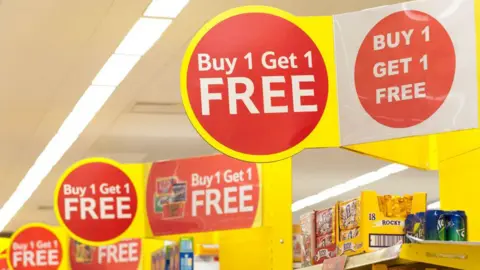
People are being asked for their views on proposals that could see the end of multibuy offers on certain food products which are deemed unhealthy.
The Department of Health (DoH) said obesity is one of the biggest public health challenges facing Northern Ireland, with 65% of adults living with obesity or excess weight.
To help tackle the issue, the DoH and Food Standards Agency (FSA) are proposing measures similar to those which already exist in England and Wales, and due to come into effect in Scotland in October.
They are also considering restricting where these products can be placed in a supermarket, including online stores, and restricting free refills of sugar-sweetened soft drinks.
The DoH and FSA launched the consultation on the issue on Monday.
According to the DoH, evidence shows that the promotion of food and drink high in fat, sugar and salt through price-based incentives, prominent placement and marketing tactics can significantly influence consumer purchasing behaviour, often at the expense of healthier options, which can contribute to obesity.
Obesity can lead to a higher risk of major health conditions, such as heart disease, stroke, type 2 diabetes and some cancers.
'The elephant in the room'
Some concerns have been raised, however, that these proposals may negatively impact low income families.
Dr Ciara Fitzpatrick, a law lecturer and anti-poverty campaigner, told BBC Radio Ulster's Evening Extra programme that there needed to be a "wider conversation" had about the "impact of the cost of living crisis and the fact that many low income families simply can't afford more healthy options".
"That is the elephant in the room," Fitzpatrick said.
She believes that a "different position of unhealthy food in the supermarket or a different pricing structure is not going to change that very stark reality for many families in Northern Ireland".
Without action being taken to make fresh fruit, vegetables and other healthy options more accessible to low income families, "we're not going to see a massive dent in those obesity figures that are on the rise", according to Fitzpatrick.
"I think we need to have a broader discussion about growing more local produce and making it more easily available to people here in Northern Ireland," she said.
Professor Susan Jebb, chair of the FSA, said the proposals were designed to help people eat more healthily.
"We've all had the experience of going shopping with a list and somehow when we come home we've bought a few extra things as well," Jebb told Evening Extra.
"And often those extra things are foods that are high in fat, in sugar and salt and they're just not good for us. They're leading to ill health."
Jebb said that with the policies in place in England, some businesses have "tried to get around the restrictions a little bit".
"So what we're also interested in is thinking how we can potentially introduce these policies in Northern Ireland in a way which makes them most effective," she said.
The DoH and FSA is interested in hearing from retailers, food businesses, manufacturers and local authorities, along with public health organisations, consumer advocacy bodies and the general public.
What are the restrictions in England?
Price or multibuy promotions on unhealthy food and drink, such as "buy one, get one free" deals were banned in England on 1 October 2025.
The restrictions apply to supermarkets, larger high street shops and online retailers.
The regulations also ban free refill promotions of certain drinks in restaurants and cafes.
The government introduced a classification system to define what food and drinks are classed as unhealthy, which is based on the products thought to have most influence on child obesity.
In terms of drinks it includes fizzy drinks such as lemonade and cola that contain sugar.
And for food it covers everything from crisps, sweets and chocolates to ice creams, pastries, cakes, and some fish fingers and pizzas.
On 5 January, a UK-wide ban came into effect stopping food and drinks high in fat, salt and sugar being advertised on TV before 21:00 and at any time online.