The man making globes for world leaders and Hollywood

 Tony Fisher/BBC
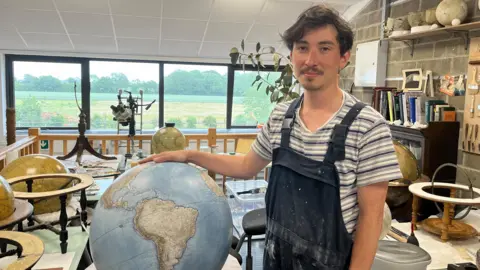
A globe maker who has made orbs for world leaders in North America and Hollywood actors has described his job as a "privilege".
Jonathan Wright, 38, has been making globes for 15 years, but said he could not name any of his famous clients.
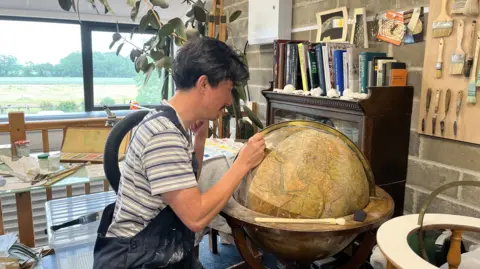
He carries out new commissions and also restores old and antique globes at Grandey's Place, near Bishop's Stortford, Hertfordshire.
He is among only six globe makers in the UK, according to Heritage Crafts, the advocacy body for traditional crafts.
 Tony Fisher/BBC
Wright said his craft became endangered "as it relied on so many different skills coming together to create this beautiful object".
He added: "To know that what I am doing now brings value to both older globes and also carries on the tradition through new globes... and that I am part of that important history is what makes it so rewarding."
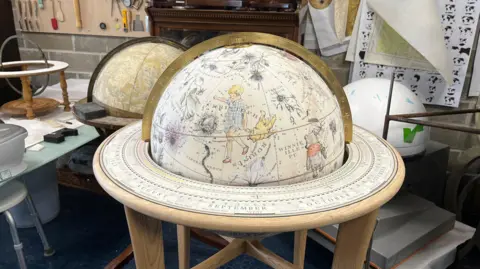
He is currently working on a pair of globes from the early 1800s by an English maker called Newton, who was a relative of Sir Isaac Newton.
Wright said they would have sat in a library and would have been used for learning about geography, astronomy, trigonometry and maths.
 Tony Fisher/BBC
Wright, who studied engineering design at university, said he "fell into it by accident" after he saw the job of a globe maker apprenticeship advertised.
This caught his imagination as "it was the mystery and the unknown... I could not work out how these objects which were so familiar had been made".
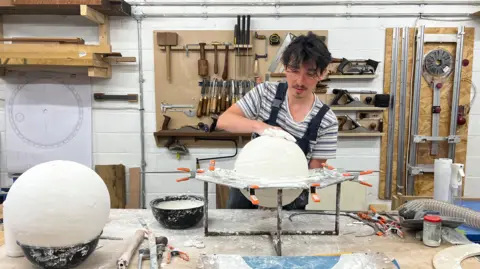
While "fundamentally, the process of making globes has not changed in 400 to 500 years", modern-day creations are the "most accurate that have ever been made" thanks to modern technology.
The profession also allowed him to think while he created and he added: "The world is so much ocean, and that is something you don't get to appreciate looking at an atlas," he added.
 Tony Fisher/BBC
Wright was awarded a Fellowship of the Royal Geographical Society in 2016 in recognition of his contributions to globe-making and has also appeared on the BBC's Repair Shop.
He specialises in "bespoke globes" for "individuals who are interested in exploring their own story through the cartography", but he also undertakes work for institutions and museums.
He is working on a globe from the 1700s, which is "quite special" and "found in someone's attic". However, he said it would take him years to restore, as "every little detail is so important".
"We think we know about most globes that are still surviving, but occasionally a rare one appears, and that is always very exciting," he added.
Do you have a story suggestion for Beds, Herts or Bucks? Contact us below.
Follow Beds, Herts and Bucks news on BBC Sounds, Facebook, Instagram and X.