Airport running costs 'jump from £5m to £10m'

 Cornwall Council
Taxpayers are paying almost £10m a year on airport running costs, a council meeting has heard.
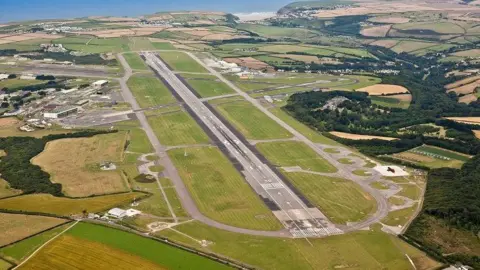
Cornwall Council, which owns Newquay Airport, met on Wednesday to discuss how the loss-making facility could be operated more efficiently. The Steer report included 71 recommendations for change.
Independent councillor Andrew Mitchell said: "We have overnight, it appears to me, required to jump from a £5m a year subsidy to £10m a year."
Paul Cooper, Corserv's director of resources, said a big increase was due to the employers' National Insurance uplift, which caused a £3.5m "hit" to Corserv, including the airport. The council agreed its corporate finance scrutiny committee should analyse the increase.
'Beggars belief'
Cornwall Council, Cornwall Airport Ltd, Corserv and Treveth are all involved in the airport's governance, operations and future plans.
Corserv will present an airport transformation plan to the council for consideration in December.
Mitchell said there had been two years where passenger figures had declined "month upon month".
"It appears to me that we have no credit control at Newquay airport. To allow Eastern Airways to go bankrupt owing us £1.6m beggars belief. It was three times what they owed Heathrow and here we are, a small regional airport," Mitchell said.
Tim Dwelly, cabinet member for economic regeneration, told the meeting: "We can be under no illusion that council taxpayers cannot be expected to find anything like £9m-£10m a year because most of them don't use the airport."

Cooper said factors for the increase, since 2020, included significant Foundation Living Wage increases for more than 50% of airport staff, an increase to the number of air traffic control staff and a pay issue for firefighters based at the airport.
Other factors included issues with the airport estate and problems involving Eastern Airways going into administration.
The current year will see a £9.7m deficit, which has been exacerbated by the council's decision to stop the subsidised Public Service Obligation (PSO) route from the airport to London Gatwick.
Cooper said the independent report did not highlight any areas where the airport was spending more money than it should.
He said Newquay, like all regional airports, had to find alternative commercial revenue streams to help with running costs.
"We are not making best value of the architecture and infrastructure around the airport," added Mr Cooper.
He said there would be a £5m "income stream" coming to Cornwall Airport Ltd from the council this year.
Dwelly said: "You can't expect a zero cost airport in somewhere like Cornwall, but you can't allow the costs to get out of control."
'Core pillars' for change
A Cornwall Airport Newquay spokesperson said its focus was to determine how best to use the report recommendations and ensure the airport could "fulfill its potential to Cornwall's connectivity and economy".
"The report recognises Cornwall Airport Newquay as one of Cornwall's most important strategic assets and gives us a clear picture of the changes needed to improve its commercial performance, strengthen governance and significantly reduce the cost to the taxpayer," the spokesperson said.
The Steer report highlighted four "core pillars" for change at the airport.
The first was consistent governance should be established to ensure "clear accountability, streamlined decision-making and robust oversight of performance".
Secondly, financial discipline should be strengthened to improve the airport's sustainability, including tighter cost control, improved contract management and more rigorous capital investment appraisal.
Third, organisational changes should be implemented to improve efficiency and enhance accountability across the executive team and wider organisation.
Finally, business opportunities should be pursued to strengthen revenue generation and maximise value from existing assets.
Follow BBC Cornwall on X, Facebook and Instagram. Send your story ideas to spotlight@bbc.co.uk.