How a mythical pigman became a local legend

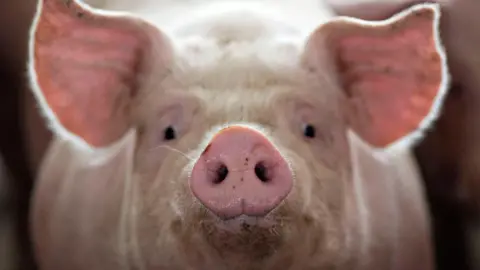 Reuters
Every community has its legend – but not many have a legend about a pigman.
Is there a half-man, half-pig hybrid wandering the land in Cannock Chase, Staffordshire, akin to the Minotaur of Greek mythology? That is a question some residents have been asking for decades.
According to historian and author Richard Pursehouse, the story first emerged in the 1960s amid rumours about human experiments during World War Two.
Since then, there have been multiple reports of sightings, he said, and most have occurred near the ancient hill fort of Castle Ring, with people claiming to have heard rustling noises and squeals.
The legend has conjured an image of a strong-looking humanoid figure with a pig's head, standing at about 7ft (2.1m) tall and not wearing much clothing.
Asked about the sightings as part of BBC Radio WM's Hidden Black Country series, Pursehouse said people would often report feeling terrified.
"They actually feel a sense of foreboding," he added, "as if something is happening that they don't quite understand – paranormal, if you like."
 Richard Pursehouse
According to the myth, a woman was kidnapped from a local pub during the war and her DNA was mixed with a pig's as part of experiments to create some kind of super soldier.
She would later, so the legend went, give birth to a half-pig, half-boy, Pursehouse said, but the hybrid escaped captivity and was claimed to be wandering Cannock Chase ever since.
The area has a strong military history, due in part to having two large training camps – one in Rugeley, one in Brocton – during World War One.
There were also German prisoner of war camps during both wars, as well as an Italian one near Etchinghill.
"What some believe to be far-fetched is impregnating a local woman with pig DNA. When you say that in the cold light of day, it sounds incredible," Pursehouse added.
But he also said there were reports of "a lot of weird stuff" going on during World War Two.

Dr Emma Newlands, senior lecturer in history at the University of Strathclyde, said there were experiments carried out in the war, mostly in secret.
She said the majority of this research happened at Porton Down in Wiltshire and would involve "offensive experiments" on servicemen, like testing different types of weaponry or chemical agents, while developing treatments and protection.
But asked about the likelihood of an experiment to create a super soldier by making a half-man, half-pig hybrid, she said: "I don't think so.
"I don't think they would have believed it could work. I can see why people in the area might develop those kind of stories.
"The military itself might have found it useful for that kind of narrative to be out there because it would keep people away, perhaps."
 Dr Ceri Houlbrook
With the existence of pigman being unlikely, to say the least, how has the myth managed to endure over the last 60 years?
Historian Dr Ceri Houlbrook, author of Folklore: A Journey Through The Past and Present, said: "People enjoy being thrilled.
"These kind of stories are macabre, they are thrilling, they are frightening. So we tell them, we listen to them and we go legend tripping in the hopes of encountering creatures like pigman."
She likened it to why we read or watch horror, adding: "There is something in human nature that likes to be scared and likes to be faced with a mystery to unpack."
Pigman "belongs" to Cannock Chase and he has become a core part of its identity, Houlbrook said.
"There is a certain pride there," she added. "Whether pigman is a malevolent or benevolent creature, there is definitely pride that this fantastical, eerie, unsettling story belongs to these people and this landscape."
Follow BBC Stoke & Staffordshire on BBC Sounds, Facebook, X and Instagram.